
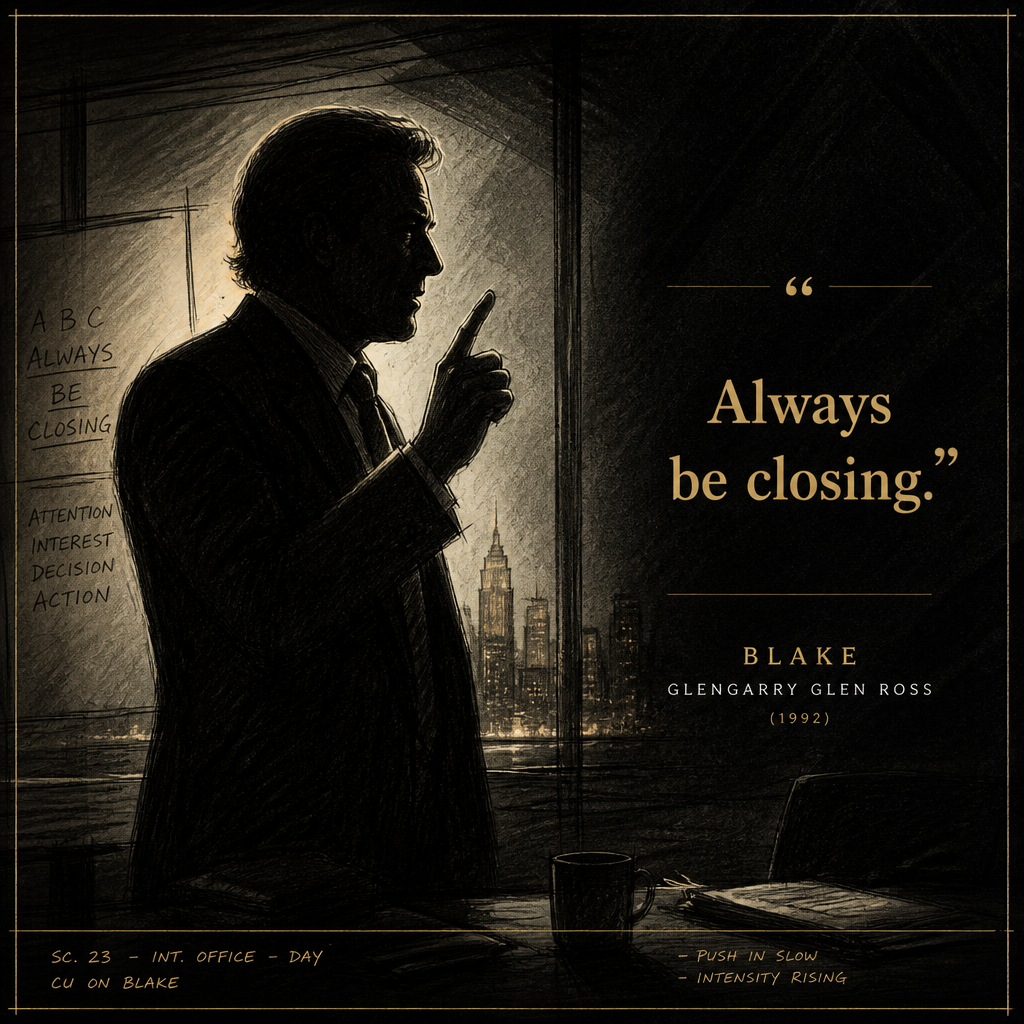
In the brutal sales terrain portrayed in the film *Glengarry Glen Ross* (1992), a singular command echoes with unwavering intensity: “Always be closing.” For many entrepreneurs, this isn’t just a line from a movie. It is a stark reminder of a mindset essential for survival — one that most founders encounter in some form during the first years of building a company, and one that most ultimately find ways to domesticate into something softer and easier to defend in a room of kind people. The question is whether that domestication is wisdom or retreat.
In one of the film’s most memorable scenes, Blake — played with ferocious precision — storms into a struggling real estate office. Armed with sharp rhetoric and unyielding presence, he delivers a speech that epitomizes the collision between effort and outcome. With theatricality and venom, Blake insists that every action must target closure. The salesmen in the room are not being criticized for laziness. They are being criticized for a far subtler failure: generating activity without generating outcomes. His message carries a logic that the discomfort of delivery tends to obscure — that in a results-dependent environment, the gap between effort and closure is not merely inefficient. It is existential.
The principle extends well beyond salesmanship into a foundational leadership question. For founders, this ethos underscores the importance of maintaining relentless and strategic momentum. Rather than indulging in activities that feel productive but produce no definitive result, every decision, pitch, and conversation should drive toward a specific, named outcome. This is not a call for aggression. It is a call for intentionality — the kind that separates founders who build durable companies from those who build impressive-looking processes that eventually stall because no one ever commits to a close.
This principle has a particular resonance in organizations that have passed the early chaos of zero-to-one and entered the more politically complex territory of ten-to-one hundred. At that stage, the pathology is rarely a lack of effort. It is a proliferation of meetings, decks, and initiatives that produce alignment theater rather than decisions. The founder’s job, as the company grows, is to protect the closing culture — to insist that every significant conversation ends with a clear outcome, not a plan to have another conversation. Blake’s speech, filtered through that lens, is not a portrait of toxic management. It is a warning about what organizations become when the discipline of closing is abandoned in favor of comfort.
In practice, the first real-world application of this principle appears in how founders structure their sales culture from the start. The temptation in early-stage companies is to treat every inbound lead as a relationship to be nurtured indefinitely, every prospect as a future customer who simply needs more time. This is sometimes true. More often, it is a form of avoidance — a way of protecting the pipeline from the clarifying pain of a definitive no. Founders who build closing cultures early learn to accelerate the qualification cycle, ask for decisions sooner, and treat ambiguity in a prospect relationship as a cost rather than a virtue. They discover that the pipeline looks smaller but moves faster, and that the organization’s morale improves when people stop chasing phantoms.
A second application emerges in internal decision-making. Organizations that have no closing culture extend the same soft ambiguity to their own operations that they apply to external sales. Strategy sessions end without owners. Roadmap reviews produce a list of considerations rather than a prioritized sequence. Hiring decisions drift past their natural close date while the committee waits for a consensus that never fully arrives. The founder who installs “always be closing” as an internal operating norm changes the texture of these processes. Every meeting has a decision it is trying to close. Every project has a named owner who is accountable for the outcome, not just the activity. Every ambiguous situation has a deadline by which the team will commit to a direction, even under uncertainty.
The third application is in how founders handle external negotiations — with investors, with partners, with key hires, with enterprise customers. These conversations are frequently long, involve multiple stakeholders, and generate a great deal of productive-feeling dialogue that can extend indefinitely without producing a commitment. Founders with a closing discipline learn to identify, early in these conversations, what the specific close looks like: a term sheet, a signed agreement, a start date, a decision on exclusivity. They move conversations toward that close with consistent, respectful pressure — not the theatrical venom of Blake’s speech, but the structural insistence that the conversation has a destination and that they are both working toward it. When the close is delayed without cause, they name the delay, examine its reasons, and either accelerate the process or walk away. The willingness to walk is part of what makes the closing discipline credible.
The discomfort of Blake’s speech lies in its elimination of the buffer between effort and accountability. Most leadership cultures prefer to honor hard work regardless of outcome, and there are good reasons for that — effort matters, context matters, and outcomes are not always within a team’s control. But the kernel of the principle survives that nuance. In a founder’s world, where resources are finite and time is the scarcest currency, every interaction that does not close something — a decision, a commitment, a next step — is a small withdrawal from an account that cannot afford indefinite deficit spending. The question worth sitting with is not whether this standard is comfortable, but whether the company you are building can afford the alternative.