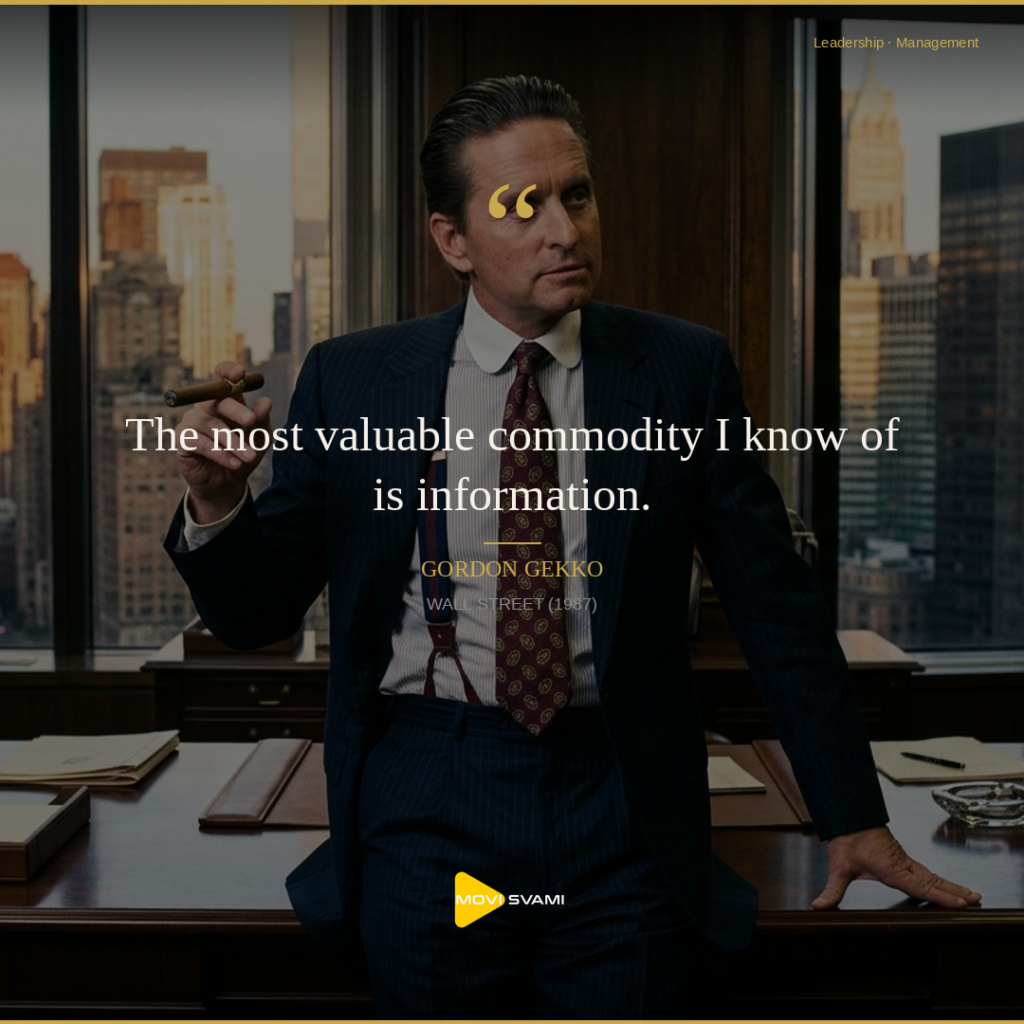
The afternoon sun streams through the floor-to-ceiling windows of a Manhattan high-rise, illuminating dust motes and casting long shadows across a teak desk littered with stock proxies. Bud Fox sits scribbling furiously, desperate to absorb the gospel being preached. Gordon Gekko leans back, eyes narrowed with the predatory calm of a man who has already read tomorrow’s news. It is not a lecture on ethics or vision statements. It is a lesson on power—specifically, the power of knowing before others do. In that moment, with Wall Street humming twenty stories below, Gekko delivers a line that would outlive the film itself: “The most valuable commodity I know of is information.”
In 1987, that statement carried the unmistakable scent of scandal. Information meant insider tips, wiretapped whispers, and briefcases full of leverage. But strip away the ethical violations, and Gekko articulated a truth that transcends decades: financial leadership is fundamentally about asymmetric access to insight. Those who know first, know best, and know fastest hold structural advantages that compound into market dominance. What has changed is not the principle, but the infrastructure. Today’s CFOs don’t rely on corrupt networks—they architect systems that render information advantages legal, scalable, and devastatingly effective.
The modern incarnation of Gekko’s doctrine is data velocity. While competitors wait for month-end close cycles to understand performance, organizations with real-time analytics spot inflection points in milliseconds. They detect variance before it metastasizes into crisis. They identify margin compression in specific SKUs before quarterly reviews surface the damage. They allocate capital toward growth vectors while rivals are still reconciling last quarter’s spreadsheets. This is not about having more data—it is about reducing the latency between event and insight, between insight and action. The CFO who builds a 48-hour reporting cycle in an industry standardized on 30-day closes has created a structural moat that competitors cannot easily replicate.
Consider the operational implications. A multinational retailer implementing real-time inventory visibility across its supply chain can detect regional demand shifts within hours, reallocating stock before competitors recognize the pattern. A SaaS company with granular cohort analytics can identify churn signals at the account level, triggering retention workflows before customers ghost. A private equity firm with API-first financial consolidation can model acquisition scenarios in real time during due diligence calls, while rivals wait days for analyst teams to produce static Excel models. In each case, the advantage is not superior intelligence—it is superior infrastructure. Information becomes a weapon only when it arrives in time to act.
Yet velocity without fidelity creates catastrophe. The CFO who prioritizes speed over accuracy builds a reporting engine that generates noise masquerading as signal. Real-time dashboards displaying unreconciled figures, uncleaned datasets, or metrics without governance become liability engines rather than decision tools. The paradox of modern financial leadership is that organizations drown in data yet starve for insight. The winners are not those with the most dashboards, but those who distill signal from noise fastest. This requires ruthless metric discipline: identifying the 5-7 KPIs that genuinely predict performance, ensuring data lineage integrity, and building feedback loops that validate predictive models against outcomes. Gekko wanted information; today’s CFO needs verified, actionable intelligence.
The strategic architecture for information advantage rests on three pillars. First, cloud-native ERP systems that eliminate batch processing latency and enable API-first integrations across operational systems. When finance, sales, supply chain, and HR operate on unified data models with sub-hour refresh cycles, the organization gains a unified truth that transcends departmental silos. Second, machine learning models that detect variance and anomaly patterns faster than human analysts. These are not futuristic experiments—they are production systems identifying invoice fraud, forecasting cash flow volatility, and flagging GAAP compliance risks in real time. Third, governance frameworks that democratize insight while maintaining strict data lineage. When analysts across the organization can self-serve dashboards without violating SOX controls or creating data sprawl, the CFO has built infrastructure that scales insight rather than centralizes gatekeeping.
Finally, consider the counterfactual. What happens to organizations that cling to legacy reporting cycles, manual consolidation, and quarterly retrospectives? They operate with structural blindness. By the time they understand what happened last month, the market has moved. Competitors with superior data velocity have already adjusted pricing, reallocated capital, and captured share. The gap compounds. The laggard CFO becomes a historian, narrating the past while leaders architect the future. Gekko’s maxim remains true: information is the ultimate commodity. But the modern translation is not about insider networks—it is about building the infrastructure that turns data into decisive advantage before your competitors finish reconciling their spreadsheets.
The question for every CFO is simple: Are you architecting a sustainable information advantage, or merely managing information overload? Because in markets where milliseconds matter, the difference between knowing and knowing first is the difference between leading and following. Gekko understood that in 1987. The tools have changed. The principle has not.