
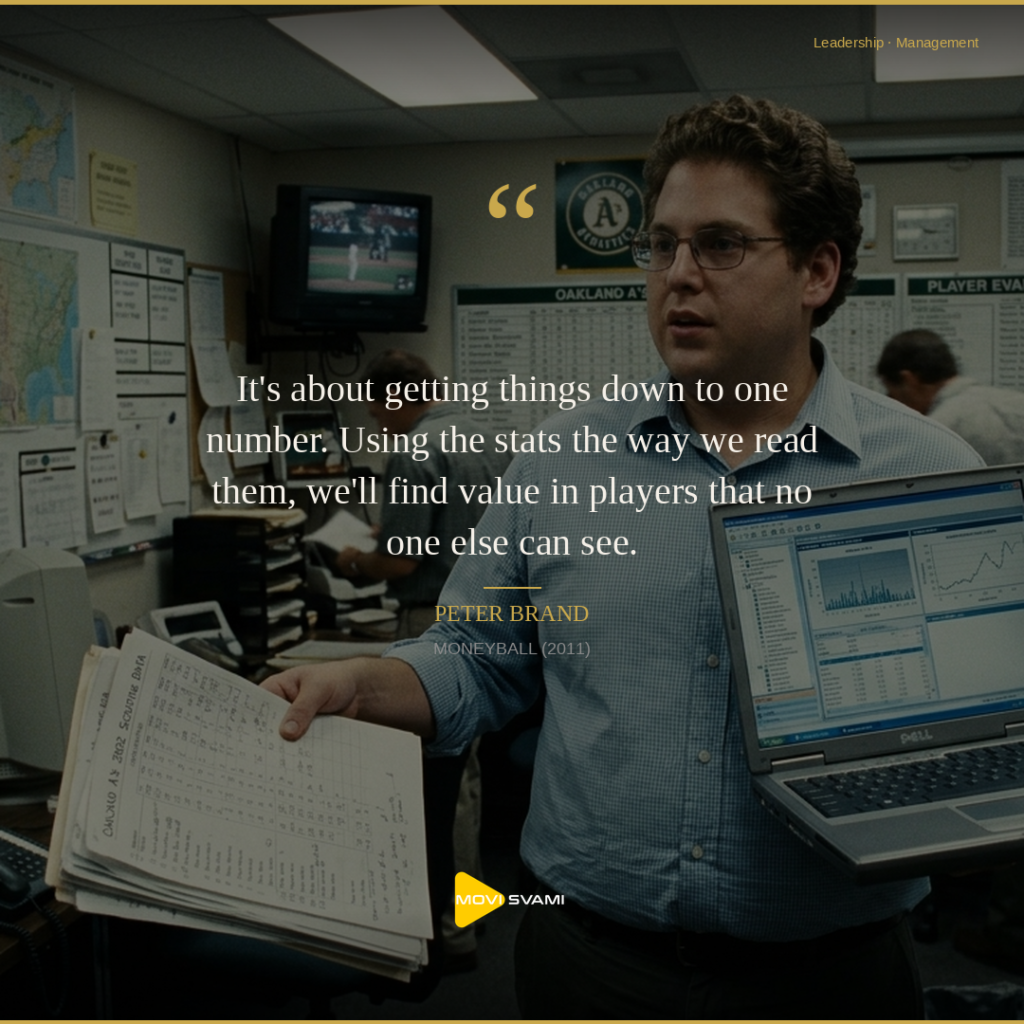
The fluorescent hum of the Oakland A’s scouting room in 2002 provided the backdrop for one of modern cinema’s most quietly radical moments. Billy Beane (Brad Pitt), the team’s general manager, had just traded his franchise player and alienated his scouts, leaving the organization in reputational and competitive freefall. Into this volatility walked Peter Brand (Jonah Hill), a Yale economics graduate clutching reams of spreadsheets that looked heretical to the grizzled baseball veterans surrounding him. The tension was palpable: centuries of institutional knowledge—scouts evaluating players by the cut of their jaw and the confidence in their stride—stood diametrically opposed to a quiet 27-year-old claiming that the entire valuation model of professional baseball was fundamentally flawed.
**The Analytics of Defiance**
“It’s about getting things down to one number,” Brand explained to Beane, his voice barely audible above the institutional noise. “Using the stats the way we read them, we’ll find value in players that no one else can see.” This was not merely a tactical adjustment; it was an epistemological assault on how the industry defined merit. Brand’s “one number” was not a reduction of complexity but a redefinition of it—replacing visceral intuition with proprietary algorithms that weighted on-base percentage over batting average, fundamentally altering the denominator of player value. The stakes transcended wins and losses; Beane was wagering his career and the dignity of a legacy franchise on the premise that the market was systematically mispricing assets because it was measuring the wrong things.
**Redefining Value Creation**
What Brand articulated—and what remains urgently relevant for modern financial leadership—is that competitive advantage rarely emerges from better execution of consensus metrics. Rather, it arises from the courage to build proprietary analytical frameworks that challenge the institutional consensus about what constitutes “value.” Traditional financial reporting operates as a lagging indicator, standardized by GAAP and celebrated by auditors, yet these metrics often obscure the true drivers of enterprise value. The CFO who relies solely on EBITDA multiples, return on invested capital, and free cash flow yield is, in essence, scouting for players with “good bodies” and “fast swings”—evaluating artifacts of past performance while remaining blind to the hidden correlations that predict future resilience.
The mandate for contemporary finance leaders is to become architects of measurement rather than custodians of reporting. This requires developing internal valuation methodologies that capture the idiosyncratic dynamics of one’s specific industry ecosystem—whether that means quantifying network effects in platform economies, measuring biological efficacy in pharmaceutical pipelines, or modeling customer cohort elasticity in subscription businesses. Like Brand’s sabermetrics, these frameworks must be sufficiently differentiated to identify arbitrage opportunities invisible to competitors still relying on commoditized financial ratios.
**From Dugout to Boardroom: Three Applications**
**M&A Arbitrage Through Alternative Valuation**
In mergers and acquisitions, the market typically prices targets through standardized EBITDA multiples and comparable transaction analysis, creating efficient markets for obvious assets but leaving inefficient markets for complex ones. A CFO applying the Moneyball mandate might develop proprietary metrics around “technology leverage ratios”—measuring how many engineering hours are required to generate incremental recurring revenue—or “ecosystem dependency indices” that quantify the stickiness of a target’s integrations. By underwriting deals based on these bespoke indicators rather than syndicated forecasts, finance leaders can acquire undervalued assets that strategic buyers dismiss due to superficial accounting losses or non-standard business models. The acquisition of a struggling software company with high API call density but low current revenue becomes logical only when one has built the internal calculus to weight platform connectivity over immediate top-line performance.
**Dynamic Capital Allocation**
Traditional capital budgeting relies on static discount rates and hurdle rates that treat all business units as equally risky and all growth opportunities as temporally uniform. A proprietary value approach introduces predictive granularity—segmenting investment decisions by “adaptation velocity” (how quickly a unit can pivot operational models) or “optionality density” (the number of future strategic paths a particular asset purchase preserves). A CFO might find that a manufacturing facility in a politically stable but low-growth region offers superior risk-adjusted value not despite its modest projections, but because of its “resilience coefficient”—a proprietary metric combining supply chain redundancy, local regulatory stability, and workforce skill transferability. By reallocating capital toward these undervalued resilience factors, organizations outperform peers who chase headline growth in volatile markets.
**Human Capital as Asymmetric Information**
Finance organizations have historically treated talent as a cost center, measuring productivity through headcount ratios and compensation benchmarks visible to every competitor. The Moneyball CFO instead builds confidential valuation models for human capital, quantifying “innovation velocity” (patent filings per R&D dollar cross-referenced with interdisciplinary collaboration patterns) or “decision entropy” (the variance and predictability of managerial choices under uncertainty). These metrics reveal that a mid-level data scientist with non-obvious domain expertise in adjacent industries may generate more derivative value than a high-priced veteran with conventional credentials. By compensating and promoting based on these proprietary indicators, CFOs secure talent arbitrage that competitors cannot replicate because they lack the measurement infrastructure to even identify the value.
**The Measurement Imperative**
The ultimate lesson of Brand’s philosophy is not that statistics triumph over judgment, but that superior measurement creates superior judgment. As you review your organization’s dashboard this quarter, consider: *What is the one number you are not calculating—because it would require abandoning comfortable consensus, rebuilding your analytics infrastructure, or admitting that your competitors are looking at the wrong data?* The answer to that question may contain the hidden value your balance sheet has been waiting to reveal.