
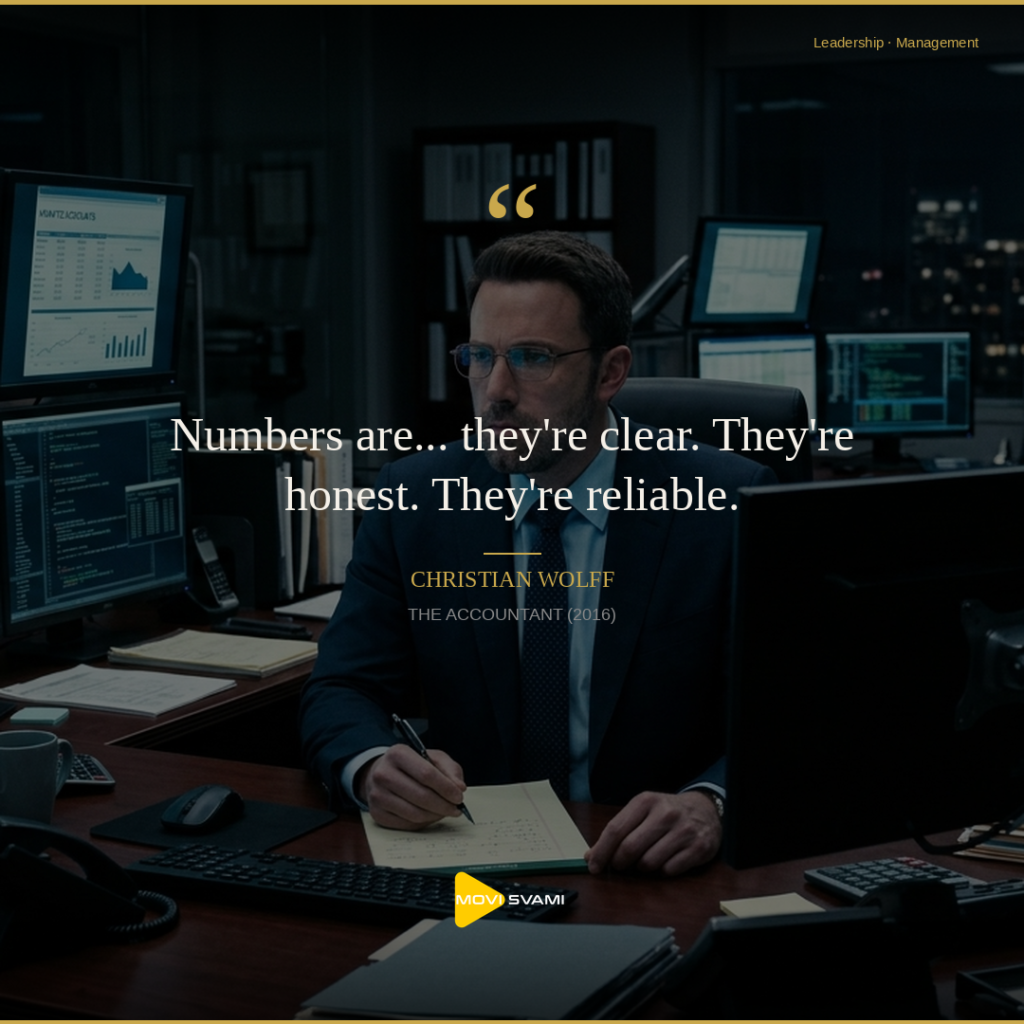
In a dimly lit farmhouse surrounded by antique weapons and high-security locks, Christian Wolff sits before a wall of monitors, methodically tracing a multimillion-dollar discrepancy. Outside, assassins are closing in. Inside, the danger is equally existential but entirely numerical: someone has been bleeding Living Robotics dry, and the trail exists only in the spaces between debits and credits. This is the world of *The Accountant* (2016), where the most lethal weapon isn’t the rifle hidden in the kitchen table, but the forensic clarity of a ledger that refuses to lie. As the walls close in—both literally and figuratively—Wolff offers a rare moment of introspection: “Numbers are… they’re clear. They’re honest. They’re reliable.” In a film saturated with violence and moral ambiguity, this simple assertion carries the weight of dogma.
Christian Wolff is not an ordinary accountant. He is a forensic auditor for criminal enterprises, a man who reconciles cartel books with the same meticulous precision he applies to legitimate corporate clients. Yet his observation about numbers transcends the noir trappings of his profession. It speaks to a fundamental truth about financial leadership: in organizations suffused with subjective narratives, political agendas, and optimistic projections, numerical data remains the last bastion of objective reality. For Wolff, numbers are a refuge from the chaos of human deception. For CFOs, they represent a fiduciary responsibility—a commitment to ensure that capital allocation, strategic planning, and performance evaluation rest on verifiable truth rather than convenient fiction.
The leadership principle embedded in Wolff’s statement is deceptively simple yet operationally profound: financial integrity is not a compliance checkbox but a strategic imperative. When executives manipulate earnings to meet analyst expectations, when controllers smooth quarterly volatility to avoid uncomfortable board questions, when FP&A teams revise forecasts to align with CEO optimism, the organization begins operating on fabricated reality. The immediate cost is credibility. The long-term cost is catastrophic misallocation of resources. A company that convinces itself revenue is growing when churn is accelerating will continue investing in acquisition while retention infrastructure collapses. A business that hides margin compression through aggressive capitalization policies will wake up one quarter to discover that profitability was always an accounting illusion. The ledger does not care about narrative. It waits, indifferent and patient, for reality to surface.
This principle manifests acutely in three common scenarios where CFOs face pressure to compromise numerical fidelity.
First, consider the quarterly earnings call. The CEO has publicly committed to 15% revenue growth, but the data shows 12%. Sales leadership argues that a handful of deals will close in the final week; marketing insists that pipeline velocity justifies optimism. The CFO faces a choice: report the current number and disappoint the Street, or allow management to “guide” based on probabilistic optimism. Wolff’s doctrine is unambiguous. The number is 12%. Anything else is not a forecast—it is hope dressed in decimal points. The CFO who allows subjective narratives to override objective data becomes complicit in a slow-motion fraud, training the organization to distrust its own metrics and rewarding teams for storytelling rather than execution.
Second, examine capital allocation in a multi-division enterprise. Division A has consistently missed targets but employs a charismatic GM with board relationships. Division B has exceeded forecasts but operates in an unsexy vertical with limited upside narrative. When budget season arrives, Division A presents a turnaround story rich with market dynamics and competitive repositioning. Division B submits spreadsheets. The political pressure favors Division A; the numbers favor Division B. A CFO who prioritizes narrative over numerical performance effectively subsidizes failure while starving success. Over time, this creates a culture where influence trumps results, and the most articulate executives capture resources regardless of ROI. The alternative—ruthlessly allocating capital based on historical performance and probabilistic return—requires the courage to let numbers override relationships. It is the difference between being liked and being effective.
Finally, consider the private equity portfolio company facing a down round. The GP insists that valuation multiples are temporarily depressed and that management should continue investing as if the previous valuation remains valid. The CFO, analyzing cash burn and realistic exit scenarios, calculates that the company has 18 months of runway at current spend and that no credible path to profitability exists without material restructuring. The GP’s narrative is seductive: “We’re playing the long game. Don’t let short-term noise dictate strategy.” But the numbers are clear. Burn exceeds growth. Unit economics remain negative. The bridge round will come with punitive terms. A CFO who prioritizes uncomfortable numerical reality over stakeholder appeasement will force the restructuring conversation early, preserving optionality and credibility. A CFO who defers to optimism will preside over a controlled crash, managing liquidity crises quarter by quarter until the inevitable down round arrives with no leverage left to negotiate.
The ultimate test of financial leadership is not technical mastery of GAAP or fluency in capital markets—it is the discipline to let data dictate strategy even when the data is inconvenient. Christian Wolff’s mantra—numbers are clear, honest, reliable—serves as a North Star for CFOs navigating the fog of organizational politics and executive wishful thinking. The question is not whether your systems can produce accurate numbers. The question is whether your organization has the courage to act on them. Because in the long run, reality always reconciles. The only variable is whether you’ve prepared for it or denied it.