
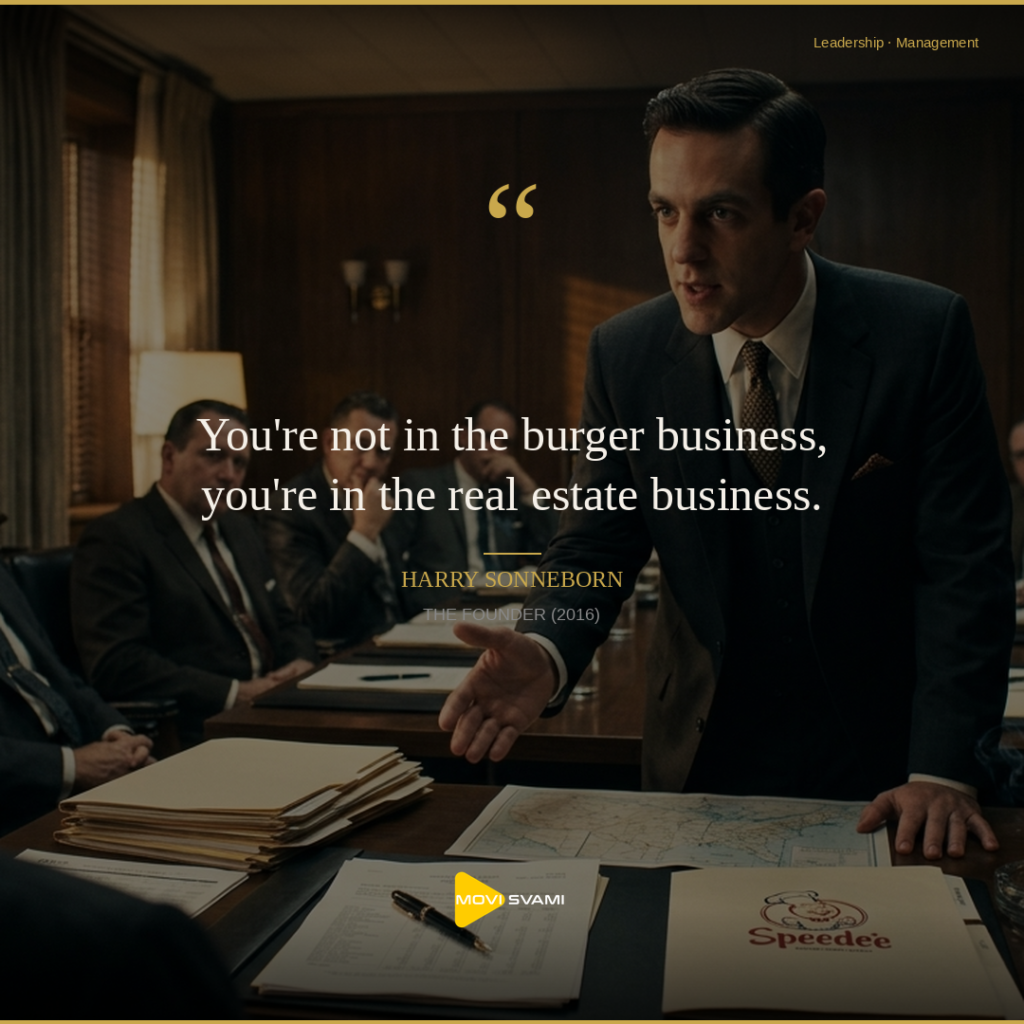
By 1959, McDonald’s was expanding at a velocity that should have signaled triumph. Ray Kroc’s Speedee System had reduced hamburger production to choreographed science, driving franchise applications into the hundreds. Yet the company teetered on insolvency. The operational metrics impressed—speed, consistency, volume—but the cash architecture was inverted. Franchise agreements required Kroc to absorb crippling setup costs while collecting only meager percentages from owner-operators. Meanwhile, supplier credit dried up, and equipment debacles threatened to drain reserves. Kroc had optimized the kitchen but not the capital structure. The paradox was brutal: a business scaling faster than it could fund itself, where every new franchise sale deepened the liquidity crisis. Operational excellence had become a liability without ownership of the underlying infrastructure.
It was Harry Sonneborn, dispatched as a financial consultant, who diagnosed the pathology with cold precision. Observing the hemorrhaging balance sheet, he delivered the line that restructured modern franchising: “You’re not in the burger business, you’re in the real estate business.” The insight was architectural, not semantic. Sonneborn proposed Franchise Realty Corporation, an entity that would purchase land, then sublease it to franchisees with a 40% markup and restrictive covenants ensuring brand compliance. The hamburger became marketing; the land became the income engine. Critically, these real estate assets served as collateral for expansion capital, solving the liquidity constraint entirely. McDonald’s did not merely sell operational systems; it controlled the scarce infrastructure upon which those systems operated, converting variable lease exposure into fixed rental income.
This distinction between operational optimization and asset control defines sustainable scaling. Operations create value; infrastructure captures and compounds it. Kroc had spent years refining throughput—reducing cost per transaction, seconds per order—yet value leaked to landlords, equipment financiers, and commodity suppliers because the company owned nothing defensible. Sustainable competitive advantage rarely resides in process efficiency, which can be reverse-engineered or automated into commodity, but in the ownership of scarce complementary assets that operational competitors cannot replicate without prohibitive capital expenditure.
When a business controls the physical or digital substrate upon which its market operates, the strategic calculus shifts. Variable costs transform into fixed revenue streams, and the enterprise constructs barriers that operational excellence cannot surmount. The competitive logic evolves from competing on margins and throughput to taxing the ecosystem itself. Ownership of the substrate converts a business from a participant in the market to the landlord of the market, collecting economic rent rather than fighting for operational surplus.
Consider cloud infrastructure. Amazon Web Services did not merely build better software than enterprise competitors; it recognized that economic value in the digital economy had migrated from application layers to compute and storage substrates. By owning the server farms, fiber networks, and energy contracts—the real estate of the internet—AWS captures rent from the entire SaaS ecosystem. Companies optimizing for code elegance or user interface find themselves paying infrastructural tolls to a landlord who controls the irreplaceable physical capacity. The competitive moat lies not in the dashboard but in the $100 billion of sunk capital that competitors cannot economically replicate without decade-long investment horizons.
In retail, Inditex operates by similar logic. While fast-fashion competitors optimize seasonal trend cycles and digital marketing spend, Zara’s parent company owns the majority of its manufacturing facilities, automated logistics networks, and prime commercial real estate. This vertical integration is not merely about supply chain velocity; it is about controlling the infrastructure of fashion’s physical delivery. When global shipping fractures or urban rental markets spike, competitors face variable cost volatility and landlord dependency, while Inditex collects rents within its own ecosystem, converting operational necessity into balance sheet strength and recession-resistant cash flows.
Healthcare offers a third variant. Ambulatory networks that lease facilities through standard commercial arrangements optimize clinical throughput and patient outcomes, yet remain exposed to rent escalation and capital availability. Systems that have reorganized physician practices into self-owned medical office buildings or REIT structures control the diagnostic infrastructure itself. They do not merely compete on surgical precision or readmission rates—metrics that are increasingly commoditized and regulated—but extract durable value from owning the constrained physical assets of care delivery. While competitors optimize patient flow, the asset-owning network optimizes capital structure.
The executive temptation is to solve constraints through operational refinement—faster processes, leaner inventories, better algorithms. Yet the Sonneborn principle suggests that sustainable scale requires redirecting capital from operational efficiency toward infrastructural ownership. In an economy obsessed with optimization speed, the enduring advantage may lie in the assets you control rather than the processes you perfect. What would change if your strategy stopped optimizing the product flow and started acquiring the irreplaceable assets upon which your entire market depends?