
The summer heat on a Detroit block hung thick enough to warp the sidewalk, yet the scene that defined Clint Eastwood’s *Gran Torino* unfolded in a strange, compressed silence. Walt Kowalski, retired Ford assembly-line worker and Korean War veteran, stepped onto his lawn not with theatrical fury but with the economical stillness of a man who had already decided what he was willing to do. The Hmong gang members arrayed before him were younger, louder, armed with the momentum of intimidation. They expected escalation, the familiar vocabulary of threats matched against threats. Instead, they received gravity. Walt did not posture, did not pace, did not clench his fists for effect. He simply occupied the boundary with a presence so undeniably anchored that the street seemed to tilt in his direction. That is the image of authority stripped to its essence: not volume, but mass.
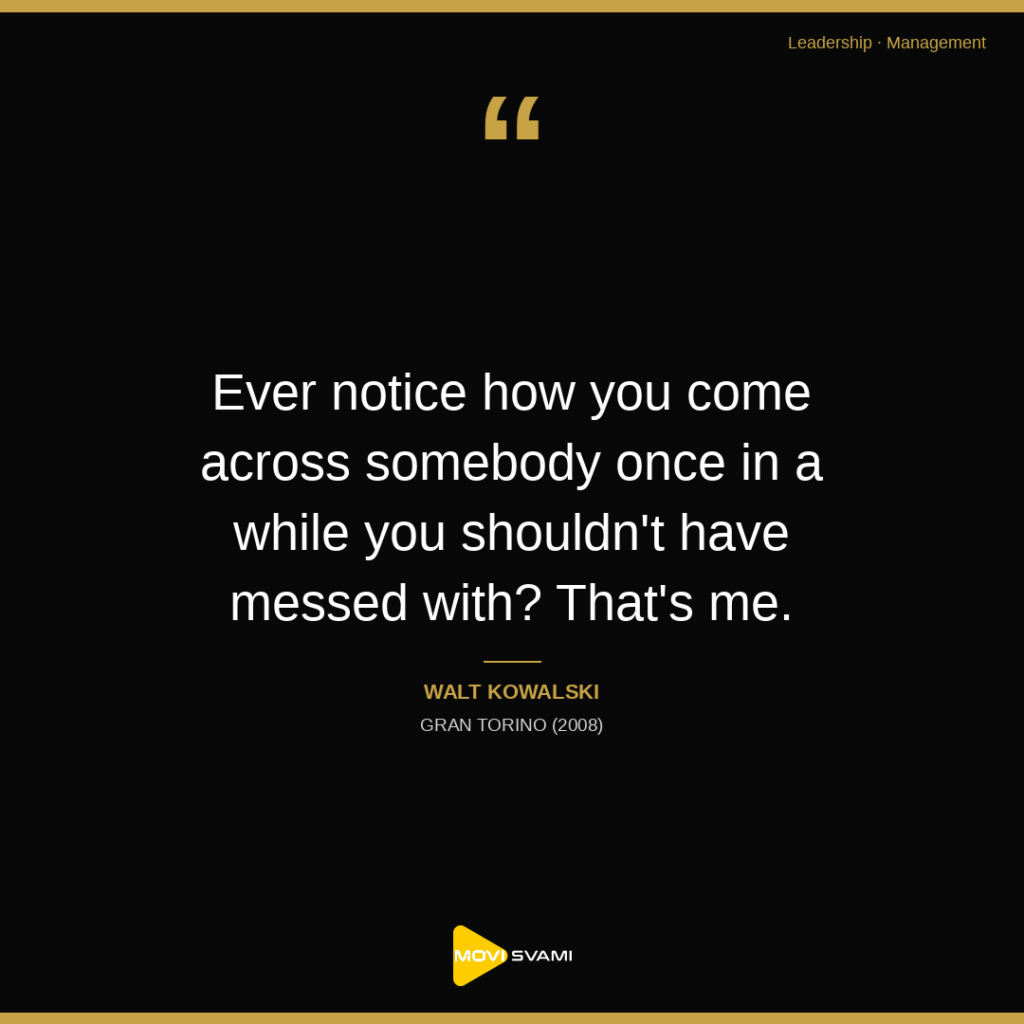
Walt’s warning—delivered to a gang that had assaulted his neighbor Sue and was threatening to conscript her brother Thao—remains one of the most quietly devastating moments in modern cinema: “Ever notice how you come across somebody once in a while you shouldn’t have messed with? That’s me.” The line is technically a question, but its syntax functions as a verdict. He offers no curriculum vitae of past violence, no bulging aggression, no attempt to match the gang’s performative hostility. What he provides is something far more disquieting: an invitation to recognize a reality that already exists. The stakes were not merely the safety of a neighbor’s family, though that mattered deeply to a widower who had spent decades treating human connection as a maintenance issue he would get to later. At a broader register, the confrontation tested whether a man living by an obsolete code of honor could still make that code operative in a world that had learned to mistake noise for strength. Walt passed the test not by dominating the gang, but by making the cost of engagement so unmistakably real that they policed themselves.
Management theory has long distinguished between power and authority, yet organizations remain crowded with leaders who conflate the two. Power operates through transaction—carrots dispensed, sticks brandished, volume dialed upward until compliance is purchased. Authority, by contrast, operates through recognition. Walt’s statement works because it requires no negotiation; it is an assertion that the listener’s own survival instincts will validate. In executive practice, the equivalent is the leader whose entry into a room alters behavior without a word being spoken. Deadlines tighten not because they are chased, but because disappointing this particular leader carries an unspecified weight that competent people intuitively refuse to test. This is gravitational presence: authority derived not from the potential to punish, but from a demonstrated history of meaning what one says and acting when principle demands it.
The distinction matters because performative dominance is expensive. When a manager raises their voice to enforce a boundary, they telegraph something unintentional—that the boundary itself was insufficiently clear before the outburst, and that their ordinary presence lacks the mass to sustain it. Walt Kowalski never performs. He never widens his stance or manufactures a scowl to borrow intimidation he does not already own. His authority is non-extractive; it does not require the other party’s fear to survive, only their acknowledgment of what is true. For the thoughtful executive, this suggests that boundaries should function like good strategy: mostly invisible, shaping movement preemptively rather than correcting it after collision. When a leader’s non-negotiables are unmistakable, adversaries rarely arrive at the point where overt aggression becomes necessary.
Consider the manager facing a high-performing employee whose sharp elbows are lacerating team cohesion. The conventional, anxious path is to amplify concern through emphasis—repeated conversations, escalating tone, documentation designed to signal seriousness. The gravitational alternative is to lower the temperature and raise the precision. Walt’s method translated to corporate life means stating the exact behavior, its precise impact, and the exact consequence with quiet finality. There is no pleading, no theatrical disappointment, no volume to mask internal uncertainty. The employee self-polices because the boundary is drawn in ink rather than pencil, and because the leader’s past consistency has established that the consequence is not theoretical. Calibration replaces capitulation.
The same logic applies when navigating institutional pressure from a client or cross-functional partner accustomed to pushing scope, compressing timelines, or bending ethical tolerances. The default posture is defensive justification—endless slide decks explaining why “no” is reasonable, as if the boundary were a petition requiring ratification. Quiet authority inverts this dynamic. The leader names the limit as a geological fact rather than an opinion awaiting debate. Like Walt on his lawn, they do not argue about who owns the property line; they simply mark it as immovable. Most organizational bullies, deprived of an argument to win, redirect their energy elsewhere rather than test a resolve whose bottom they cannot see. The boundary patrols itself because the cost of discovery has been credibly established long before the current conversation.
Even in direct peer conflict or team disruption, where factions breed and senior contributors stage subtle revolts, gravitational presence proves more surgical than interventionist theater. The instinct to facilitate endlessly—or to pull rank with declarative shouting—usually prolongs the dysfunction. The authoritative leader intervenes once, without spectacle. They name the behavior, assign the consequence, and return to work. The silence that follows is more disquieting than a shout because it contains certainty. Walt does not chase the gang down the street to prove his dominance; he states the terms and lets the threat of his follow-through do the patrolling. For the executive, this means resisting the temptation to hold meeting after meeting. State the standard. Maintain stillness. Allow the room to adjust its own orbit around a center that does not waver.
Authority is ultimately not an act of coercion performed upon others; it is a field generated from within. Before your next difficult conversation, consider whether your presence creates that field before a word is spoken, or whether you are still attempting to construct it one raised voice at a time. Are you establishing boundaries so clear that others feel the weight of them and police themselves, or are you merely hoping that louder will be enough?