
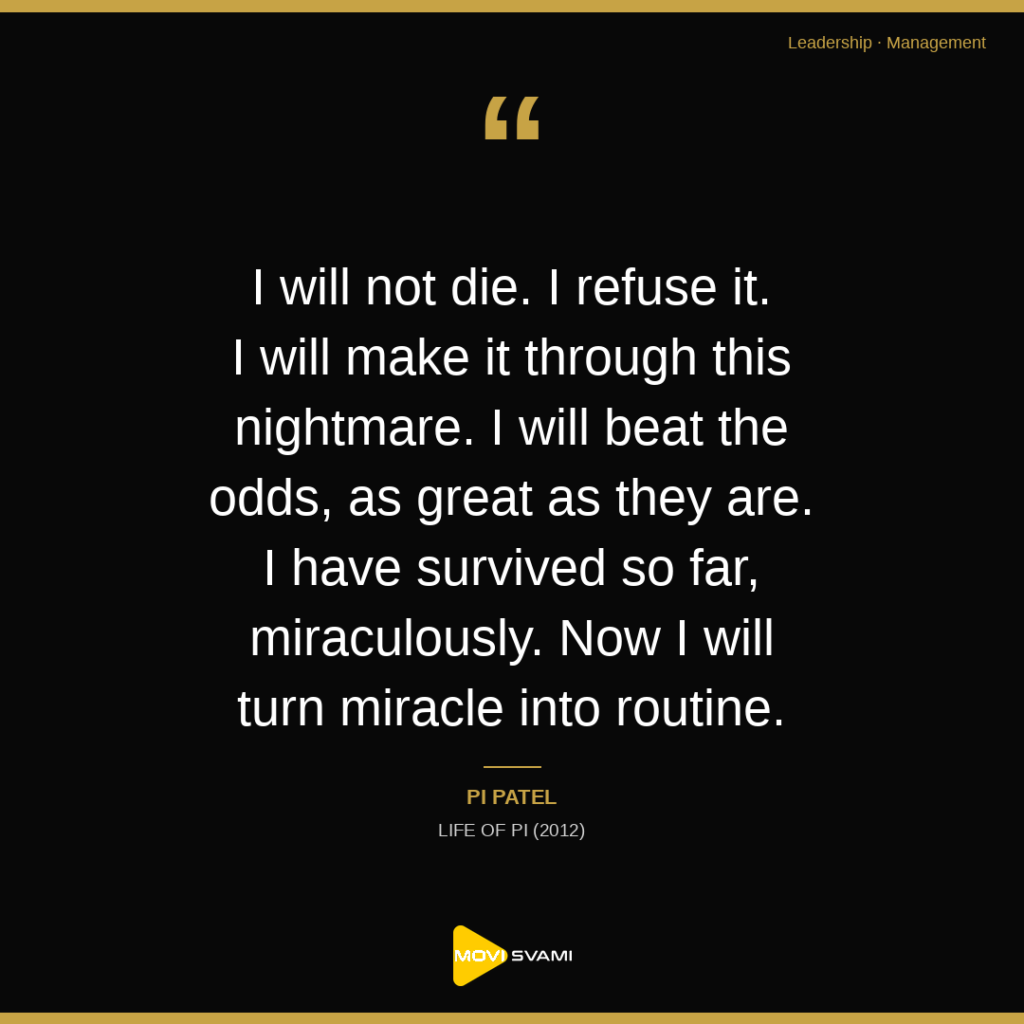
Organizations suffer from a survivorship bias that romanticizes heroic improvisation while neglecting the operational infrastructure that renders excellence reproducible. We celebrate the miracle quarter, the impossible turnaround, and the crisis navigated through sheer executive will—yet we fail to interrogate the stochastic nature of these successes. When Pi Patel, adrift in the Pacific with only a Bengal tiger for company, declares his intention to “turn miracle into routine,” he articulates the defining challenge of resilient leadership: the conversion of unpredictable luck into replicable capability. This is not merely psychological fortitude; it is the industrialization of survival.
In *Life of Pi*, the protagonist’s 227-day odyssey presents a laboratory for observing the operationalization of resilience. Pi’s initial survival is genuinely miraculous—fortuitous proximity to the lifeboat, the emergency supply kit, meteorological chance. However, the critical inflection point occurs when he ceases to view his survival as a series of fortunate accidents and begins treating it as a system requiring engineering. His declaration marks a shift from hoping for rescue to building infrastructure: the systematic training of Richard Parker (establishing territorial hierarchy), the procedural rationing of supplies (converting inventory into sustainable consumption rates), and the methodological documentation of time (preventing psychological fragmentation through ritual). Pi recognizes that survival is not a state but a process architecture.
This distinction illuminates a principle frequently absent from leadership development curricula: resilient leaders operationalize survival instinct into systematic process. While traditional resilience narratives emphasize individual grit or adaptive capacity, Pi’s methodology suggests that sustainable performance requires the reduction of complex, uncertain environments to procedural protocols. The objective is to convert stochastic outcomes—dependent on luck, timing, and individual heroism—into deterministic capabilities embedded in organizational routine. Miracles are fragile; methods are scalable.
The strategic implications manifest across three organizational domains. First, in crisis management, the post-pandemic enterprise has accumulated a repository of ad-hoc miracles—supply chain pivots executed through personal networks, remote workforce mobilizations accomplished through heroic IT interventions, liquidity secured through charismatic banking relationships. Resilient leadership now requires the reverse-engineering of these improvisations into institutional playbooks. The question is not “How did we survive?” but “What protocols can now trigger these responses without requiring the specific individuals who executed them?”
Second, within innovation pipelines, organizations routinely generate breakthrough successes that remain dependent on the idiosyncratic genius of specific teams or temporal market conditions. The transition from miracle to method requires the deconstruction of these successes into modular components: customer discovery protocols, rapid prototyping cadences, and kill-criteria decision gates. When a skunkworks project succeeds, leaders must resist the temptation to simply replicate the team and instead extract the underlying operational logic—converting the alchemy of innovation into reproducible chemistry.
Third, in talent and knowledge management, enterprises consistently face the “key person risk” associated with star performers whose contributions appear irreducible to training or documentation. Pi’s approach suggests treating these high performers as experimental laboratories rather than irreplaceable assets. Systematic shadowing, procedural documentation, and the codification of decision heuristics allow organizations to convert individual miracles into organizational muscle memory. The objective is not to clone the star performer but to isolate the specific routines that generate their results and embed these in workflows.
The imperative for executives is to conduct a rigorous audit of their organization’s miracle portfolio. Which successes remain dependent on contingent factors—specific individuals, market timing, or fortunate accidents? For each such miracle, develop a methodological extraction plan: identify the three procedural elements that determined the outcome and codify them into standard operating procedure. Your organization’s resilience will be measured not by its capacity to generate miracles, but by its ability to render the miraculous mundane. Turn miracle into routine. The alternative is to remain adrift, hoping for rescue.