
# Know Your Craft, Know Your Worth: Peggy Olson and Professional Authority
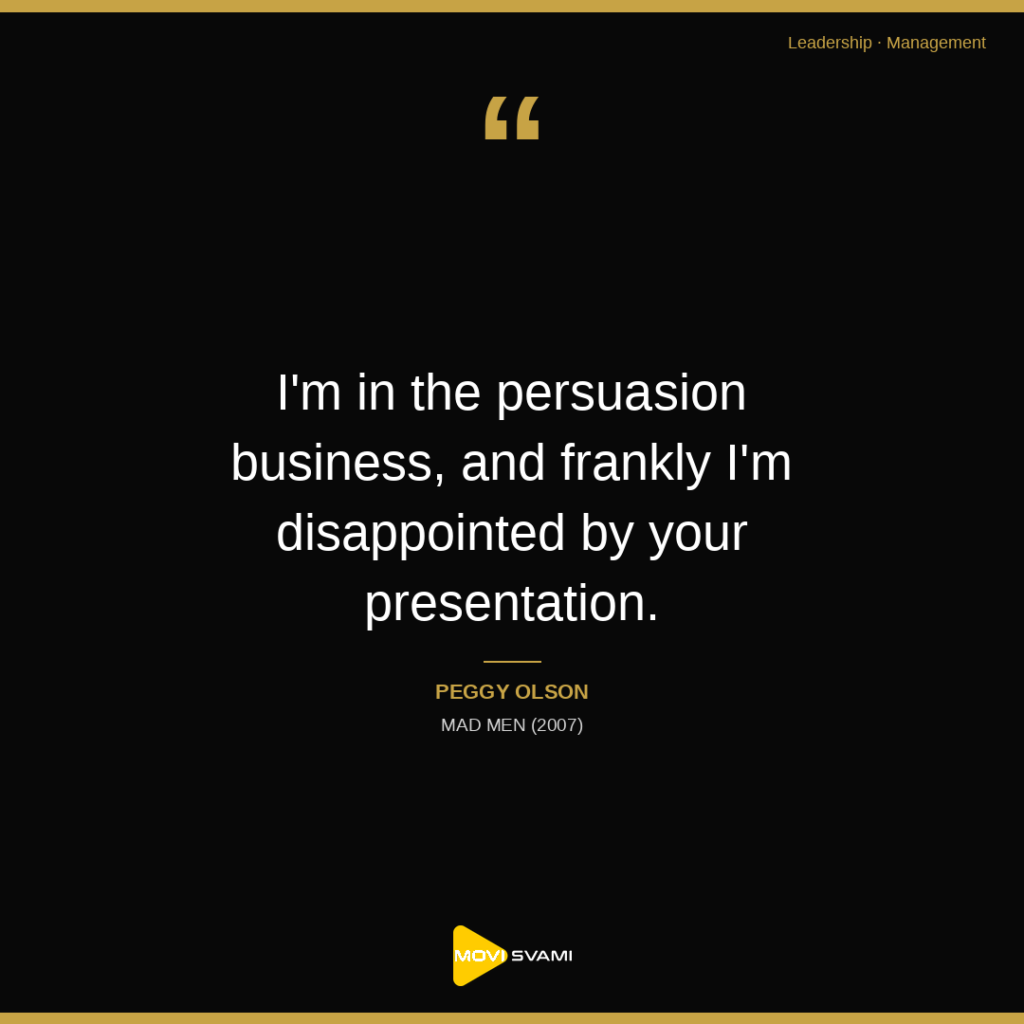
Peggy Olson does not say “I don’t like this” or “This isn’t working.” She says “I’m in the persuasion business, and frankly I’m disappointed by your presentation.”
This is the language of expertise. She has placed herself in her profession, defined the standards of that profession, and measured the work against those standards. She is not expressing opinion. She is applying professional knowledge to an evaluation.
This distinction matters profoundly for leaders. Professional authority is not the same as positional authority. It is authority earned through mastery. And it is one of the most powerful forces in any organization.
## The Scene: Authority Earned Through Expertise
Peggy has spent years in advertising. She has studied the masters. She has produced campaigns. She has learned what makes some presentations brilliant and others merely competent. She has paid the price of expertise.
When someone brings her work, she does not evaluate it as a peer would evaluate the work of another peer. She evaluates it as an expert in her field. She knows what excellence looks like because she has produced it. She knows what mediocrity looks like because she has learned to recognize the patterns.
And having earned this knowledge, she has earned the right to judge directly. She does not soften the judgment or apologize for it. She states it plainly, rooted in her expertise.
This is what separates true professional authority from both false bravado and false humility. False bravado is confidence without knowledge. False humility is knowledge without confidence. True professional authority is confidence rooted in knowledge.
## The Leadership Principle: Expertise as Power
There is a particular kind of power that comes with deep mastery of your craft. It is the power to set standards. It is the power to judge. It is the power to say no to work that does not meet the standards of excellence that define your field.
Most leaders are uncomfortable with this kind of direct judgment. They have been trained to be collaborative, to seek consensus, to avoid appearing arrogant. These are valuable instincts in many contexts. But they can also become a liability when a leader has developed genuine expertise and fails to apply it.
The person who has spent years mastering a craft has earned something valuable: the right to judge others’ work by the standard of that craft. This is not arrogance. This is clarity. It is the ability to see what is missing, what is wrong, what does not meet the standard.
A leader who has this expertise but fails to use it is abdicating a responsibility. She is allowing substandard work to move forward because she is uncomfortable with the judgment that expertise demands. She is choosing false humility over truth.
But a leader who applies expertise with clarity—who says directly what the standard is and how the work fails to meet it—creates something powerful in her organization. She creates a culture where excellence is not negotiable. Where the standard is not arbitrary. Where judgment is rooted in knowledge, not in ego.
## Three Real-World Applications
**For the Expert Newly Promoted to Leadership**: You have spent ten years becoming an expert in your field. You understand the craft deeply. You can see instantly what is wrong with a piece of work. But now you are in a leadership role, and you feel pressure to be collaborative and supportive. You begin softening your judgments. You start saying things like “This is pretty good, but maybe we could…” instead of “This doesn’t meet the standard.”
The question is: Are you serving your team by being nice, or are you serving them by being clear? The team that works for an expert who applies high standards consistently will produce better work than the team that works for a leader who is afraid to judge. Hold the standard. Say clearly when work does not meet it. Root that judgment in your expertise, not in ego, and your team will rise.
**For the Executive Building a Culture of Excellence**: You want to build an organization known for quality. You want clients to associate your name with excellence. But excellence is not achieved through nice feedback and collaborative processes. It is achieved through having leaders who know their craft, know the standard of that craft, and hold that standard without apology.
This means building a leadership team where each leader is an expert in their domain and is willing to use that expertise to judge the work that comes before them. It means creating a culture where feedback rooted in expertise is valued, where standards are not soft, where mediocre work is not promoted.
**For the Professional Earning Authority in Your Field**: You have spent years developing expertise. You know your field. You can see what others miss. But you may be hesitant to assert that authority because you fear appearing arrogant. The insight from Peggy is this: Authority rooted in expertise is not arrogance. It is clarity. The person who has earned knowledge has earned the right to judge. Use it. Not to belittle others, but to set clear standards. Not to dominate, but to lead.
## The Question for Leaders
Here is what Peggy’s directness demands of every leader: Have you done the work to develop genuine expertise in your field?
If the answer is yes, then the second question is: Are you willing to use that expertise to judge the work that comes before you? Are you willing to apply the standard of your profession without apology?
The leaders who build excellence are not the nice ones. They are not the ones who avoid judgment to protect feelings. They are the ones who know their craft, know what the standard is, and hold that standard consistently.
This is not about being harsh. It is not about belittling people. It is about clarity. It is about saying: Here is what excellence looks like in this field. Here is what your work is missing. Here is what it would take to meet the standard.
The teams and organizations that produce the best work are led by people who have earned expertise and are willing to use it. The question is whether you will be one of them.