
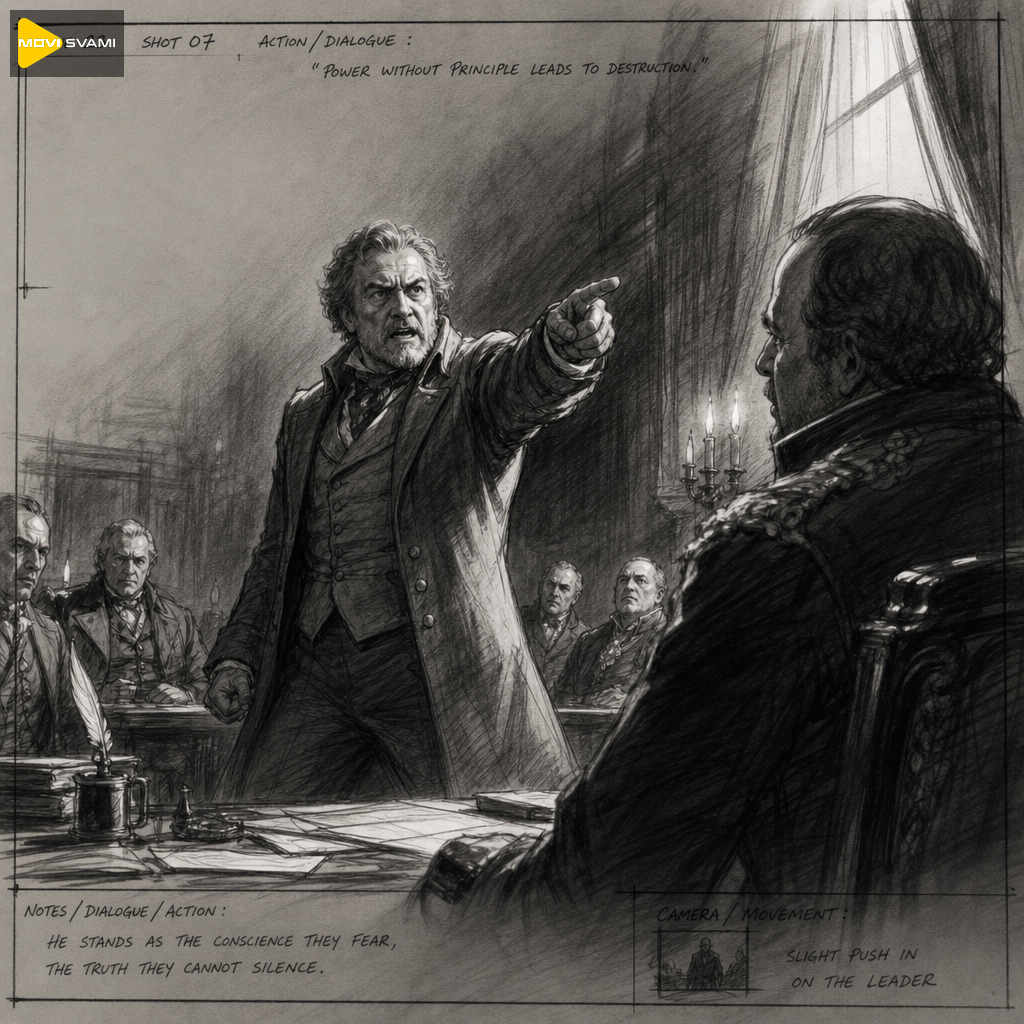
# Power Without Moral Principle Leads to Total Destruction
In the half-light of a secluded chamber, where corrupt officials have gathered to divide the spoils of unaccountable governance, Ramanna Chowdary stands as the solitary interruption. The room is heavy with complicity, its silence broken only by the quiet certainty of his warning. He does not raise his voice. He does not need to. The officials before him have mistaken the trappings of office for legitimacy, and their system has begun to feed upon itself. Ramanna sees what they refuse to acknowledge: that the architecture of their power is already eroding from within. The confrontation is not merely a dramatic set piece. It is a moral intervention. The stakes extend far beyond individual reputations or temporary political advantage. He is addressing the survival of the institution itself, and the lives it governs. When authority abandons ethical boundaries, it ceases to be a tool of order and becomes an instrument of collective destruction.
Ramanna Chowdary is not an idealistic outsider railing against power he has never touched. In *Rayalaseema Ramanna Chowdary*, he operates within a world defined by feudal hierarchies and factional violence, a terrain where dominance is often mistaken for leadership. His declaration that power without principle leads to destruction emerges from lived experience, not abstract philosophy. He has witnessed how institutional corruption calcifies when those in charge begin to believe that might alone justifies their continued rule. The officials he confronts represent a system that has ceased to serve any purpose beyond self-perpetuation. For Ramanna, the statement is an act of clarification. He is forcing the room to recognize that their authority is already hollow, sustained only by coercion and mutual protection. Once principle is removed from the equation, governance devolves into extraction, and extraction inevitably exhausts its own foundation.
True leadership requires a clear distinction between power and authority. Power is the mechanical capacity to compel action, to allocate resources, and to enforce compliance. Authority, however, is power that has been legitimized through ethical consistency, transparency, and a demonstrable commitment to the welfare of those subject to it. A leader may wield immense power yet possess no authority, particularly when that power is exercised arbitrarily or predatory. Ramanna’s observation cuts to the core of this distinction: unprincipled power may generate obedience in the short term, but it cannot generate trust. Without trust, coordination fragments, institutions lose their adaptive capacity, and the social contract between ruler and ruled begins to dissolve. The leader who mistakes fear for respect has already begun the process of institutional decline.
When ethics are systematically removed from decision-making structures, organizations do not merely suffer moral failures; they suffer structural ones. Corruption distorts incentives, rewarding loyalty over competence and concealment over accountability. Capable individuals either depart or conform to the prevailing cynicism, creating a self-reinforcing cycle of mediocrity and malfeasance. The resulting decay is rarely visible in daily operations until a moment of stress exposes the brittleness of the entire system. Ramanna’s warning to the assembled officials is precisely this: their unbridled authority is consuming the very power structure that sustains it. What appears to be consolidated strength is, in fact, accelerated erosion.
The dynamics of the dimly lit chamber are not confined to cinema. In the corporate sphere, organizations that prioritize dominance over integrity routinely engineer their own collapse. Consider the pattern of major accounting and financial scandals in which executive leadership treated ethical boundaries not as guardrails but as obstacles to be navigated through legalistic maneuvering. When revenue targets become absolute and compliance is viewed as a cost center, the institutional culture shifts from value creation to value extraction. The result is rarely a single catastrophic decision made in isolation. Rather, it is a cascading series of rationalized compromises that hollow out the organization’s operational and moral foundations with each successive quarter. Employees learn to internalize the indifference, auditors become complicit in the fiction, and boards mistake opacity for strategic discipline. Regulators, markets, and public trust withdraw in rapid succession, leaving behind a structure that cannot sustain its own weight and executives who discover, too late, that their indemnities were illusory.
Political and organizational leadership crises frequently follow the same arc. Individuals who consolidate authority while systematically dismantling normative constraints often believe they are insulating themselves from consequence. They promote loyalty above judgment, centralize control, and treat institutional precedent as disposable. In the short term, this approach can deliver decisive action and apparent unity. Over time, however, the removal of principled restraint isolates the leader from accurate information and creates an environment where dissent is driven underground. The personal ruin that follows is nearly as predictable as the institutional damage. Leaders who operate without ethical moorings eventually find themselves surrounded by sycophants and enablers, unable to correct course even when the warning signs become unmistakable. Power, deprived of principle, turns inward and consumes its own agent.
At the level of organizational culture, the absence of principle manifests as a quiet but pervasive toxicity. Teams learn that outcomes justify methods, and that moral language is merely performative. Recruitment becomes difficult as the organization’s reputation calcifies around its worst behaviors. Existing talent departs not because of market opportunities, but because participation in a morally bankrupt system becomes personally untenable. The culture itself becomes the primary mechanism of decay, normalizing behavior that would be unthinkable in a healthy institution. External stakeholders, from investors to customers, eventually recognize that the organization cannot be trusted to steward long-term relationships. The erosion is gradual, then sudden. What Ramanna identifies in the chamber is the same phenomenon: a system that has mistaken the capacity to dominate for the right to lead.
Sustainable power and hollow power are distinguishable not by their immediate intensity, but by their source of nourishment. The former is sustained by reciprocal trust, ethical coherence, and a shared sense of purpose that survives the departure of any single individual. The latter is fueled by extraction, intimidation, and the temporary alignment of self-interest among those who have nothing left to lose. Ramanna Chowdary’s confrontation is ultimately a study in refusal, the moment a leader chooses to name the decay rather than participate in its collective denial. His warning remains relevant across decades and domains because the temptation to divorce authority from accountability is perennial. Markets change, technologies evolve, and institutional forms adapt, but the fundamental arithmetic of unprincipled power remains constant. Organizations and the individuals who lead them face a choice between building structures that endure and seizing advantages that will inevitably collapse. In the end, power without moral principle does not simply lead to destruction. It guarantees that the destruction will be total, consuming the institution, its people, and ultimately the leader who believed themselves immune to consequence.