
# Reversion Under Fire: How Core Training Becomes Operational Anchor
The bridge at Ramelle stands as a scarred monument to exhaustion. Captain John H. Miller, his uniform caked in mud and blood that isn’t all his own, surveys what remains of his squad. The men are hollowed—hollowed by the Omaha Beach landing, by the march across France, by the deaths of friends whose faces they already struggle to recall. Now, intelligence reports confirm what the distant rumble of artillery promises: a German battalion approaches, mechanized and relentless, while Miller commands a handful of paratroopers and Rangers, low on ammunition and lower on hope.
The smoke drifts through broken walls. Jackson, the sniper, checks his rifle with trembling hands. Reiben argues about the odds. Upham, the interpreter, fiddles with his helmet, eyes wide with the terror of anticipated violence. Chaos doesn’t announce itself with trumpets here; it seeps in as static, as short breaths, as the paralysis of men who have seen too much and have nowhere left to retreat.
## The Quote in Context
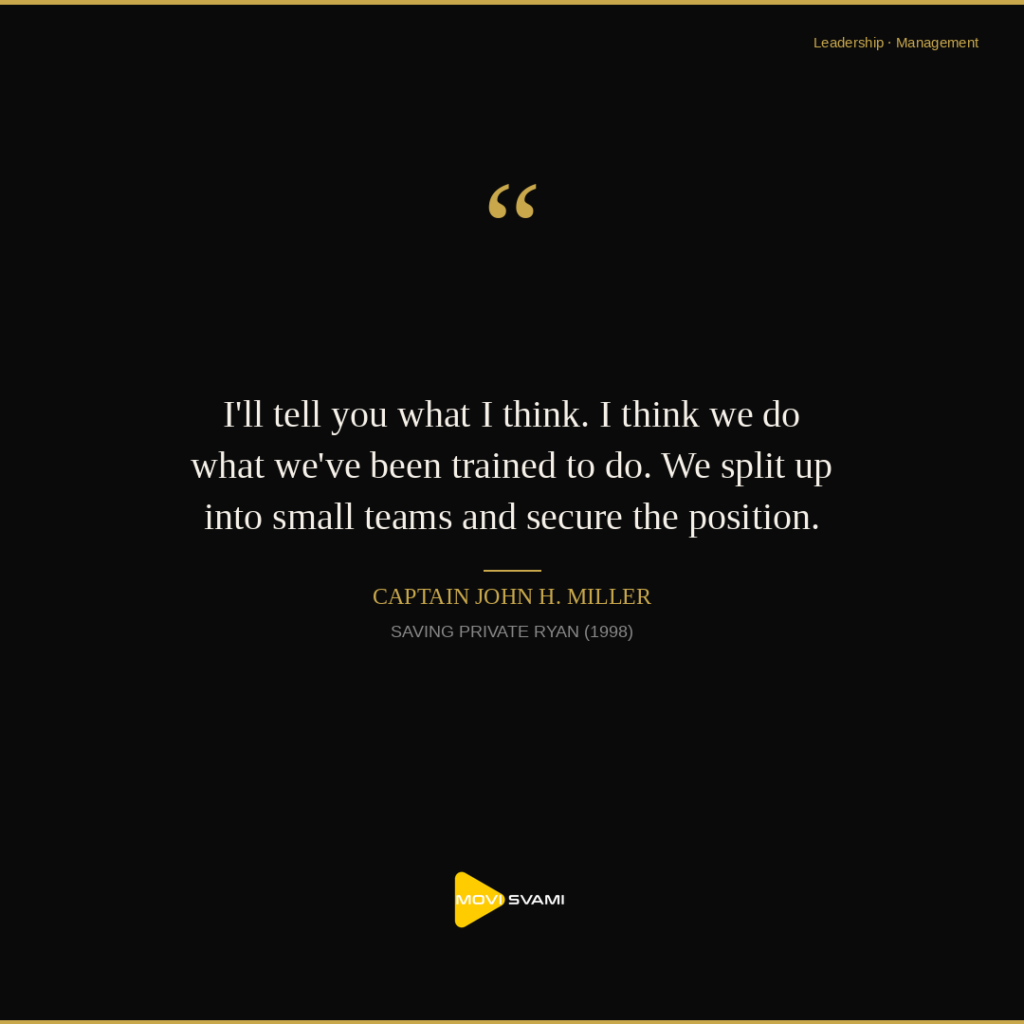
It is in this crucible—when the tactical situation defies solution and fear threatens to fracture unit cohesion—that Miller delivers his quiet mandate. Not a rallying cry. Not a Hollywood speech about glory or sacrifice. Instead, he offers operational clarity: “I’ll tell you what I think. I think we do what we’ve been trained to do. We split up into small teams and secure the position.”
The words land with the weight of authority earned, not rank given. Miller isn’t improvising. He isn’t reaching for complex maneuvers or clever flanking movements that might impress a general but confuse exhausted privates. He is reverting. Stripping away the variables, the unknowns, the terror of the approaching armor, he returns to the immutable architecture of military fundamentals: small unit tactics, overlapping fields of fire, defensive positioning.
## The Leadership Principle
Miller’s instruction embodies a psychological reality that high-reliability organizations have institutionalized across disciplines: under conditions of extreme stress, human cognitive capacity contracts dramatically. The amygdala floods the system with cortisol and adrenaline—necessary for survival, but catastrophic for complex reasoning. Peripheral vision narrows. Working memory, the mental scratchpad holding tentative plans, evaporates. In these moments, the capacity for creative improvisation doesn’t just diminish; it often proves fatal.
This is where process discipline becomes operational anchor. When Miller orders his men to their assignments—to the bell tower, to the rubble pile, to the vulnerable left flank—he is activating procedural memory, the deep neurological encoding that survives when explicit memory falters. Like a surgeon performing a crisis thoracotomy or a pilot executing emergency landing protocols, Miller’s squad doesn’t need to think their way through the defense; they need to execute patterns burned into muscle and memory through repetition.
The military understands this as “battle drill”—the transformation of conscious competence into unconscious competence. The civilian equivalent appears in trauma centers, where code blue responses follow algorithmic precision not because doctors lack creativity, but because creativity consumes seconds that patients cannot spare. Process discipline isn’t the antithesis of leadership; it is the substrate that permits leadership to function when cognition fails.
## Real-World Applications
This principle translates from the beaches of Normandy to modern boardrooms with surprising fidelity. When cyber-attacks breach corporate firewalls at 3 AM, the organizations that survive aren’t typically those whose leaders devise brilliant extemporaneous strategies. They are the ones with incident response playbooks, with pre-assigned roles, with communication trees drilled quarterly until execution becomes reflexive. The “secure the position” mandate in business means isolating compromised systems before investigating root causes—containment before analysis.
In aviation, Captain Chesley Sullenberger’s landing of Flight 1549 on the Hudson River exemplifies Miller’s philosophy. Faced with dual engine failure after bird strikes, Sullenberger didn’t innovate. He executed the emergency checklist he had practiced for decades, allocating the scarce cognitive resources remaining to judgment while automating the mechanical responses. The checklist—institutionalized training—anchored the possible while chaos consumed the theoretical.
Even in less dramatic contexts, the principle holds. When market volatility triggers liquidity crises, financial institutions with pre-established risk protocols and liquidation hierarchies outperform those relying on ad-hoc committees. The training becomes the anchor; the process becomes the strategy.
## Closing Reflection
There is a paradox in Miller’s leadership that demands contemplation. We celebrate leaders for vision, for innovation, for the ability to see around corners. Yet the highest form of leadership may manifest not in moments of creative abundance, but in the disciplined restraint to follow the path prepared when creativity proves impossible.
The bridge at Ramelle eventually falls. Some defenses, against some odds, cannot hold. But Miller’s platoon inflicts disproportionate damage precisely because they execute their training with religious fidelity until the last possible moment. They do not panic into chaos; they anchor into procedure.
For modern leaders, the lesson endures: build your protocols in peacetime. Drill your fundamentals when stakes are low. When the smoke rises and the ground shakes—when the quarterly numbers crater, when the supply chain snaps, when the unthinkable arrives—you will not rise to the occasion. You will fall to the level of your training. Make that level worthy of the moment.