
# Standing Alone: How One Man’s Doubt Transformed a Jury Room
The courtroom is silent. A single man, Juror #8, sits alone in the jury room, his hand hovering over the “Not Guilty” button. The other eleven jurors have already reached a verdict—guilty. Their voices are sharp, their certainty unshakable. But Juror #8, played by Henry Fonda, refuses to move. His quiet defiance sets off a chain reaction, forcing the group to confront the evidence, their biases, and the weight of their decision. This is not just a story about a murder trial; it is a masterclass in leadership, where one man’s willingness to question assumptions becomes the catalyst for justice.
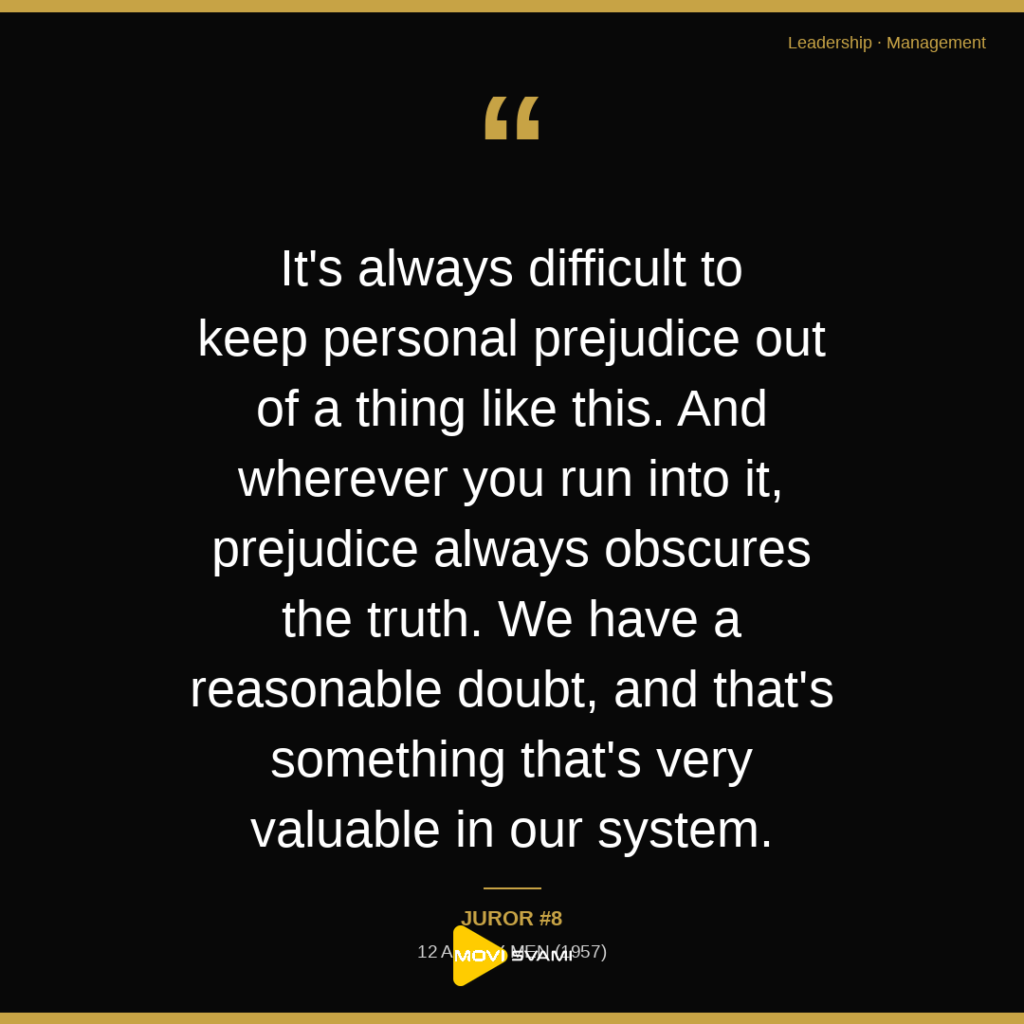
Juror #8’s pivotal moment comes early in the film, when he votes “Not Guilty” despite the overwhelming consensus. The other jurors dismiss his hesitation as weakness, even mockery. “You’re the only one who’s still not sure,” Juror #3 sneers. But Juror #8’s doubt is not a lack of conviction—it is a commitment to truth. His declaration, “It’s always difficult to keep personal prejudice out of a thing like this. And wherever you run into it, prejudice always obscures the truth. We have a reasonable doubt, and that’s something that’s very valuable in our system,” is both a challenge and a revelation.
What was at stake was more than the fate of an accused killer. It was the integrity of the judicial process itself. Juror #8’s initial vote forces the group to re-examine the evidence, not as a collective entity, but as individuals. He does not seek to dominate the discussion; instead, he invites others to see the case through a different lens. His approach is not about winning an argument but about ensuring that no stone is left unturned. The stakes for the jurors are personal as well: their reputations, their sense of duty, and their ability to reconcile their own biases with the law.
This moment crystallizes a critical leadership principle: questioning assumptions is not a weakness—it is a necessity. Juror #8’s actions reveal that true leadership often requires standing alone in the face of groupthink. In management, this principle is equally vital. Leaders who dismiss dissenting opinions risk making decisions based on incomplete information or unexamined biases. Juror #8’s insistence on reasonable doubt mirrors the role of a leader who prioritizes critical inquiry over expediency. By creating a space where uncertainty is acknowledged and explored, leaders can foster environments where innovation, accountability, and ethical decision-making thrive.
Moreover, Juror #8’s approach underscores the value of doubt as a tool for clarity. In a world where information is abundant but truth is elusive, doubt is not an obstacle—it is a compass. Leaders who embrace this mindset recognize that uncertainty can be a starting point for deeper understanding. Consider a manager tasked with launching a new product. If the team is confident in their data, they may overlook subtle inconsistencies. But a leader who questions the assumptions behind the data—examining the sources, the methodologies, and the potential for blind spots—can prevent costly mistakes. Doubt, when harnessed constructively, becomes a mechanism for refining decisions and mitigating risk.
Real-world applications of Juror #8’s leadership style abound. In a corporate setting, for instance, a manager might face a high-stakes decision about restructuring a department. The team may be eager to approve a plan that aligns with short-term goals, but a leader who pauses to ask, “What are we missing?” can uncover hidden consequences. This could mean re-evaluating the impact on employee morale, market dynamics, or long-term strategy. Similarly, in a project team, a manager might notice conflicting feedback from stakeholders. Instead of pushing forward with a compromise, the leader could facilitate a deeper discussion to identify the root causes of the disagreement. This not only strengthens the decision but also builds trust by demonstrating respect for diverse perspectives.
Another scenario involves navigating ethical dilemmas. Imagine a manager who discovers a flaw in a product that could compromise customer safety. The pressure to release the product on time is immense, but the leader’s responsibility is to prioritize integrity over expediency. By standing alone in advocating for a delay, the manager aligns with Juror #8’s commitment to truth. This act of courage not only protects the company’s reputation but also reinforces a culture where ethical considerations are non-negotiable.
Finally, consider the role of doubt in fostering innovation. A leader who encourages questioning the status quo can spark breakthroughs. For example, a tech firm’s R&D team might be focused on incremental improvements to an existing product. A manager who challenges the team to explore alternative approaches—asking, “What if we started with a different assumption?”—can unlock new possibilities. This mindset mirrors Juror #8’s ability to see beyond the obvious, transforming doubt into a driver of progress.
In the end, Juror #8’s story is a reminder that leadership is not about certainty but about the courage to seek it. His solitary stand in the jury room is a testament to the power of doubt as a leadership tool. As managers, we are called to ask: In our own organizations, where are we allowing bias to cloud our judgment? Where can we create space for questioning, even when it feels uncomfortable? The answer lies not in avoiding doubt, but in embracing it as a foundation for fair, informed, and ethical decision-making.
**Reflection Question:** In your next team meeting, how might you create space for dissenting opinions? What assumptions are you willing to question to ensure a more accurate and just outcome?