
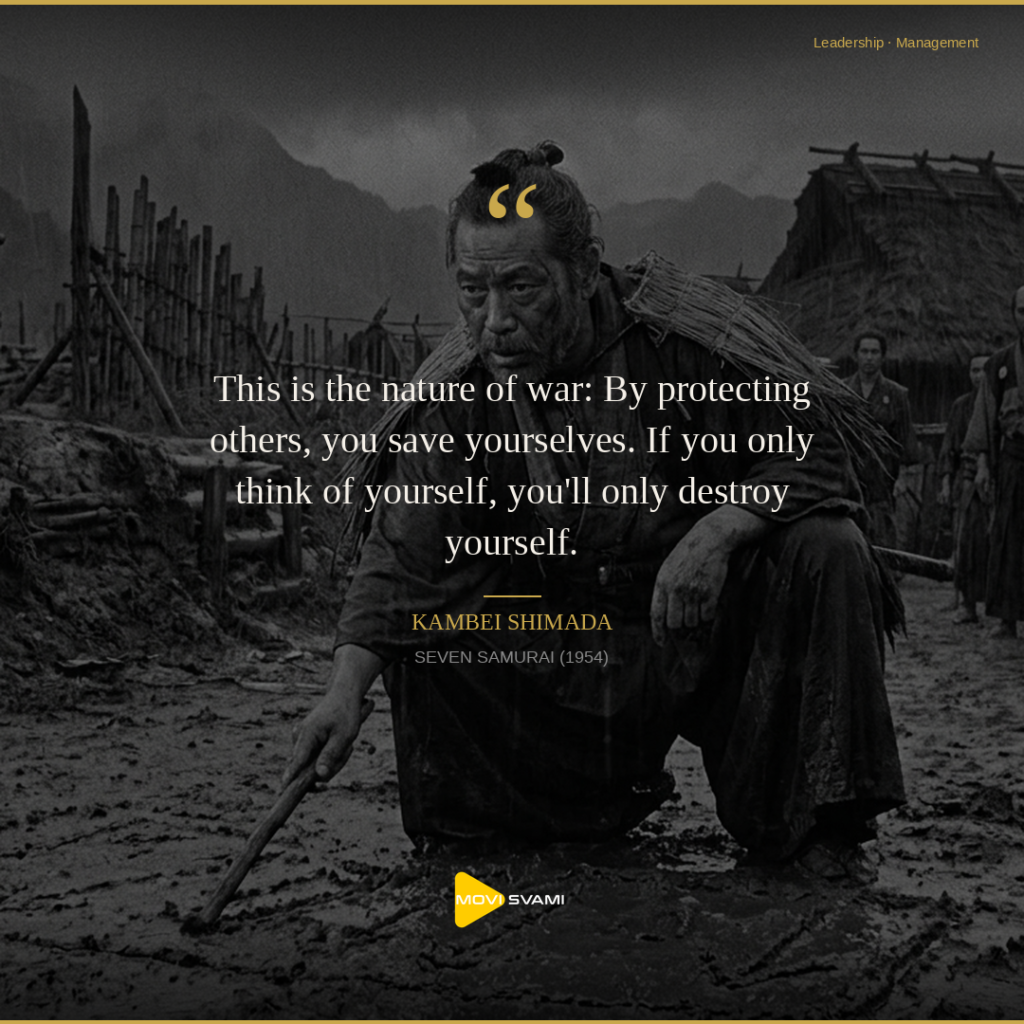
The rain falls in sheets across the rice paddies as Kambei Shimada traces lines in the mud, sketching the village’s perimeter. The farmers cluster around him, clutching bamboo spears, their eyes fixed not on the strategic terrain but on their own doorways, their hidden stores of grain, their individual survival. The bandits will come in force, and the instinct of each man is to fortify his own hut. Kambei stops them. He explains the defense not as a collection of individual strongpoints but as a single organism: the river, the bridge, the high ground, and the fields must be held together or lost together. It is here, in this moment of tactical instruction, that he delivers the lesson that transcends warfare.
“This is the nature of war: By protecting others, you save yourselves. If you only think of yourself, you’ll only destroy yourself.”
Kambei speaks not as a moralist but as a systems engineer. As a ronin who has survived decades of conflict, he understands that the village’s survival depends on a specific structural condition: the mechanical impossibility of individual preservation without collective defense. The farmers cannot hide their rice and hope the bandits pass; the samurai cannot hold the high ground while the village burns. The stakes are absolute—fragmentation guarantees annihilation, while interdependence offers the only probabilistic path to survival. The quote is not an appeal to charity; it is a description of tactical reality.
This distinction between moral exhortation and structural design is the critical insight for modern organizational leadership. Most enterprises attempt to foster collaboration through cultural initiatives—values statements about teamwork, offsite retreats focused on trust, or performance reviews that include “collaboration” as a competency. These are psychological interventions. Kambei’s approach is architectural. Reciprocal altruism, in this context, is not a personality trait to be hired for; it is an organizational property to be engineered. When individual survival—whether defined as compensation, reputation, or career progression—is mechanically coupled to collective outcomes, self-interest becomes indistinguishable from mutual aid. The structure compels the behavior; culture merely polishes it.
Consider how this principle manifests in sales compensation architecture. Traditional enterprise sales models reward individual quota attainment with uncapped commissions, creating a class of “lone wolf” performers who optimize deal closure without regard for implementation capacity, customer success, or territorial equity. The result is predictable: revenue that churns, burned bridges between sales and delivery, and siloed market intelligence. A structurally interdependent design would mechanically fuse individual and collective preservation. Imagine a compensation model where forty percent of variable pay derives from individual quota attainment, but sixty percent is gated by regional net revenue retention and cross-sell ratios requiring active coordination between account executives. The high-performing seller who closes an unprofitable deal or poaches leads from an adjacent territory would see her commission mechanically decay, not because of a manager’s disapproval, but because the payout algorithm requires collective health. Conversely, the hours spent mentoring a junior colleague or documenting customer context for the implementation team are no longer acts of altruism; they become the only rational path to maximizing personal income. The structure makes the protection of others the sole mechanism for saving oneself.
In technical organizations, structural interdependence addresses the feudalism of microservices architectures, where teams optimize their own service latency while ignoring downstream fragility. When systems collapse, responsibility diffuses, and individual teams retreat to their own codebases. To engineer reciprocal altruism here requires “shared fate” mechanisms that make operational survival contingent on communal defense. One approach is to mandate that engineering teams own both development and operational support—the “you build it, you run it” model—but with a critical coupling: incident response is collective and career consequences are distributed. If Service A fails, the team responsible for Service B (which depends on A) joins the war room not as a courtesy, but because their own service-level objectives are suspended until ecosystem stability is restored. Performance reviews weigh not merely individual system uptime, but the frequency and quality of support provided to dependent teams. The engineer who refuses to harden APIs or document dependencies finds her own promotion prospects eroded when colleagues’ systems falter due to her opacity. Technical preservation becomes inseparable from the defense of the collective infrastructure.
At the executive level, structural interdependence confronts the “golden parachute” problem, where leaders optimize for quarterly metrics while accumulating personal wealth insulated from long-term institutional collapse. Reciprocal altruism here requires vesting schedules and clawback provisions tied to cross-functional resilience. Consider a pharmaceutical firm where C-suite equity vests not merely on FDA approval—a scientific milestone achievable by research alone—but on post-market surveillance metrics requiring flawless coordination between manufacturing, legal, and pharmacovigilance over thirty-six months. Or a financial services firm where executive bonuses are held in escrow, released only if the firm passes stress tests that require active, documented collaboration between risk, trading, and compliance departments. The CFO who cuts compliance corners to boost quarterly earnings does not merely face ethical sanction; she mechanically jeopardizes her own financial preservation because the compliance team’s failure triggers her own compensation forfeiture. Self-interest becomes structurally aligned with the institution’s defense.
The architecture of your organization sends signals louder than any mission statement. Are you building walls between departments that allow retreat, or bridges that make isolation fatal?