
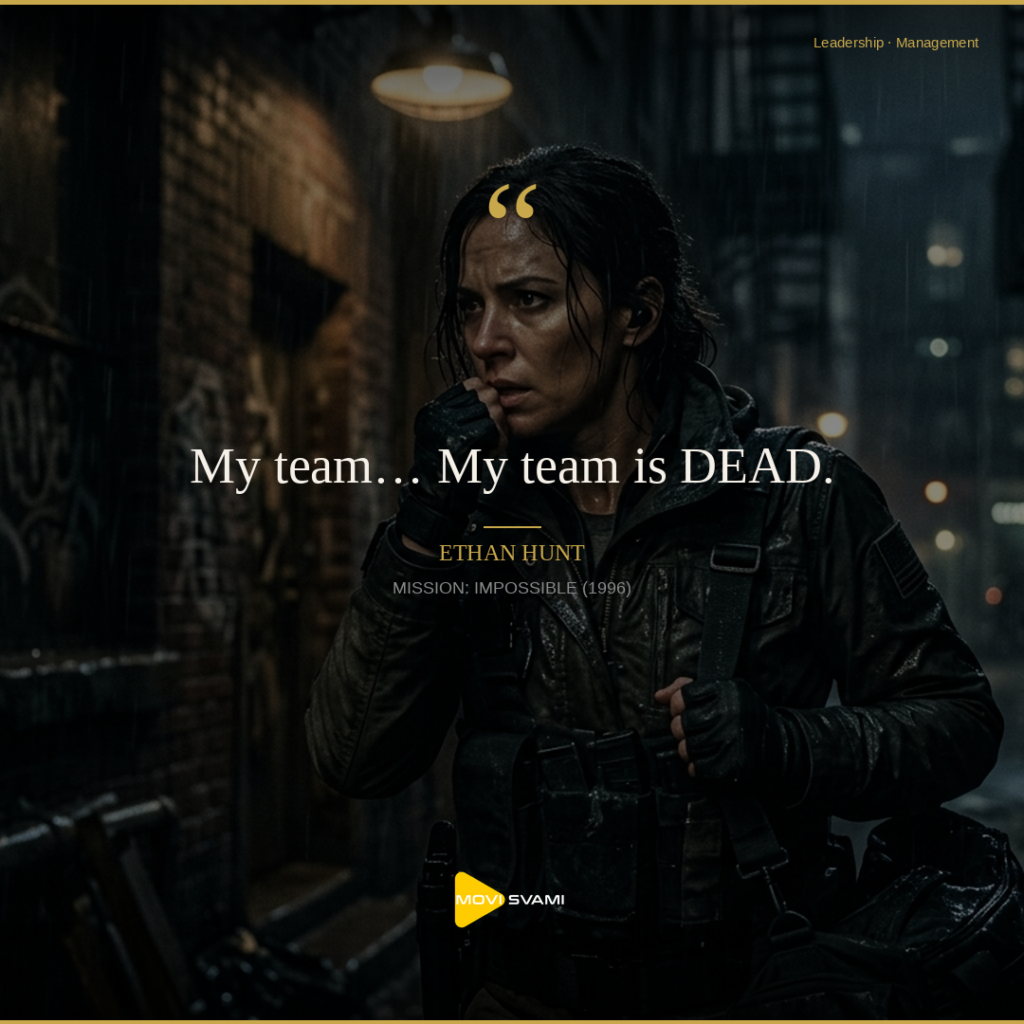
The rain-slicked streets of Prague blur into static as Ethan Hunt sprints through the aftermath of what should have been a standard extraction. In Brian De Palma’s 1996 thriller *Mission: Impossible*, the young operative staggers onto the Charles Bridge not merely traumatized, but professionally amputated. The entire Impossible Missions Force team dispatched to the embassy—veterans and specialists, each carrying irreplaceable institutional knowledge and cryptographic clearances—has been obliterated in a manufactured double-cross. The “accident” that kills them isn’t merely a tactical failure; it represents the catastrophic endpoint of organizational design optimized purely for efficiency without redundancy.
Hours later, cornered on the TGV hurtling toward London, Ethan confronts the impossible truth of his situation. “My team… My team is DEAD,” he gasps, the words fractured by adrenaline and horror. The statement carries weight beyond grief. In that moment, Hunt recognizes that his operational viability as a lone agent has evaporated alongside his colleagues. The IMF’s lean structure—designed for plausible deniability and minimal footprint—has concentrated catastrophic risk into a single point of failure. The team’s demise doesn’t just cost lives; it annihilates mission capability, leaving Ethan not merely mourning friends but navigating a complex geopolitical crisis without the specialized competencies his deceased teammates embodied. The quote echoes the dark reality of modern organizational fragility: when expertise is siloed and teams are stripped to skeletal minimalism, extinction-level events become statistical inevitabilities rather than remote possibilities.
Contemporary organizational theory has fetishized leanness as an unalloyed virtue. Startups boast of “two-pizza teams,” corporations celebrate “rightsizing,” and venture capital rewards capital efficiency measured in headcount minimization. Yet this architectural philosophy contains a fatal assumption: that environmental stability is the default state rather than the exception. Lean teams concentrate what operational researchers term “dependency risk”—the exponential amplification of failure probability when critical functions map to singular individuals. When budget constraints or aesthetic preferences eliminate overlap, organizations trade resilience for efficiency, effectively purchasing velocity with existential insurance premiums they can no longer afford.
The leadership imperative emerges at this intersection: the obligation to architect redundancy not as bureaucratic bloat, but as strategic continuity insurance. This requires distinguishing between *efficiency* (eliminating waste) and *fragility* (eliminating buffers), recognizing that cohesive teams need not be minimal teams, and that the cost of maintaining parallel competencies pales against the cost of operational discontinuity when key personnel depart, fail, or—as in Ethan’s case—are violently excised from the system.
In technology sectors, engineering teams confront this fragility through the morbid metric known as the “bus factor”—the number of developers who, if struck by a bus (or hired away by competitors), would irreparably compromise a codebase. High-functioning engineering organizations now deliberately implement “chaos engineering” not merely at the infrastructure level, but at the human resource level, enforcing cross-training and pair programming to ensure that critical system knowledge never calcifies within individual silos. Leaders must institutionalize documentation rituals and rotation protocols that feel inefficient in the short term but prove essential when senior architects depart unexpectedly.
Family-owned enterprises and professional service firms frequently succumb to “key person risk,” where decades of client relationships, tacit operational knowledge, and strategic vision reside exclusively in founders or rainmaking partners. Effective succession planning requires leaders to treat this concentration as a liability rather than a badge of indispensability. This means structurally decoupling client relationships from individual personalities, codifying decision-making frameworks that exist outside founder intuition, and maintaining parallel leadership development tracks that feel expensive until the moment they prevent organizational collapse during unplanned transitions.
The remote work revolution has introduced geographic concentration risks previously mitigated by physical colocation. When distributed teams rely on specific regional talent clusters—perhaps Eastern European developers or Southeast Asian operations centers—they replicate Ethan’s Prague scenario on a macro scale. Geopolitical instability, infrastructure failures, or localized pandemics can instantly incapacitate entire functional verticals. Prudent leadership now mandates geographic redundancy in team distribution, ensuring that no single time zone or municipality hosts the sole instance of a critical business function.
The IMF eventually rebuilds its capability, but the cinematic lesson endures for operational leaders: cohesion requires redundancy, not its absence. Lean is a tactic, not a theology, and the wise architect of teams builds not merely for the mission at hand, but for the catastrophe that history suggests is inevitable. Ethan’s haunted realization on that train serves as a permanent warning—when your team dies, if your organization dies with it, you have not built a lean enterprise; you have built a fragile one.