
# The Lasso Doctrine: How Belief Became the Ultimate Business Strategy
When Ted Lasso arrived at AFC Richmond with his folksy aphorisms and infamous “BELIEVE” sign taped above the locker room door, he appeared to be everything sophisticated sports management had evolved beyond. Here was an American football coach leading a Premier League football club, armed with nothing but optimism and homemade biscuits. It should have been a disaster. Instead, it became a masterclass in the most undervalued competitive advantage in business: authentic, embodied belief.
The 2021-2023 run of *Ted Lasso* transcended entertainment to become a cultural treatise on modern leadership. In an age of algorithmic management, remote work, and transactional employment relationships, Ted offered something radical: the idea that people perform best when they feel safest, that vulnerability is a leadership strength, and that belief—genuine, integrated, unshakeable belief—is not soft sentiment but hard strategy.
## The Architecture of Belief
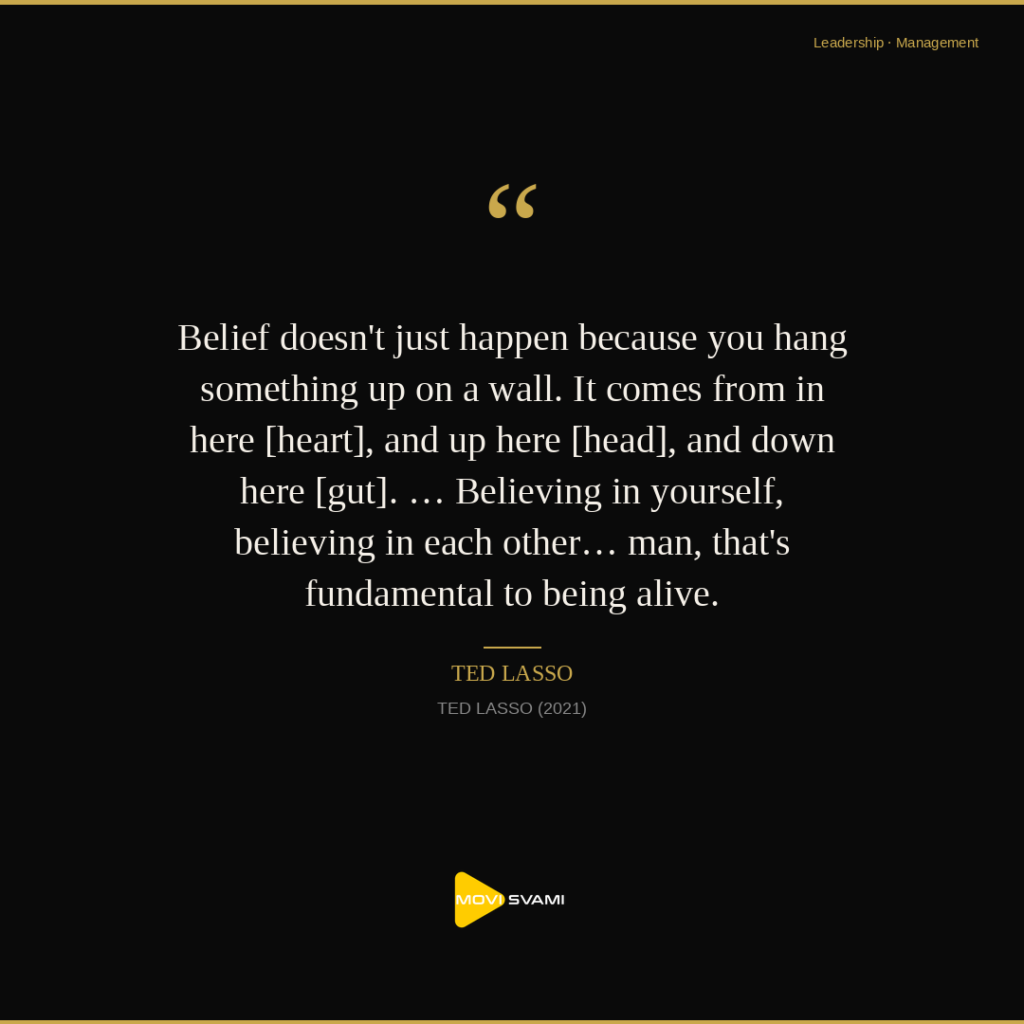
Ted’s famous locker room speech crystallizes the show’s thesis: “Belief doesn’t just happen because you hang something up on a wall. It comes from in here [heart], and up here [head], and down here [gut]… Believing in yourself, believing in each other… man, that’s fundamental to being alive.”
This tripartite model—heart, head, and gut—represents an integrated approach to leadership that contrasts sharply with binary management philosophies. It acknowledges that humans aren’t merely cognitive processors (head) or emotional reactors (heart) but embodied beings who rely on somatic intelligence (gut). Effective leadership must engage all three domains.
The “head” component requires strategic clarity. Ted understands the game of football (soccer) better than his detractors assume, but he subordinates tactical knowledge to relational intelligence. The “heart” component demands emotional availability—the willingness to sit with someone else’s pain without rushing to fix it. Witness Ted’s handling of Jamie Tartt’s father issues, or his support of Roy Kent through retirement anxiety. The “gut” component is the hardest to teach: the instinctive knowing when to push and when to pause, when to speak and when to listen.
## Confidence as Contagion
Contemporary leadership literature often discusses “psychological safety” in clinical terms. *Ted Lasso* demonstrates it in human terms. When Ted refuses to bench Jamie Tartt despite his toxic behavior, he’s not being naive—he’s recognizing that Tartt’s arrogance masks profound insecurity. By maintaining belief in Tartt’s potential even when Tartt doesn’t believe in himself, Ted creates the exact conditions required for transformation.
This is the contagion of confidence. Leadership research consistently shows that teams perform to the level of their leader’s belief in them. When a manager treats employees as capable, creative, and committed—even when current performance suggests otherwise—those employees internalize higher standards. Conversely, micromanagement signals distrust, which produces the very inefficiencies it seeks to prevent.
Nathan Shelley’s arc illustrates this vividly. When Ted elevates the shy kit man to assistant coach, he’s communicating that he sees potential others miss. This belief creates a feedback loop: Nate produces better work because he feels believed in. However, the show’s genius lies in depicting what happens when that belief isn’t maintained—when Nate feels unseen, he becomes destructive. Belief requires maintenance; it’s not a deposit but a ongoing investment.
## Strategic Vulnerability
Perhaps the show’s most revolutionary statement about leadership is that vulnerability isn’t weakness—it’s the foundation of authority. When Ted suffers panic attacks and eventually shares his struggles with the team, he doesn’t lose their respect; he deepens it. He models that high performance and mental health struggles aren’t mutually exclusive. This creates permission for others to bring their full selves to work.
In business contexts, this translates to leaders who admit mistakes, who acknowledge uncertainty, and who separate their worth from their win/loss record. When Ted divorces his wife, he doesn’t hide his grief from the team. When he fails to notice Nate’s growing resentment, he apologizes authentically. These moments of fallibility make his leadership more powerful, not less, because they signal that perfection isn’t required for belonging.
## The Safety Imperative
The research backing Lasso’s philosophy is robust. Google’s Project Aristotle, a massive study of team effectiveness, found that psychological safety—not talent, experience, or resources—was the single greatest predictor of team success. Teams where members felt safe to take risks, admit errors, and express disagreement outperformed teams with higher aggregate intelligence.
Ted operationalizes this through what we might call “radical belonging.” He learns every player’s name, their backstory, their fears. He cares about Sam’s Nigerian heritage and Isaac’s leadership struggles. This isn’t just being nice; it’s strategic intelligence. When people feel known, they’re willing to sacrifice for the mission. When they feel like interchangeable parts, they do the minimum required.
## From Entertainment to Methodology
The Business Application
*Business leaders can extract specific methodologies from Lasso’s approach:*
**The Curiosity Protocol:** Ted responds to hostility with questions rather than defenses. When Rebecca attempts to sabotage him, he brings her biscuits. When the press mocks him, he asks about their families. This disarms opposition and converts adversaries into allies.
**The Diamond Dogs Model:** Ted creates a peer support group (the “Diamond Dogs”) where leaders can be vulnerable without losing authority. This models that seeking help is leadership strength. Modern organizations should normalize peer coaching and executive therapy.
**The Lasso Feedback Loop:** Correction delivered with belief (“you’re better than this behavior”) produces change; correction delivered with disappointment produces compliance or resentment. Ted’s feedback to Jamie in Season 2—firm, clear, and rooted in belief in his potential—exemplifies developmental rather than punitive management.
## The Courage to Care
Ultimately, *Ted Lasso* suggests that the hard part of leadership isn’t the strategy—it’s the emotional labor. Maintaining belief in people when they disappoint you, staying curious when you’re angry, choosing kindness when cynicism is easier—these require tremendous discipline. Ted’s optimism isn’t naive; it’s a muscle he’s developed through pain.
The show’s final season grapples with the limits of this philosophy. Ted can’t save everyone (Nate’s betrayal). He can’t fix everything (his own depression). But the metric of success shifts. AFC Richmond doesn’t need to win the championship to prove the model works. They need to play as a team that trusts each other. They need to “be curious, not judgmental” (the show’s most famous quote, derived from Walt Whitman).
## Conclusion: The Business of Belief
As industries grapple with burnout, quiet quitting, and disengagement, the Lasso model offers a counter-narrative. Instead of optimizing for productivity, optimize for safety. Instead of managing performance, cultivate belief. Instead of treating employees as resources, recognize them as humans whose full participation requires full acceptance.
The “BELIEVE” sign isn’t just decor; it’s an operating system. In a world of scarcity and cynicism, the leaders who dare to believe—authentically, vulnerably, strategically—will attract and retain the talent that builds the future.
Ted Lasso didn’t just win games. He proved that when you lead with heart, head, and gut aligned, you don’t just change a team—you change lives. That’s not just good leadership. That’s a good life, applied to business.
And that, as Ted might say, is worth believing in.