
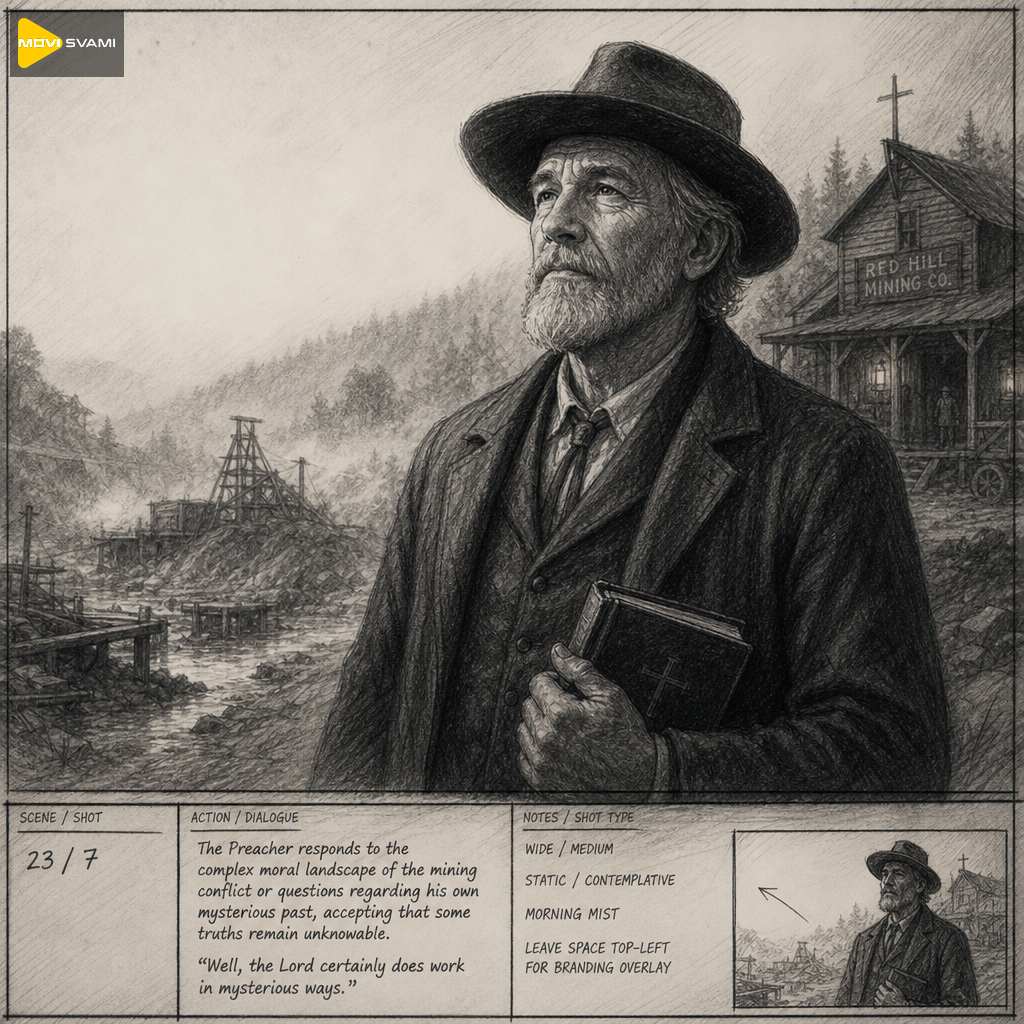
The dust settles over the Carbon Canyon mining camp as a lone figure emerges through the Sierra Nevada haze on a pale horse. In Clint Eastwood’s 1985 Western Pale Rider, the mysterious stranger known only as the “Preacher” arrives not with fire-and-brimstone sermons, but with an unsettling calm and a curious acceptance of fate’s complexity. He carries himself with the quiet confidence of someone who has learned that control is often illusion. When unexpected alliances form and violent confrontations unfold in the lawless territory controlled by the hydraulic mining baron LaHood, the Preacher offers a simple observation that cuts deeper than any bullet: “Well, the Lord certainly does work in mysterious ways.”
He delivers this line not as a theological cop-out, but as a statement of strategic clarity. Throughout the film, the Preacher recognizes that he cannot control every variable—the corrupt politics of the territory, the violent enforcers employed by LaHood, the fragile economic alliances of the independent pan miners he chooses to protect, or even his own mysterious past that seems to bridge the gap between mortal and supernatural. Yet he refuses to let this uncertainty paralyze him or drive him to false bravado. Instead, he operates with a profound intellectual humility: the acknowledgment that while he may not understand the full pattern of events or their ultimate destination, he can still act decisively within them, guided by principle rather than prediction.
In contemporary business discourse, we typically celebrate leaders who project unshakeable certainty. We expect executives to have the answer, to see around corners, to deliver five-year forecasts with unwavering confidence, and to communicate vision with absolute conviction. But research in organizational psychology and behavioral economics increasingly suggests that this expectation is not only unrealistic but potentially dangerous for organizational health. Intellectual humility—the willingness to acknowledge the limits of one’s knowledge, the fallibility of one’s perceptions, and the provisional nature of one’s strategic convictions—correlates strongly with better decision-making under pressure, more innovative teams, and resilient organizational cultures capable of weathering disruption.
The Preacher’s wisdom lies in recognizing that ambiguity is not a temporary state to be eliminated through better data or harder work, but rather a permanent condition of complex adaptive systems. When leaders model strategic acceptance of uncertainty, they create psychological safety for their teams to experiment without fear of blame, to voice dissenting opinions, and to update their beliefs when confronted with new evidence. They signal that complex challenges rarely yield to simple solutions, and that the courage to say “I do not know yet” or “I might be wrong” often opens strategic doors that false certainty slams shut.
Consider how this applies to crisis navigation and strategic pivots. When the COVID-19 pandemic disrupted global supply chains in 2020, organizations led by executives who admitted uncertainty and actively gathered diverse input adapted their business models significantly faster than those whose leaders pretended to possess contingency plans for every conceivable scenario. Strategic humility allows leaders to update their mental models in real-time, treating each new data point as valuable evidence rather than existential threat to their authority. Instead of defending flawed initial positions out of ego or sunk-cost fallacy, intellectually humble leaders pivot quickly and transparently, acknowledging that the “mysterious ways” of market disruption and technological change require constant recalibration of assumptions. They understand that admitting “we are navigating uncharted territory” does not signal incompetence, but rather creates the cognitive flexibility necessary for survival.
The principle extends directly to innovation architecture and research and development strategy. Alphabet’s X division (formerly Google X) explicitly hires for intellectual humility, recognizing that breakthrough technologies and “moonshot” innovations emerge primarily from teams willing to acknowledge what is not known rather than optimizing existing knowledge within comfortable parameters. When leaders create explicit space for ambiguity in the innovation process—resisting the administrative urge to prematurely define success metrics, constrain experimental pathways, or demand ROI projections for undefined solutions—they allow for serendipitous discoveries and adjacent possibilities. The Preacher did not know exactly how the independent miners would ultimately defeat LaHood’s hydraulic mining operation, but he created tactical conditions where possibility could emerge from chaos. Similarly, leaders who tolerate the discomfort of strategic not-knowing foster the generative conflict and creative abrasion necessary for genuine breakthroughs rather than incremental improvements.
Finally, consider the implications for stakeholder communication and trust architecture. In an era of radical transparency and instant information dissemination, leaders who acknowledge uncertainty build more durable trust with employees, investors, and customers than those who project false confidence that later unravels. When a CEO admits that a strategic pivot involves unproven assumptions, when a product leader acknowledges that timeline estimates are provisional based on current information, or when a founder confesses that the market is teaching them something unexpected, they invite collaborative problem-solving rather than passive dependency. This does not mean abandoning accountability or direction—it means distinguishing between unwavering commitment to core values and rigid attachment to specific tactical outcomes. By acknowledging that markets, technologies, and human systems often work in “mysterious ways,” leaders signal their own humanity while maintaining the adaptive capacity to seize opportunities that rigid planning would miss.
The next time you face a decision shrouded in ambiguity—whether navigating market volatility, managing team conflict, or betting on unproven innovation—resist the ego-driven urge to feign certainty. Channel the Preacher’s strategic humility. Acknowledge the mystery, embrace the uncertainty as information rather than threat, and lead forward anyway with principle as your compass. Because in a world of accelerating complexity and exponential change, the leaders who ultimately thrive will not be those who claim to see the clearest through the fog—but those brave enough to move forward while admitting they cannot yet see the destination, trusting that the path will reveal itself through motion, not prediction.