
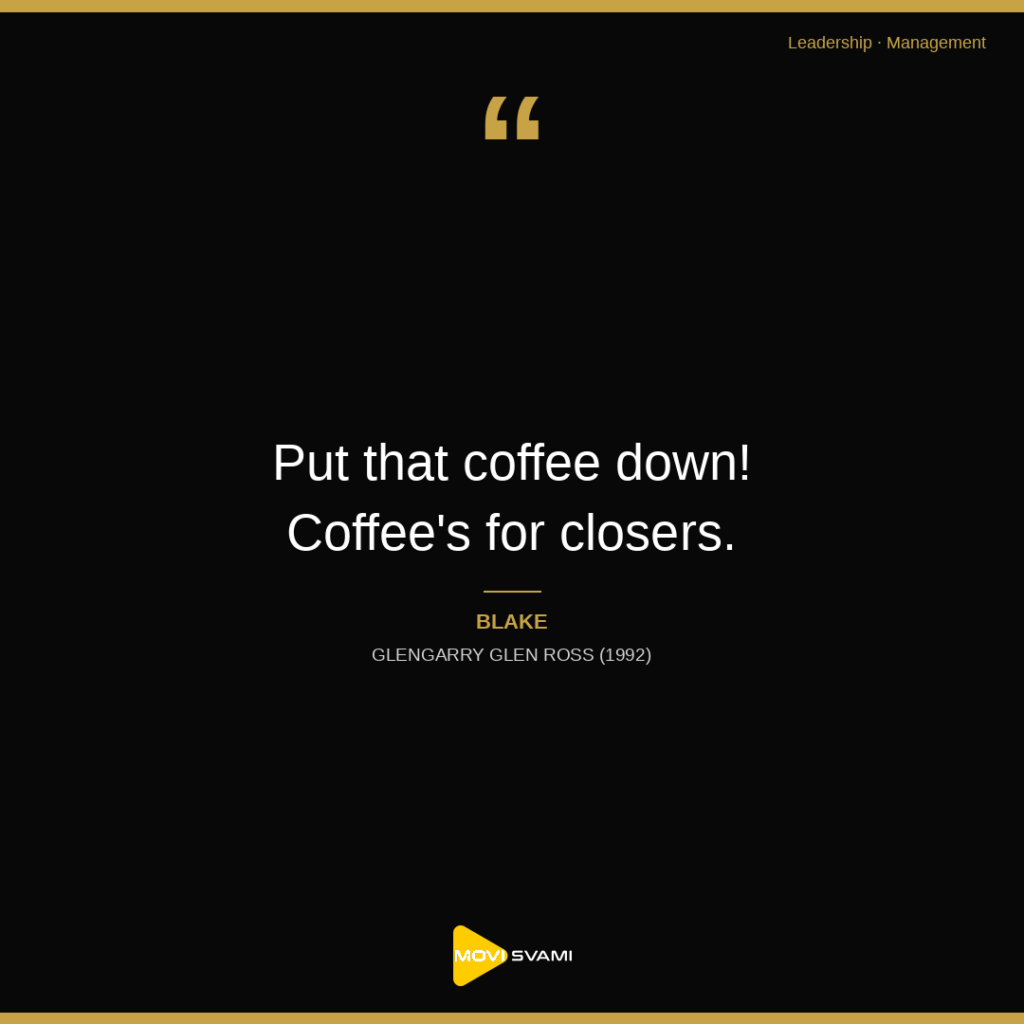
The fluorescent tubes hum above a drab Chicago sales office where four real estate agents nurse their resentments like cold coffee. Outside, rain slicks the streets, but the real storm arrives with the elevator’s ding: Blake, a corporate consultant sent by “Mitch and Murray,” steps onto the floor with the swagger of an executioner inspecting the gallows. He does not know these men’s names, their histories, or the months of dead leads accumulating in their filing cabinets. He knows only the numbers on a ledger, and he has come to deliver a message from downtown. The atmosphere shifts instantly from weary resignation to acute physiological threat. When Blake barks, “Put that coffee down! Coffee’s for closers,” he is not instituting a break-room policy. He is weaponizing status, transforming a mundane caffeinated beverage into a symbol of organizational worthiness, and establishing a brutal calculus: produce or perish.
Played with predatory precision by Alec Baldwin, Blake exists outside the company’s operational hierarchy; he is a mercenary brought in to shock the system. The line lands during his “brass balls” monologue—a performance designed to terrorize underperforming salesmen by announcing a high-stakes contest where winners receive the prized Glengarry leads and losers face termination. By confiscating the coffee, Blake performs a ritual stripping of dignity. The cup represents comfort, routine, and humanity; its removal signals the suspension of psychological safety. He constructs artificial scarcity around basic resources to trigger survival mode, ensuring that competition becomes not merely professional but existential. It is leadership through dominance, a model that mistakes intimidation for inspiration and assumes that stripping away security will somehow reveal excellence.
Neuroscience confirms what the salesmen instinctively feel: fear-based motivation activates the amygdala, flooding the prefrontal cortex with cortisol and narrowing attention to immediate threat avoidance. In such states, employees exhibit remarkable short-term compliance—deadlines are met, calls are made, quotas are achieved—because the brain perceives punishment as a predator requiring escape. Yet this neurological hijacking comes at a profound cost. Compliance born of terror is fundamentally different from commitment born of purpose. The former extracts effort through coercion; the latter invites discretionary energy through trust. When leaders weaponize status symbols like Blake does, they trigger zero-sum competition that destroys the collaborative tissue necessary for adaptive problem-solving. Team members begin hoarding information, sabotaging peers, and optimizing for individual survival rather than collective success, creating a transactional culture where loyalty is impossible because existence is temporary.
The critical distinction lies between pressure and panic. High-performance cultures require pressure—challenging stretch goals, transparent accountability, and rigorous standards that sharpen focus and drive flow states. Panic, however, occurs when pressure eliminates psychological safety, forcing cognitive resources toward threat management rather than creative output. Pressure asks, “How might we solve this complex problem together?” Panic demands, “Why haven’t you solved it yet, and who must be sacrificed?” Blake’s methodology induces panic. While it may generate a flurry of immediate activity—desperate voicemails, aggressive closes, ethical corner-cutting—it systematically degrades the capacity for complex judgment and long-term strategic thinking. The trap for executives is mistaking the adrenaline of panic for the momentum of high performance, conflating the silence of compliance with the alignment of commitment.
In sales environments already prone to volatility, Blake-style leadership creates a toxic feedback loop. When teams operate under existential threat—rank-and-yank performance reviews, public leaderboards of shame, or resource withholding—short-term metrics often improve. Activity increases; pipelines swell with forced prospects; quarterly numbers may spike as reps scramble to secure their position. But beneath the surface, the machinery fractures. Ethical standards erode as desperate reps misrepresent products to force closes. Institutional knowledge evaporates as top performers flee to competitors offering stability. Collaboration on pitch decks and sharing of best practices cease because helping a colleague might elevate them above you in the rankings. The long-term cost is a culture of learned helplessness where customer relationships become transactional extraction points rather than strategic partnerships, and turnover costs ultimately erase the quarterly gains won through intimidation.
Where creativity and complex cognition are the primary outputs, Blake’s approach backfires catastrophically. Engineering and knowledge work require psychological safety—the shared belief that the team is safe for interpersonal risk-taking. When leaders withhold “coffee,” literally or metaphorically, they trigger defensive routines: code hoarding, documentation gaps, and risk aversion masquerading as diligence. Innovation requires the ability to propose half-formed ideas, admit errors, and iteratively fail without status degradation. A developer fearing humiliation will obscure bugs until they become systemic failures; a researcher under status threat will pursue safe, incremental projects rather than breakthrough discoveries. Blameless postmortems transform into blame-heavy inquisitions, and the cognitive load of managing fear leaves no bandwidth for the abstract reasoning that creates competitive advantage in knowledge economies.
Blake’s zero-sum aggression mirrors distributive negotiation tactics where one party attempts to claim maximum value through intimidation. When counterparties feel cornered—stripped of their metaphorical coffee—they respond with positional bargaining, information asymmetry, and relationship destruction. While this may secure short-term concessions, it destroys the trust necessary for integrative solutions that expand the pie. Sustainable negotiation requires the opposite posture: mutual gain through interest exploration and status elevation of all parties. The Blake approach leaves value on the table by ensuring future transactions become hostile, monitored, and litigious rather than collaborative, transforming potential partners into permanent adversaries who guard their resources as jealously as the salesmen guarded their leads.
Blake exits the office as abruptly as he arrived, leaving behind a poisoned well of anxiety masquerading as urgency. For the executive watching quarterly dashboards, the appeal is understandable: fear produces immediate, visible motion. But leadership is measured not in moments of compliance captured in the silence that follows a shouted command, but in the longitudinal commitment of teams willing to navigate ambiguity together. As you review your own management rituals—the incentives you set, the status you withhold, the scarcity you manufacture—ask yourself: Are you building a culture of closers, or merely training survivors to guard their coffee until the next threat arrives?