
The dinner table at the Johnson household is set with the careful formality of 1960s courtship, yet the atmosphere carries the texture of a professional crucible. Outside, the Virginia evening settles over a segregated landscape where the laws of physics remain democratic even when the lunch counters are not. Jim Johnson, a National Guardsman visiting from out of town, regards Katherine Goble Johnson across the cuts of roast beef with a mixture of admiration and condescension. When he suggests, perhaps half-jokingly, that her position at NASA Langley must be a novelty—a temporary allowance for women in a man’s world—he does not anticipate the precision of her response. It is here, in this domestic space, that Katherine deploys the same clarity she applies to orbital mechanics. She does not raise her voice. She simply recalibrates his understanding of power.
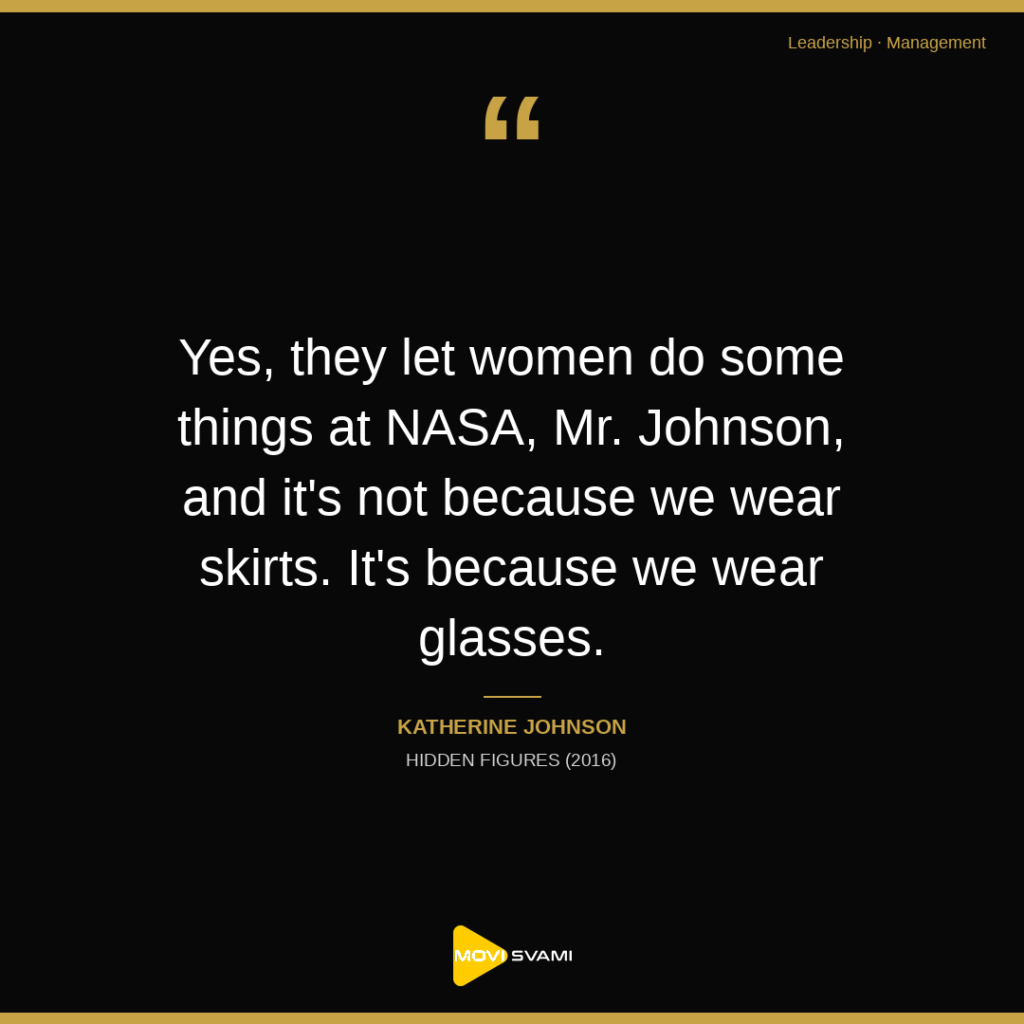
“Yes, they let women do some things at NASA, Mr. Johnson, and it’s not because we wear skirts. It’s because we wear glasses.”
The line lands with the weight of an axiom. Jim has mistaken tokenism for opportunity, assuming Katherine’s presence in the Space Task Group is a bureaucratic kindness rather than a strategic necessity. Katherine corrects this misconception not with indignation but with surgical accuracy. The “skirts” represent the superficial markers of gender that institutions tolerate when seeking favorable publicity or compliance. The “glasses” symbolize the analytical apparatus—the pure capacity to compute, verify, and solve—that makes her indispensable. She is not there to fulfill a quota. She is there because John Glenn’s trajectory cannot be calculated without her, because the Mercury capsule will not splash down safely without her verification of the electronic computer’s numbers. The stakes in this moment extend beyond her personal dignity; they encompass the unrecognized expertise of the West Computers, the Black women mathematicians whose competence had been rendered invisible by segregated bathrooms and unlisted authorship. Katherine insists on being seen through the lens of contribution, not concession.
This reframing offers a sophisticated model for contemporary leadership, one that distinguishes between positional authority and authentic influence. Authentic leaders do not accumulate power by enforcing hierarchies; they amplify the unheard by recalibrating what the organization chooses to see. Katherine’s leadership is demonstrated not through title—she holds none—but through her unwillingness to have her expertise filtered through the distorting lens of institutional prejudice. When she eventually demands entrance to the Pentagon-sanctioned engineering meetings, she is not asking for charity. She is requiring the institution to align its perception with reality. The logic is immutable: visibility flows not from granting permission but from removing the cataracts of bias that obscure raw capability. In this sense, leadership becomes an act of verification—ensuring that the glasses, not the skirts, determine who is heard.
Consider the manager reviewing quarterly projections in a conference room where junior analysts hesitate to interrupt senior voices. The pattern is familiar: the loudest opinions dominate while the most accurate calculations remain unspoken, trapped behind invisible barriers of tenure and tone. Here, Katherine’s logic applies directly. The effective leader does not simply invite quiet voices to speak; they redesign the room’s architecture so that analytical rigor cannot be ignored. When a junior team member possesses the data that resolves a strategic impasse, the manager’s role is to clear the path for that contribution to reach its destination, bypassing the hierarchies that would otherwise mute it. The barrier is not merely psychological; it is structural, and it requires the same deliberate dismantling that Katherine demanded when she needed to see the redacted source data.
In talent assessment, the “skirts versus glasses” dichotomy reveals itself most acutely in promotion pipelines where potential is inferred from pedigree rather than demonstrated output. A director examining succession candidates often relies on visibility metrics—who networks skillfully, who speaks confidently in town halls—while overlooking the engineer who debugged critical infrastructure at 2:00 AM without an audience. Authentic leadership requires auditing these evaluation criteria, stripping away the demographic signifiers and stylistic preferences that function as modern-day skirts, ensuring that the glasses—the capacity for genuine problem-solving—determine advancement. This means scrutinizing the language in performance reviews, where competence is often coded differently across gender and racial lines, and ensuring that promotion materials speak in calculations rather than atmospherics.
The principle extends further to hiring and team composition, where unconscious bias frequently disguises itself as cultural fit or tradition. When NASA initially resisted integrating women into core engineering roles, it was not merely a failure of equality but a failure of cognition, an inability to process the evidence of capability standing directly before it. Today’s equivalents persist in industries where technical roles remain homogenous not because talent is scarce, but because selection processes still search for skirts—familiar profiles, comfortable demographics, candidates who remind the interviewer of themselves—rather than glasses. The leader who clears the literal and figurative barriers, as Al Harrison eventually does by removing the “Colored Computers” sign and the physical distance to the restroom, recognizes that institutional legitimacy is earned not by maintaining segregation but by accelerating competent contribution. The sign comes down not because the law requires it, but because the math does.
Where in your organization does competence remain invisible because it wears the wrong uniform, arrives through the wrong door, or speaks with the wrong accent? What critical calculations remain uncomputed because you have not yet removed the barriers that obscure the view?