
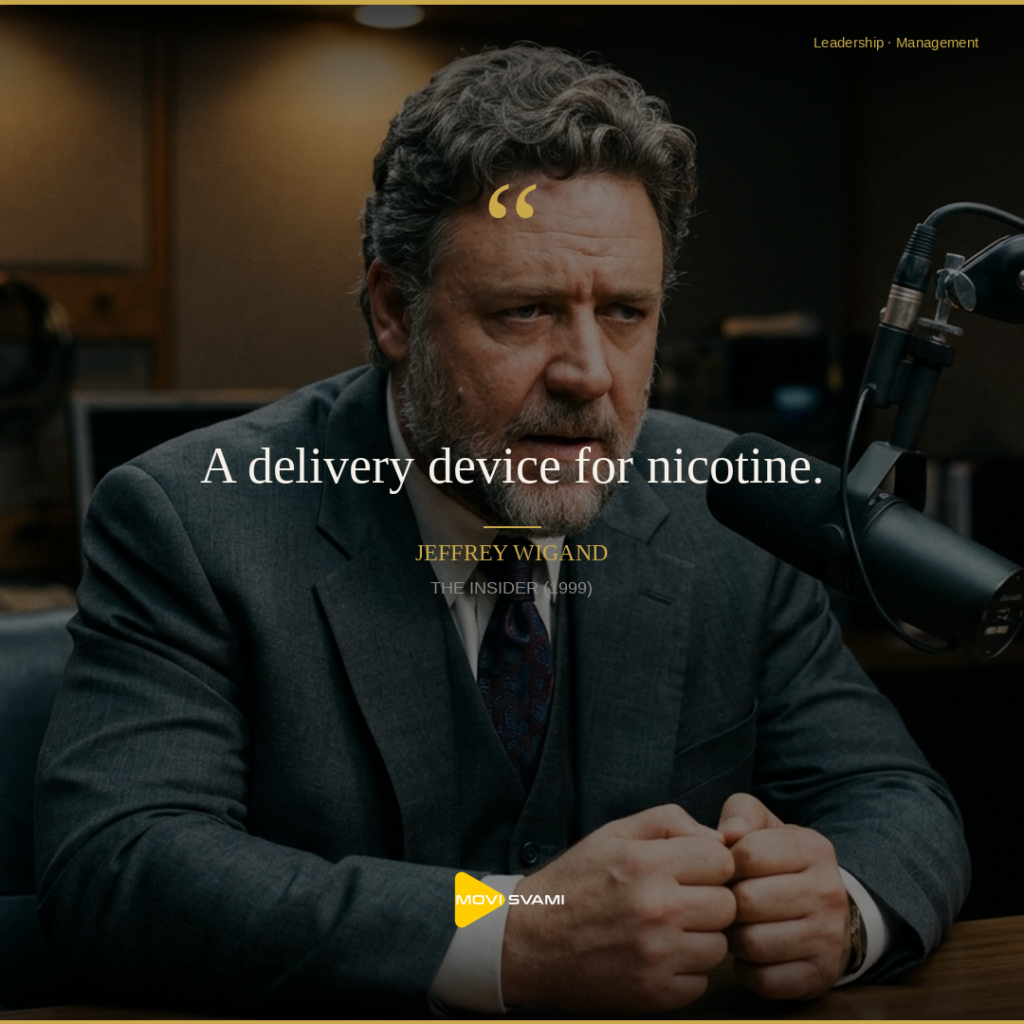
The deposition room is lit too brightly for comfort, the kind of institutional fluorescence that reveals every bead of sweat, every tremor in the hands. Jeffrey Wigand sits before the cameras and attorneys, a former Vice President of Research and Development for Brown & Williamson Tobacco Company who has already lost his marriage, his home, and his anonymity. When he finally testifies to what he knows—that the tobacco industry had long understood it was not selling an agricultural product but rather engineering a chemical delivery system—his voice carries the weight of a man who has seen the architecture of deception from the inside. The cigarette, he explains, is not simply tobacco rolled in paper. It is, in the clinical terminology he helped develop, “a delivery device for nicotine.”
Wigand’s choice to speak publicly violated his confidentiality agreements and exposed him to severe legal and financial retaliation. Yet his testimony was pivotal not merely because it revealed that cigarettes were addictive—society had long suspected as much—but because it demonstrated the *intentionality* behind that addiction. Brown & Williamson had chemically engineered their products to maximize nicotine impact through ammonia chemistry and pH manipulation, ensuring efficient delivery of the drug while masking harshness that might discourage consumption. The quote “a delivery device for nicotine” encapsulates a strategic pivot that occurred in corporate boardrooms: cigarettes were no longer to be understood as leaves people chose to smoke, but as mechanisms designed to create and sustain dependency. The stakes transcended individual liability; they implicated the fundamental business model of an entire industry, one that had prioritized revenue preservation over the physiological autonomy of its consumers.
What emerges from Wigand’s testimony is a stark lesson in institutional fragility: when a business plan requires the degradation of product integrity to sustain itself, the enterprise is structurally unsound, regardless of near-term profitability. Ethical leadership in this context means recognizing that transparency is not a public relations liability to be managed, but rather the essential infrastructure of sustainable value creation. The tobacco industry’s long-term cost was not merely the $246 billion Master Settlement Agreement, but the permanent destruction of stakeholder trust—a form of capital far more difficult to rebuild than financial reserves. Organizations that treat ethics as a constraint upon strategy inevitably discover that the reverse is true: unethical strategy is a constraint upon longevity. When information asymmetry or engineered dependency becomes the primary driver of revenue, the business model accrues “reputational debt” that compounds until systemic collapse becomes inevitable.
This dynamic—where ethics becomes not a moral abstraction but a strategic imperative—repeats across industries where revenue models outpace product integrity. Consider the architecture of contemporary social media platforms. Like the cigarette designers Wigand exposed, platform engineers have sophisticated understanding of variable reward schedules and dopamine loops. When engagement metrics—time-on-site, ad impressions, data extraction—become the dominant measure of success, the “product” subtly transforms from a communication tool into a delivery device for psychological dependency. The business strategy prioritizes the efficiency of user capture over the stated mission of connection, creating the same institutional fragility Wigand witnessed: a model that requires users to remain unconscious of the mechanism’s true function.
Financial services present another theater where revenue models often supersede product integrity. Complex derivatives, payment structures obscured by fee layering, or “buy now, pay later” instruments marketed to vulnerable demographics all share the tobacco industry’s original sin: engineering opacity into the product’s core. When profitability depends on the customer’s inability to comprehend the true cost or risk structure, the firm is not engaged in value exchange but in extraction. The 2008 financial crisis demonstrated how quickly such models unravel when transparency is forcibly imposed; the subsequent regulatory environment and lasting reputational damage to major institutions illustrate that unethical strategy carries compound interest.
Even within the contemporary ESG movement, we observe instances where ethics is treated as marketing veneer rather than operational infrastructure. Corporations that purchase carbon offsets to neutralize fundamentally destructive supply chains, or that issue sustainability reports while lobbying against climate legislation, adopt the same strategic posture as Big Tobacco in its defensive years. They treat transparency as a narrative to be managed rather than a structural reality to be built. The result is “greenwashing”—a delivery device for corporate conscience that enables continued consumption without systemic change. As detection methods improve and stakeholder scrutiny intensifies, these organizations face the same inflection point Wigand described: the moment when the engineering of deception becomes more costly than the engineering of integrity.
When reviewing your organization’s five-year strategic roadmap, consider where the pressure to optimize revenue might be quietly compromising the integrity of what you actually deliver. Are you building value, or merely optimizing a delivery device?