
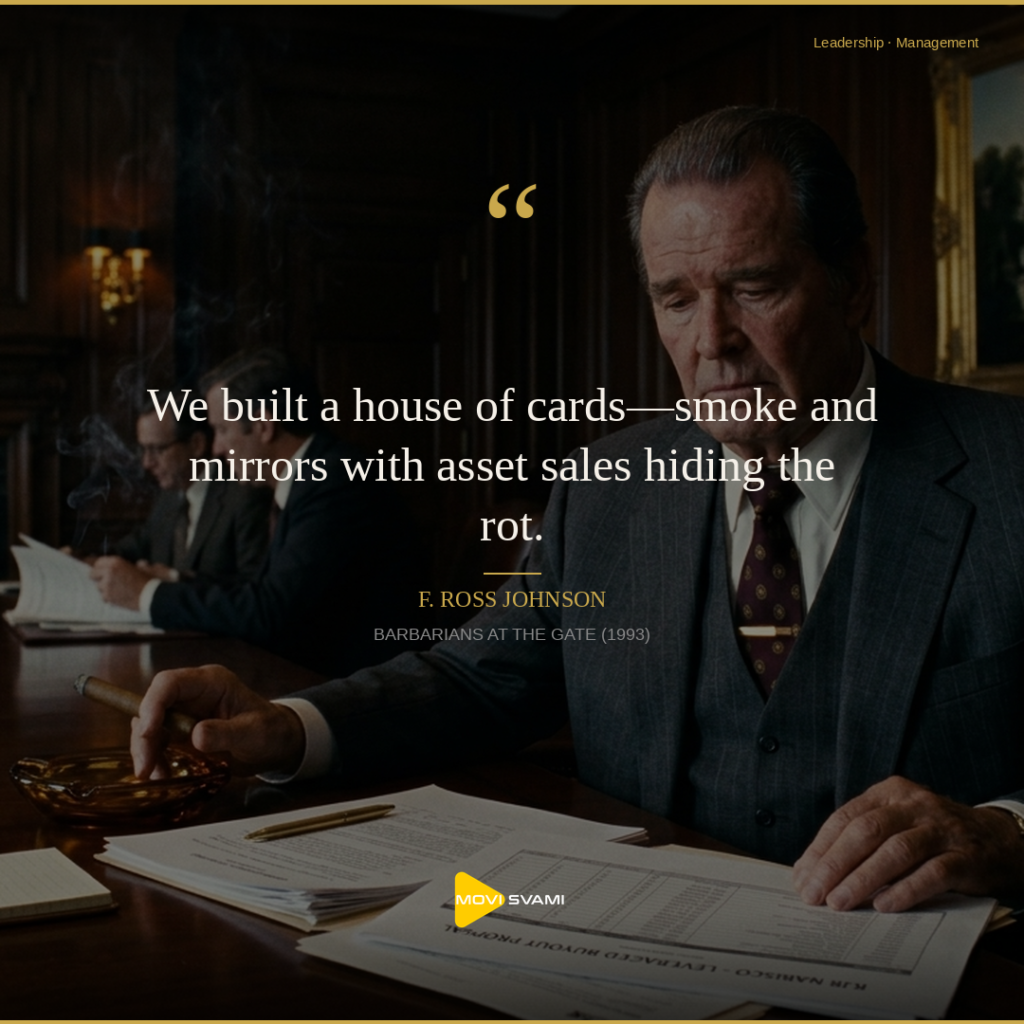
The mahogany had never looked darker. In the hushed silence of the RJR Nabisco boardroom, far above the Winston-Salem tobacco fields and the cookie factories below, F. Ross Johnson—played in the 1993 HBO film *Barbarians at the Gate* by a weary, magnificent James Garner—stared at the buyout offer that was supposed to crown his career. Outside, the 1980s leveraged buyout machine was grinding toward its $25 billion crescendo. But inside that room, the oxygen had thinned. Johnson wasn’t looking at a triumph; he was looking at a cadaver he had personally dressed in evening wear. The debt structure he had engineered to keep shareholders happy and predators circling had become the very thing suffocating the enterprise. It was in that suffocating moment, with KKR’s barbarians already at the gate, that the illusion shattered.
“We built a house of cards,” Johnson admits, the cigar smoke no longer seeming celebratory but rather votive, offering cover for the rot. “Smoke and mirrors with asset sales hiding the rot.” The line lands like a confession, not because Johnson lacked business acumen—he was a brilliant operator who had streamlined brands and expanded market share—but because he had spent years mastering the art of appearing solvent rather than actually being so. By monetizing assets to prop up earnings per share, by treating the balance sheet as a source of cosmetic surgery rather than structural engineering, he had masked a debt-to-equity ratio that had quietly moved from aggressive to lethal. The market capitalization looked heroic; the actual enterprise value, once you stripped away the financial engineering, was on life support. What was at stake was not merely his severance or his legacy, but the recognition that his leadership had confused liquidation tactics with corporate strategy.
The scene reveals a pathology that remains endemic in executive suites: the conflation of market cap with corporate health. Johnson’s tragedy—and it is a tragedy of management science, not merely melodrama—is that he optimized for the metric the Street could see while neglecting the ratios that determine actual survival. Leadership, at its most fundamental, is the stewardship of organizational life expectancy. Yet too many executives treat debt as a lever for returns without calculating it as a drag on endurance. Johnson’s “smoke and mirrors” represents the ultimate fiduciary hallucination: the belief that you can sell the furniture to pay the mortgage indefinitely, that asset sales can substitute for cash flows, and that a rising stock price disinfects a deteriorating capital structure. When the LBO barbarians arrived, they weren’t destroying a healthy company; they were simply pulling the sheet off a body that had already stopped breathing, revealing that the equity cushion had been thin air all along.
Consider the modern CFO staring at a dashboard glowing with vanity metrics while covenant ratios tighten like a tourniquet. She has spent quarters celebrating enterprise value while net debt-to-EBITDA ratios climbed silently past 4.5x, then 5.5x, entering the territory where a single basis-point shock in the credit markets triggers technical default. The market cap still looks robust on the Bloomberg terminal, but the interest coverage ratio has deteriorated to the point where operational hiccups become solvency crises. Johnson’s sin was not greed; it was the failure to distinguish between *liquidity*—having cash on hand—and *solvency*—having a structure that can survive stress. Leadership requires the discipline to ignore the standing ovation of the stock price and listen instead to the creaking weight of the leverage.
This pathology appears in three distinct scenarios that echo Johnson’s boardroom reckoning. First, consider the technology founder who has raised successive rounds at escalating valuations, each predicated on revenue multiples that assume infinite runway, while the burn rate consumes eighteen months of cash and customer acquisition costs outpace lifetime value by disturbing margins. The cap table looks like a triumph; the cash-flow statement reveals a corpse in motion. The founder, like Johnson, believes that the next asset sale—whether a secondary offering or a strategic divestiture—will bridge the gap, failing to recognize that each dilutive event weakens the structural integrity of the remaining equity.
Second, observe the legacy manufacturing executive who has spent a decade juicing earnings per share through aggressive stock buybacks, shrinking the equity base while deferred maintenance on plant and equipment mounts in the footnotes. The P/E ratio appears attractive to analysts, but the debt-to-equity ratio has inverted, and the maintenance capex required to keep the machinery running has been treated as discretionary. The smoke of accounting optics hides the rot of physical depreciation. When the covenant comes due, there is no portfolio of cookie brands left to sell to satisfy the lenders; the assets have been stripped to wallpaper over quarterly targets.
Third, examine the private-equity-backed CEO who treats normalized EBITDA as distributable cash, ignoring that the “adjustments” required to reach that number—add-backs for one-time costs that recur annually, working capital expansions that will never reverse—represent liabilities dressed up as earnings. The dividend recapitalization looks like a victory for sponsors, but the additional leverage layered onto the operating company has transformed the entity from a going concern into a speculative financial instrument. When the refinancing wall approaches, there is no operational fix available; the house of cards has been built too high on too narrow a base.
The lesson of Johnson’s house of cards is not that leverage is evil or that ambition is fatal. It is that leadership requires a pitiless assessment of which metrics determine survival and which merely determine perception. Before your next board meeting, ask yourself: which three ratios on your dashboard actually predict corporate life expectancy, and which are simply smoke designed to keep the barbarians from noticing the rot?