
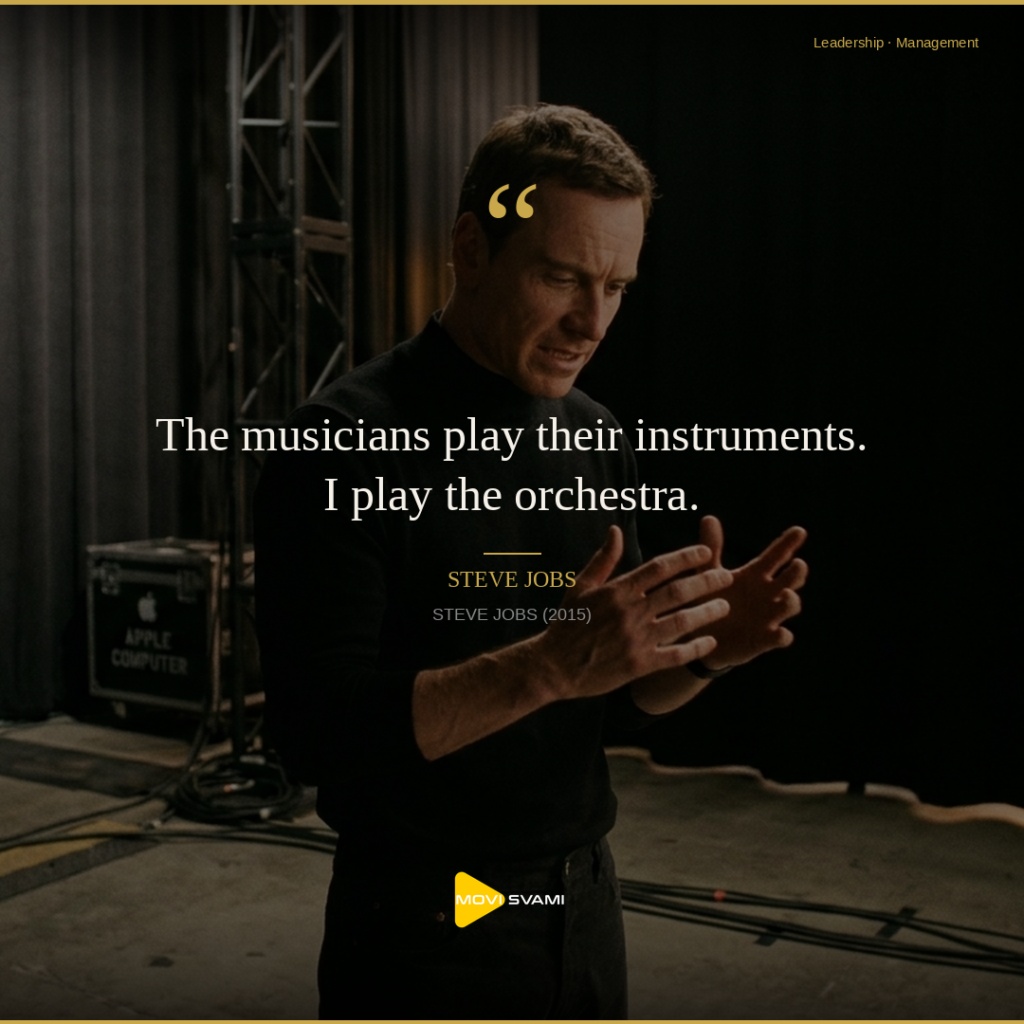
Fluorescent lights hum above the cramped corridors of the Flint Center, 1998. Moments before the curtain rises on the iMac, Steve Jobs stands in the wings, impervious to the din of anticipation. He is not rehearsing code, nor is he stress-testing circuitry. Instead, he is ensuring that the translucent blue plastic of the chassis reads as friendly rather than toy-like, that the typography on the screen matches the curvature of the hardware, and that the narrative of “Think Different” has already begun in the audience’s mind before he speaks a single word. When pressed to define his contribution to the machine—his tangible, technical fingerprint—he offers a metaphor instead of a schematic: “The musicians play their instruments. I play the orchestra.”
This declaration arrives during the third act of Danny Boyle’s *Steve Jobs* (2015), written by Aaron Sorkin, at a moment of acute vulnerability. Jobs, portrayed by Michael Fassbender, faces accusations of parasitism. He is not an engineer in the Wozniak mold; he does not solder boards or write kernels. Chrisann Brennan confronts him with the brutal arithmetic of creation: if he does not manufacture the components, what exactly does he make? The answer reframes the debate entirely. Jobs does not deny his technical deficiency; he transcends it. To play the orchestra is to accept that value creation in complex products no longer resides within individual components—faster processors, elegant code, sleek packaging—but in the invisible architecture that binds them. The stake in this scene is not merely personal vindication but a defense of a particular species of leadership: one that treats product development as compositional rather than constructional.
The leadership principle embedded here is systems thinking elevated to an art form. Traditional management often organizes product development as a relay race: research passes the baton to engineering, which hands off to manufacturing, which dumps finished goods into marketing’s lap. The “orchestra principle” rejects this sequential fragmentation. Instead, it posits that a product is an emergent property of simultaneous, interdependent performances. The conductor does not produce sound; she shapes time, balances dynamics, and ensures that the oboe’s solo does not obliterate the viola’s counterpoint. Similarly, the product leader’s mandate is to prevent functional excellence from becoming systemic discord. Brilliant engineering is noise if it serves no narrative; stunning design is mere decoration if it obscures utility. The leader’s instrument is the system itself—the calibration of trade-offs, the enforcement of interfaces, and the ruthless elimination of elements that threaten harmonic coherence.
This demands a peculiar form of negative capability: the strength to refrain from playing. A conductor who picks up a violin mid-symphony destroys the very integration she seeks to create. In product terms, this manifests as the discipline to not add features simply because they are technically feasible, to not pursue markets that dilute the brand’s acoustic signature, and to not allow organizational silos to optimize locally while degrading the global experience. It is the recognition that product vision is not a roadmap of destinations but a score of relationships.
Consider the critical intersection of end-to-end integration versus modular assembly. The personal computer industry of the 1980s and 90s operated as a modular symphony: IBM-compatible hardware ran Microsoft software, which interacted with third-party peripherals in a cacophony of driver conflicts and design discontinuities. Jobs’s insistence on controlling hardware, operating system, and industrial design was not mere control-freak economics; it was an attempt to eliminate the seams between components. When the software’s reflection in the screen’s glass feels inevitable rather than incidental, the orchestra is in tune.
Second, the temporal coordination across functions. In most organizations, marketing and engineering operate on different clocks: engineering works in sprints toward technical completion while marketing builds campaigns toward launch windows. The orchestra principle demands a unified tempo. The announcement is not the end of the process but a beat in the same measure. This requires the product leader to act as a metronome, ensuring that the story told on stage cannot be undermined by the reality of the shipping product, and conversely, that technical innovations find their emotional expression in the market’s ear. It prevents the dissonance of a product that is “great but poorly marketed” or “well-marketed but unfinished.”
Finally, aesthetic coherence as functional requirement. The NeXT Cube’s magnesium casing, its black-and-white user interface, and its Stanford-derived typography were not stylistic indulgences but systemic assertions. Each element reinforced the others to signal “academic workstation” rather than “home computer.” The removal of the floppy drive on the iMac was not a technical deletion but a compositional choice: removing a noisy instrument that was throwing the rest of the section out of balance. The product leader must treat the product’s surface, its interaction model, and its technical substrate as motifs in a single theme, ensuring that no detail contradicts the whole.
The musicians play their instruments; the leader plays the relationships between them. As you assess your own organization, ask not whether your functional teams are world-class soloists, but whether they are listening to one another. Ask whether you are optimizing the violin section or conducting the symphony. What is the one instrument currently drowning out your product’s true voice—and do you have the resolve to lower its volume?