
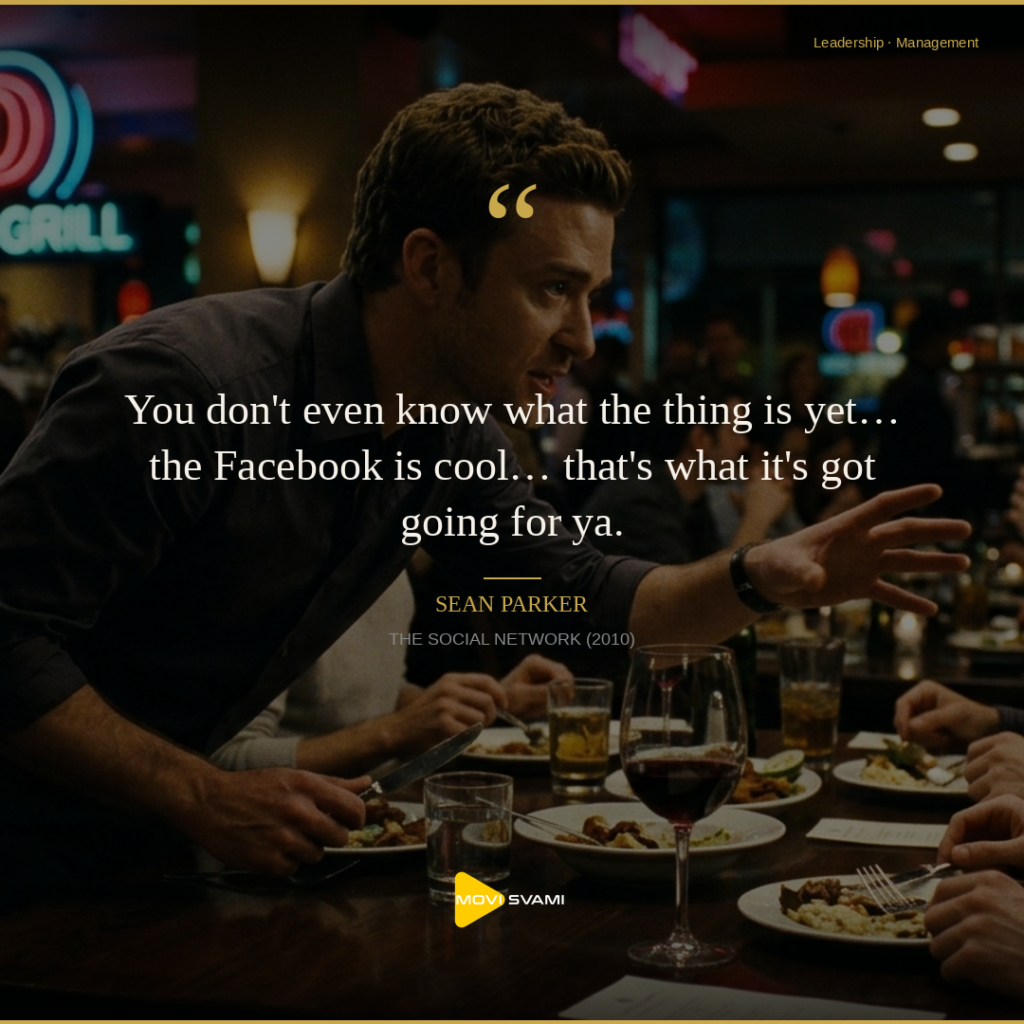
It happens halfway through the meal, after the oysters but before the check. Eduardo Saverin clutches his leather folio, ready to discuss ad revenue and server costs, when Sean Parker—Napster royalty, arrived late and underdressed—leans across the table and stops the conversation cold. The Edison bulbs glint off his glasses as he dismisses the business plan with a wave. “You don’t even know what the thing is yet,” he tells them, ignoring the spreadsheets. “The Facebook is cool. That’s what it’s got going for ya.” In that moment, the axis of power shifts. The company ceases to be a Harvard dorm-room project guided by conventional business school wisdom and becomes something feral, iterative, and momentum-driven.
Parker’s line lands with particular force because it arrives precisely when Eduardo is attempting to impose order on chaos. He wants forecasts, burn rates, and revenue models—markers of strategic control. Parker counters not with a different financial model, but with an epistemological one: the product is not yet knowable. To formalize a business plan for a mutable social artifact is to mistake the map for the terrain. What matters is not the perfection of the planning document, but the velocity of the signal. “Cool” here is not mere adolescent aesthetics; it is a heuristic for product-market fit before the metrics exist to measure it. The stakes could not have been higher. Had Eduardo’s comprehensive planning won the argument that night, Facebook might have pursued early advertising deals that would have calcified its user experience, destroyed its exclusivity, and neutralized the very network effects that made it valuable. Parker understood that in zero-gravity markets, premature monetization is a form of strategic suicide.
This scene illuminates a fundamental inversion in how we conceptualize leadership under uncertainty. Traditional strategic management—rooted in Porter’s five forces and detailed scenario planning—presumes a relatively stable competitive landscape where information is costly but obtainable, and where advantage comes from positioning against known rivals. Yet Parker embodies an emergent, “lean” logic that treats strategy not as a blueprint to be executed, but as a hypothesis to be invalidated. The comprehensive business plan becomes a liability when the environment is volatile; it anchors the organization to assumptions that become obsolete before the ink dries. Instead, orientation replaces planning. The leader’s function shifts from architect to cartographer, mapping the terrain in real time while the expedition is already marching. “Cool” is simply the first observable signal that the product is generating organic momentum—a necessary precondition for any sustainable competitive advantage. Without that resonance, no amount of planning creates adoption; with it, monetization is a problem that can be solved later by better-resolved minds.
This is not, however, an argument for recklessness or the abdication of financial discipline. Rather, it recognizes that in network-effect businesses (and increasingly, in most digital transformations), the cost of delay exceeds the cost of imperfection. The “cool” factor generates the user data and behavioral insights that allow for *informed* iteration; comprehensive planning in a vacuum generates only speculation. When Parker advocates for cool over commerce, he is advocating for a sequence: resonance first, optimization second. The leader who waits for the perfect plan before shipping the imperfect product usually inherits a market already captured by someone who shipped on Tuesday.
Consider the founder agonizing over the tenth revision of a SaaS platform, delaying launch until the onboarding flow includes enterprise-grade SSO integration, custom reporting dashboards, and a white-glove implementation protocol. The Parker principle suggests the opposite: strip the feature set to the single interaction that makes early users feel like insiders, launch to a cohort of five hundred, and let their behavior dictate the roadmap. The “cool” factor here is the specific delight of the core action—the photograph shared, the document collaborated upon, the connection made. If that resonance is absent, no amount of infrastructure will salvage the product; if it is present, the users will tolerate (and even suggest) the missing features. Leaders must recognize when their obsession with operational completeness is actually fear masquerading as diligence.
Inside established organizations, digital transformation efforts often collapse under the weight of their own governance. Executives commission eighteen-month change management programs, complete with swim-lane diagrams and ROI projections, only to watch adoption flatline. The Parker approach to internal leadership suggests seeding change through “cool” precedents rather than comprehensive mandates. Identify one workflow—expense reporting, team communication, project management—and replace it with a tool that generates organic advocacy because it feels different, faster, or slightly illicit compared to corporate standard. When employees begin pulling the new tool into their routines because it grants them status or efficiency, the transformation has already begun. Only then does leadership codify the change with policy. Momentum creates the architecture; architecture rarely creates momentum.
When entering new markets—whether expanding a consumer app into Southeast Asia or launching a professional service in a secondary city—leadership teams often over-invest in market analysis and localization strategy before testing appetite. The iterative alternative involves a “cool” beachhead: a lightweight, unscaled presence that tests whether the core value proposition generates the same cultural resonance. If early adopters in Bangkok or Austin begin behaving like the users in Boston—sharing the product unprompted, creating unauthorized use cases, demanding access—then the comprehensive infrastructure (localized support, supply chains, regulatory compliance) is justified. If the signal is absent, the firm has saved millions in planned obsolescence. Strategy becomes a function of validation, not prophecy.
The uncomfortable truth Parker delivers over that half-eaten dinner is that control is often the enemy of comprehension. We plan comprehensively because it reduces anxiety, not because it improves outcomes. As you review your current portfolio of initiatives, ask yourself: *Where are we polishing a business plan for a product that has not yet proven it can generate a “cool” response?* Identify the one initiative where you are waiting for certainty, and consider launching it on Thursday—imperfect, unmonetized, and alive. The market will tell you what the thing is. Your job is to ensure you are listening before the moment passes.