
# The Moneyball Mirage: Why Scarcity Is Your Strategic Superpower
In the sterile analytics rooms of the 2002 Oakland Athletics, Billy Beane didn’t just revolutionize baseball—he accidentally wrote the definitive textbook on modern business strategy. The film Moneyball (2011), adapted from Michael Lewis’s seminal work, captures a moment that transcends sports: the precise instant when an organization realizes that its greatest limitation is actually its greatest asset.
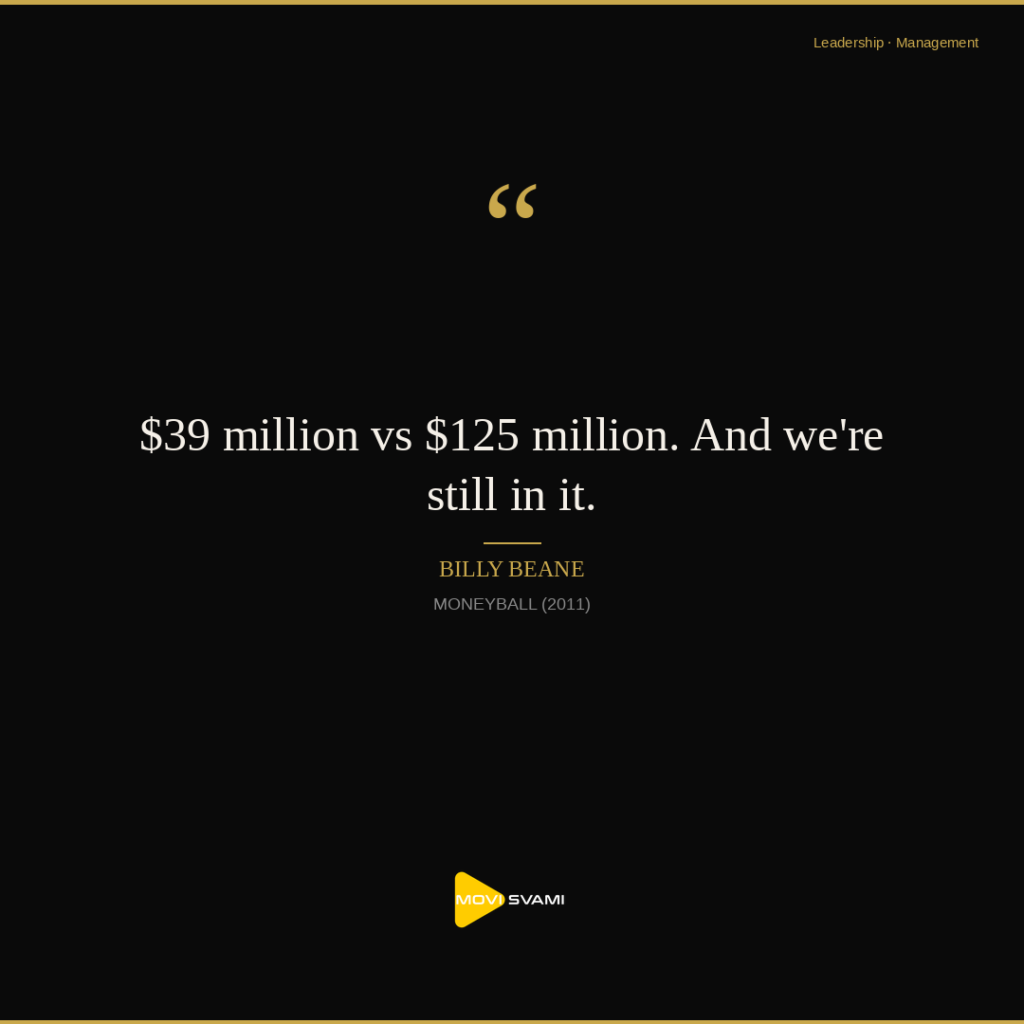
The setup is almost mythic in its unfairness. The Oakland A’s, operating with a payroll of approximately $39 million, find themselves competing against the New York Yankees’ $125 million war chest. In any conventional analysis, this isn’t a competition; it’s an execution. The Yankees can afford the superstars, the proven veterans, the established names that draw crowds and win championships. The A’s can afford whoever the Yankees don’t want.
But here’s where Billy Beane (portrayed by Brad Pitt with a restless, hungry intensity) diverges from the path of expected resignation. Instead of accepting the narrative of the underdog who fights bravely but loses inevitably, Beane asks a dangerous question: What if everything we think we know about value is wrong?
## The Algebra of Constraint
The central insight of Moneyball isn’t about statistics—it’s about scarcity economics. When resources are abundant, organizations become lazy. They purchase solutions rather than engineering them. They buy names rather than outcomes. They mistake correlation for causation (“he looks like a baseball player” vs. “he gets on base”).
Beane’s epiphany comes through his partnership with Peter Brand (Jonah Hill), a Yale economics graduate who sees players not as personalities or phenoms, but as data points in a complicated equation. Together, they identify that the market was systematically undervaluing certain skills—specifically, the ability to get on base—while overvaluing others like speed, fielding prowess, and “the look.”
This is the essence of constraint-driven innovation. When you have $125 million, you don’t need to be clever. You can afford to be wrong. You can buy Jason Giambi and Johnny Damon and assume the rest will sort itself out. But when you have $39 million, every dollar must be interrogated. Every roster spot must be optimized. You are forced to separate signal from noise.
Amazon’s famous “frugality” principle operates on similar logic. When teams aren’t given infinite resources, they develop asymmetric advantages in efficiency and creativity. They build systems that scale. They find the Jeremy Browns—the overlooked assets that, in aggregate, outperform the expensive superstars.
## The Psychology of Scarcity
What the film captures brilliantly is the psychological recalibration that occurs when options are removed. For years, the A’s organization operated under the assumption that they were perpetually one good season away from losing their stars to bigger markets. This created a scarcity mindset of the worst kind: defensive, pessimistic, resigned.
Beane’s genius was flipping this script. Instead of mourning the players he couldn’t afford, he asked: What can we afford that they don’t want? This shifted the organization from a scarcity mindset (“we don’t have enough”) to an abundance mindset (“they don’t know what enough actually is”).
The 20-game winning streak depicted in the film’s climax isn’t just a sporting achievement—it’s a validation of epistemological humility. The A’s didn’t just win games; they proved that the dominant paradigm for evaluating talent was empirically wrong. They demonstrated that when you can’t play the game on their terms, you change the terms of the game.
## Application to Modern Business
In today’s business environment, where capital often seems endless (at least for well-funded startups and tech giants), Beane’s lesson feels counterintuitive. We’re told to “move fast and break things,” to “blitzscale,” to acquire growth at any cost. But the 2022-2023 tech correction has revealed the danger of assuming infinite resources.
The companies surviving this winter aren’t necessarily the best-capitalized—they’re the most capital-efficient. They’re the ones who learned to win with less, who built sustainable unit economics, who treated every dollar as if it were their last. Like Beane’s A’s, they’ve learned to ignore the “scouting reports” (industry consensus) and trust the fundamental metrics that actually drive value.
Consider the parallel to human resources. Companies like Google and Meta spent years in a “talent war,” bidding up salaries for the same pool of elite engineers from the same elite universities. But companies like Basecamp, GitLab, and Automattic built incredible products by hiring globally, optimizing for output over pedigree, and recognizing that “on-base percentage” (reliable shipping, clear communication, autonomy) beats “slugging percentage” (brilliant but erratic genius) in the long run.
## The Legacy of Recalibration
Billy Beane never won a World Series with the Moneyball A’s. This fact often gets cited by critics as proof that the system failed. But this misses the point entirely. Beane’s goal wasn’t to win a championship—his goal was to keep his job and field a competitive team with resources that should have made that impossible. By that metric, he succeeded wildly.
More importantly, he changed the game forever. Within five years, every MLB team had adopted sabermetric principles. The market inefficiencies Beane exploited disappeared because they were exposed. But the methodology—rigorous, data-driven, constraint-aware resource allocation—became the standard.
For leaders today, the lesson is clear: Your constraints aren’t temporary obstacles to be removed. They’re permanent features that should shape your strategy. If you have less budget than your competitors, you need a different methodology, not just a smaller version of theirs. If you have less brand recognition, you need a different go-to-market motion. If you have fewer engineers, you need different architecture.
The “$39 million vs $125 million” gap isn’t a death sentence. It’s an invitation to innovate.
Because as Billy Beane understood better than anyone: when you can’t buy the answer, you’re forced to think your way to it. And thought, unlike capital, is an unlimited resource.