
# The Martian’s Leadership Secret: Process Beats Hope
The Martian (2015) opens with a scene that immediately immerses viewers in the stark, unforgiving reality of space exploration: Mark Watney, an astronaut stranded on Mars, is declared dead by his crew. As the film progresses, the tension escalates, not from external threats but from the internal struggle of a man fighting to survive against impossible odds. With limited resources, a hostile environment, and no clear path to rescue, Watney’s survival hinges on one thing: his ability to solve problems. This is not a story of hope or luck—it is a masterclass in leadership through process.
## “You Solve One Problem and You Solve the Next One…”
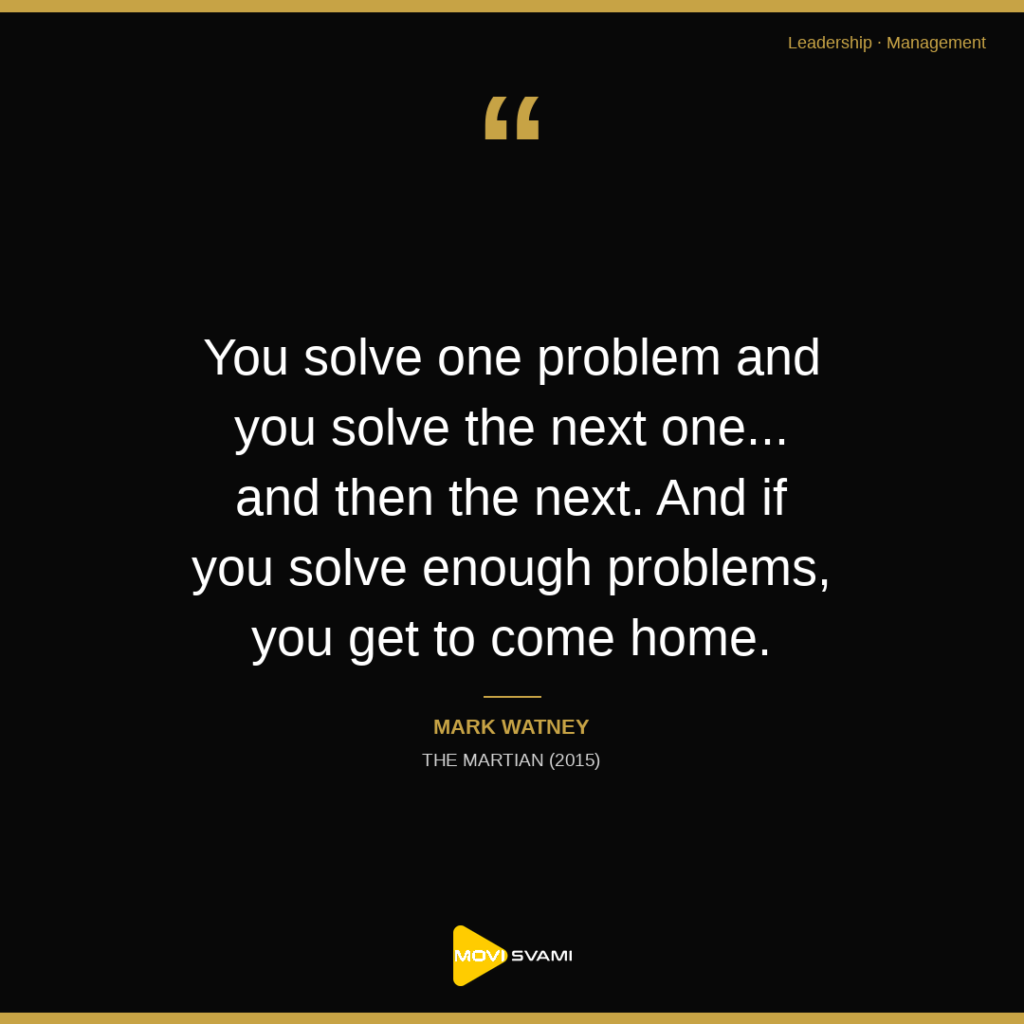
Mark Watney’s iconic line—”You solve one problem and you solve the next one… and then the next. And if you solve enough problems, you get to come home”—emerges from a moment of quiet determination. After being left behind during a mission to Mars, Watney is forced to confront the reality that his survival depends on his own ingenuity. The quote encapsulates his approach: rather than relying on hope or waiting for external salvation, he commits to a relentless, methodical process of problem-solving.
The stakes are astronomical. Watney’s life depends on his ability to grow food, produce water, and communicate with Earth, all while dealing with the psychological toll of isolation. His survival is not a matter of chance but of precise calculation. Every decision he makes is driven by a singular purpose: to break down the seemingly insurmountable into manageable steps. This mindset is not just about survival—it’s about leadership. Watney’s actions demonstrate that true leadership in crisis is not about inspiration alone but about the discipline to execute a plan with unyielding focus.
## The Leadership Principle: Process Over Hope
Watney’s leadership is defined by his commitment to process. In the face of chaos, he refuses to surrender to despair. Instead, he creates a framework of action, treating each challenge as a puzzle to be solved rather than an obstacle to be overcome. This approach aligns with a fundamental leadership principle: the ability to transform complex problems into sequential, actionable steps.
Leadership in high-stakes environments often requires a balance between vision and execution. Watney’s genius lies in his ability to maintain both. He envisions a way home, but he also executes the daily grind of survival with scientific rigor. His leadership is not about grand gestures but about the relentless pursuit of incremental progress. This is a critical insight for managers: the most effective leaders do not rely on hope or charisma alone. They build systems, document processes, and ensure that every step forward is grounded in logic and precision.
Watney’s story also underscores the importance of adaptability. While his process is methodical, it is not rigid. He constantly adjusts his strategies based on new information, demonstrating that true leadership requires flexibility. In a world where uncertainty is the norm, the ability to iterate and refine processes is as vital as the initial plan.
## Real-World Application 1: Tech Startups and Product Launches
Consider a tech startup facing a critical product launch. The team is under pressure to meet a deadline, but a key feature is failing to function as intended. Panic sets in—some members urge a delay, others advocate for a rushed fix. A leader inspired by Watney would take a different approach. They would break the problem into smaller, sequential steps: diagnose the root cause, test potential solutions, and implement the most viable fix. This methodical process ensures that the team stays focused on the task at hand, avoiding the pitfalls of either procrastination or haphazard decision-making. By treating each challenge as a solvable problem, the leader turns crisis into opportunity.
## Real-World Application 2: Healthcare Management During Pandemics
In the midst of a pandemic, a hospital administrator must manage a surge in patients while maintaining staff morale and operational efficiency. The situation is overwhelming, with limited resources and rapidly changing guidelines. A leader who embraces Watney’s philosophy would prioritize process: establishing clear protocols for triage, optimizing staff rotations, and streamlining communication channels. This structured approach ensures that the hospital can handle the immediate crisis while laying the groundwork for long-term resilience. By focusing on actionable steps rather than existential dread, the leader transforms chaos into coherence.
## Real-World Application 3: Project Management in Construction
A construction manager overseeing a delayed project faces mounting pressure from stakeholders. The team is exhausted, and the timeline is slipping. A leader guided by Watney’s principles would dissect the problem: identify the root causes of the delay, reassess resource allocation, and create a revised schedule with clear milestones. This process-driven mindset prevents the team from spiraling into frustration. By breaking the project into manageable phases and celebrating incremental progress, the leader rebuilds confidence and keeps the project on track.
## Reflection: What’s Your Next Problem to Solve?
The Martian’s leadership secret is a powerful reminder that in times of crisis, process is the foundation of resilience. Mark Watney’s survival was not a miracle—it was the result of a disciplined, methodical approach to problem-solving. For managers, this offers a clear lesson: the most effective leaders do not rely on hope or luck. They build systems, execute with precision, and turn the impossible into the achievable.
As you face your own challenges, ask yourself: What is the next problem to solve? How can you break it into manageable steps? The answer may lie not in grand gestures, but in the quiet, relentless work of process.