
The camera lingers on a holographic display in the dim light of the S.H.I.E.L.D. helicarrier bridge. Nick Fury stands before the World Security Council, his leather coat heavy, his eye patch obscuring nothing of the intensity in his gaze. Outside the viewport, an alien army threatens to obliterate Manhattan. Inside, bureaucrats demand nuclear escalation. Fury has something else in mind—something the organizational chart cannot capture. He has a god, a gamma-radiated monster, a frozen super-soldier, a billionaire in a metal suit, and two assassins. Separately, they constitute a terrifying roster of human capital. Together, unproven, they represent either humanity’s salvation or its most expensive catastrophe. The moment crystallizes the precise terror of leadership: the gap between possessing talent and deploying capability.
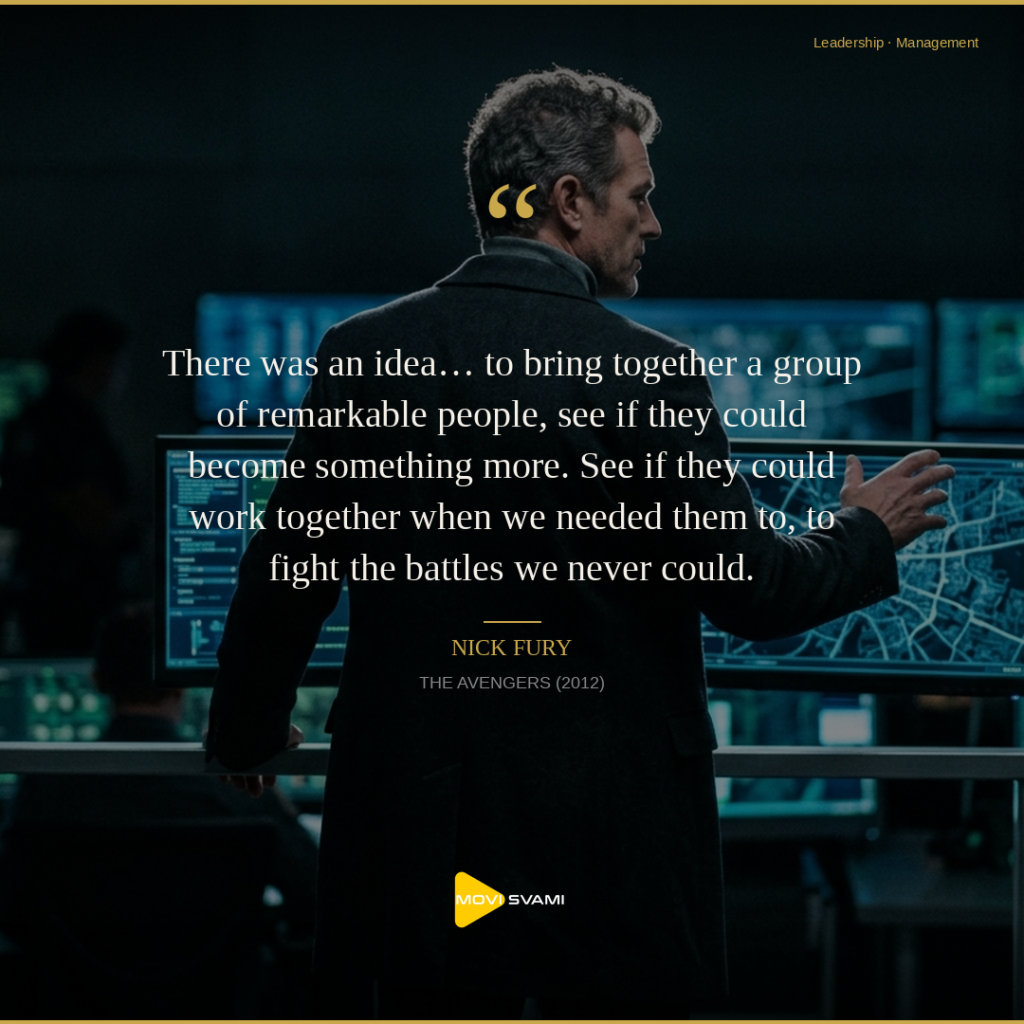
“There was an idea… to bring together a group of remarkable people, see if they could become something more. See if they could work together when we needed them to, to fight the battles we never could.”
Fury utters these words not as a mission statement, but as a rebuttal. The Council sees assets and liabilities; Fury sees architecture. The context is existential: Loki has opened a portal above New York, the Chitauri are pouring through, and conventional military force is proving decorative. The stakes could not be higher—global annihilation versus a speculative gamble on human chemistry. Yet Fury’s insistence reveals a deeper organizational truth: when facing complexity that outpaces individual cognition, survival depends not on skill accumulation but on emergent coordination. The Council commits the aggregative fallacy, assuming that excellent individuals sum to excellent teams. Fury understands that without structural intention, they merely collide.
This distinction defines strategic leadership in environments of high uncertainty. Most management frameworks treat team assembly as a procurement exercise: identify competencies, eliminate redundancies, optimize for coverage. Fury operates as a vision architect, recognizing that synergistic capability must be engineered, not assumed. His insight—”see if they could become something more”—acknowledges the non-linearity of collaborative performance. The output of a Stark plus a Rogers does not equal the sum of their résumés; it equals either civil war or the destruction of a Leviathan, depending on the connective tissue between them. The leader’s job is not to stack skills but to forecast interactions, anticipating how egos, methodologies, and temporal rhythms will intersect under pressure. Individual excellence becomes collective liability when friction points are ignored; conversely, apparent mismatches (the chaotic inventor and the disciplined soldier) create multiplicative effects when properly aligned.
Consider the executive overseeing a post-merger integration. Two firms with sterling individual track records—each dominating its market segment—combine to form a lumbering dysfunction. The acquired talent flees; the acquiring culture calcifies. The leader assumed that excellence would osmose across the firewall. They stacked capabilities without architecting interfaces, forgetting that synergistic forecasting requires mapping not just *what* each unit knows, but *how* they know it. The integration fails not from lack of talent, but from the absence of Fury’s patient engineering: the observation of patterns, the identification of catalytic pressure points, and the willingness to let conflict generate heat rather than ash.
In crisis response scenarios, the same architecture proves decisive. When a cybersecurity breach threatens critical infrastructure, the instinct is to convene the best technical experts—cryptographers, network engineers, forensic analysts—and demand immediate coordination. Yet without pre-established translation protocols between these disciplinary dialects, the room fills with brilliant individuals speaking past one another while the threat metastasizes. Effective crisis leadership mirrors Fury’s helicarrier gambit: selecting for complementary cognitive styles, not just complementary expertise, and establishing the minimal viable structure (a command hierarchy, a shared vernacular, a contained space for productive antagonism) that allows expertise to compound rather than cancel.
Even in innovation contexts, the principle holds. Consider the R&D director assembling a team to disrupt an established market. The temptation is to recruit the highest-IQ specialists from each relevant domain—materials science, behavioral economics, digital interface design—and await the alchemy. But without architectural vision regarding how these minds will negotiate trade-offs (the scientist’s purity versus the designer’s pragmatism, the economist’s scalability versus the engineer’s feasibility), the result is a collection of siloed geniuses producing elegant fragments. The leader must forecast the synergistic collisions before they occur, designing rituals and constraints that force the “something more” Fury gambled on—turning potential energy into kinetic, directed force.
Nick Fury’s gamble paid off because he understood that collective capability is a design problem, not a hiring problem. The Avengers saved New York not because they were each extraordinary, but because the architecture of their assembly created conditions where their extraordinariness could combine without combusting.
As you examine your own organizational chart, ask yourself: Are you stacking skilled individuals, or are you architecting for emergence? What battles are you fighting alone because you have not yet built the container that would let your remarkable people become something more?