
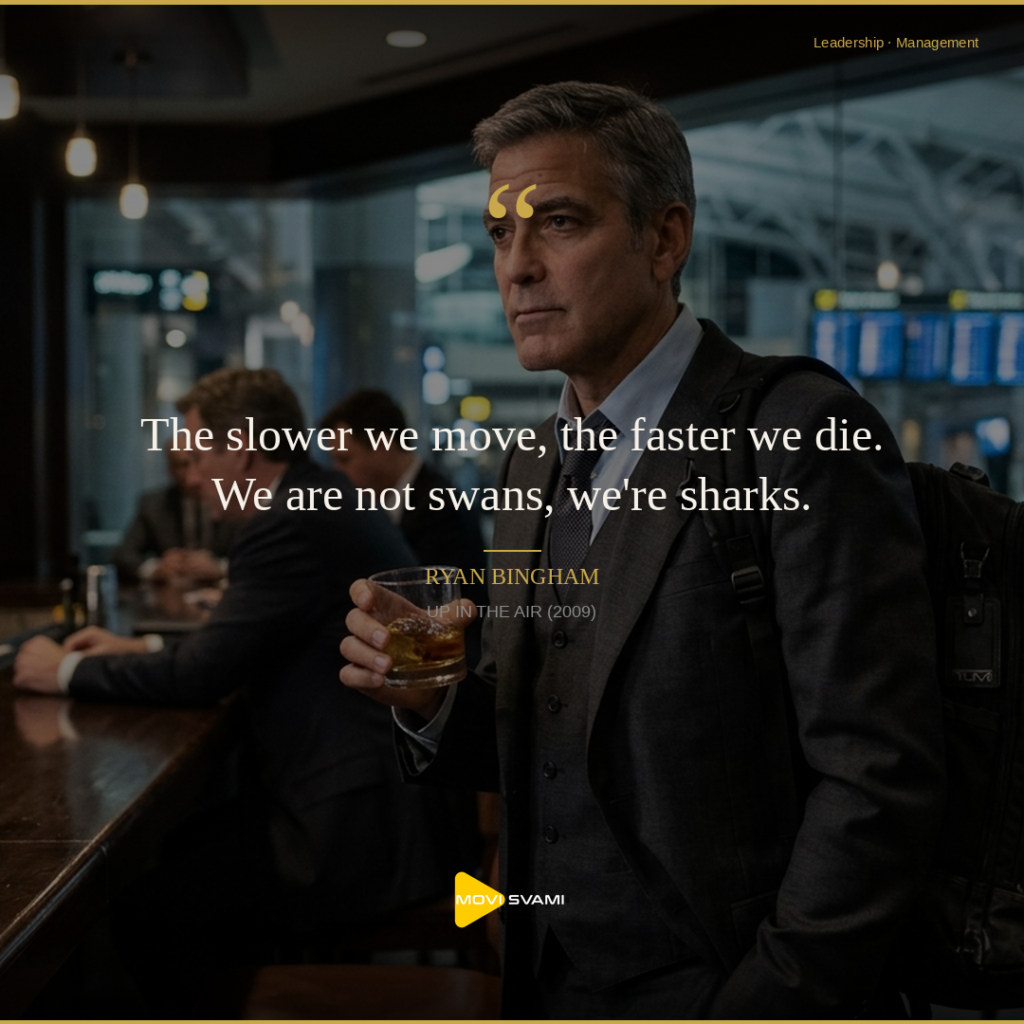
The hotel bar in Detroit smells of industrial carpet and crushed ice. Ryan Bingham sets down his whiskey and delivers the physics lesson with the casual precision of a man who has rehearsed it in a hundred airports: sharks must keep swimming or die. They do not glide like swans; they suffocate without forward motion. It is 2009, and Bingham—played by George Clooney in Jason Reitman’s *Up in the Air*—has spent the day executing terminations for a company too cowardly to fire its own people. He carries a backpack containing everything he owns, unburdened by mortgages or relationships. To him, stillness is lethal. Yet beneath the seductive metaphor lies an uncomfortable inversion: the companies hiring him to swim— to cut headcount and accelerate toward quarterly targets— are often bleeding out in ways their spreadsheets refuse to register.
## The Physics of Predation
Bingham’s biology lesson is not merely personal philosophy; it is corporate ontology. When he tells fellow traveler Alex Goran, “The slower we move, the faster we die… we are not swans, we’re sharks,” he articulates the anxiety of late-capitalist efficiency. Organizations hire him because they believe stagnation is death, that cost structures must perpetually tighten to keep the predator alive. But Bingham’s real genius— the brutal mathematics he performs while handing out severance packets— is inadvertent. He reveals that termination cycles carry a hidden variable that finance departments rarely capture: the instantaneous depreciation of human capital. Every fired employee does not simply subtract a salary line; they remove nodes of institutional memory, client tacit knowledge, and process intelligence that took years to compound. The shark swims, yes, but it does not notice the blood trail it leaves behind.
## The Depreciation Algorithm
Leadership, in this context, requires recalibrating how we value motion. Traditional balance sheets treat layoffs as linear transactions: salary expense eliminated, severance liability booked, EBITDA improved. This accounting is catastrophically incomplete. When Bingham fires a mid-level engineer who holds fifteen years of undocumented client workaround knowledge, or a logistics manager who remembers why the 2011 supply chain adjustment prevented the 2024 bottleneck, the organization suffers an asset write-down that never appears in the annual report. Human capital depreciation during termination cycles follows an aggressive, often accelerating curve— typically front-loaded in the first ninety days post-exit, when knowledge transfer is impossible and remaining staff operate under cognitive load and moral hazard (the “survivor syndrome” that breeds risk aversion). Operational health demands that leaders calculate this hemorrhage not as soft cost, but as intellectual property attrition. The shark survives only if it can still smell blood in the water; terminate the sensory organs, and the predator becomes disoriented prey.
## Three Balance Sheets That Don’t Add Up
Consider the technology sector’s recent contraction cycles. When SaaS firms cut twenty percent of engineering staff to satisfy growth metrics, they optimistically model savings against severance multipliers. Rarely do they audit the depreciation of system architecture knowledge— the “tribal code” that exists only in the terminated developer’s head, undocumented because agile sprints prioritized shipping over documentation. Six months later, velocity collapses not because the remaining engineers are lazy, but because they are archaeologists excavating logic without maps. The calculation must include not just saved salaries, but the net present value of delayed product releases and the technical debt incurred through ignorance.
In professional services, the math is equally stark yet culturally obscured. When management consulting firms or investment banks force out senior partners during downturns, they treat the action as trimming “overage.” Yet these partners carried client relationships built on fifteen-year trust cycles— intellectual property that is simultaneously personal and institutional. The depreciation is immediate and absolute: the client does not transfer loyalty to the firm, but departs with the human who understood their unspoken risk tolerances. The balance sheet shows reduced compensation expense; the operational reality shows revenue attrition that outpaces the savings by multiples.
Manufacturing automation presents a third variegation. As firms terminate veteran floor operators to justify robotics CapEx, they assume machine manuals contain sufficient operational knowledge. They do not. The “touch” of the experienced operator— the acoustic diagnostics of a failing press, the seasonal humidity adjustments known only to someone who spent winters on that concrete floor— constitutes irreplaceable human capital. When these sharks are removed from the ecosystem, downtime spikes erase labor savings within the first fiscal quarter. The depreciation rate here is physical: machines require human intermediaries to function optimally, and removing that synaptic layer converts capital equipment into expensive sculpture.
## The Cost of Forward Motion
Bingham’s transience is ultimately a defense mechanism against attachment, but organizational leadership cannot afford such dissociation. The imperative to move— to restructure, automate, and optimize— remains real, yet velocity without vector calculation is merely entropy. Before your next termination cycle, ask this: has your finance team modeled the depreciation schedule of the knowledge walking out the door, or are you simply counting the salary mass you no longer carry? The difference between a shark and a sinking body is not motion itself, but the capacity to navigate.