
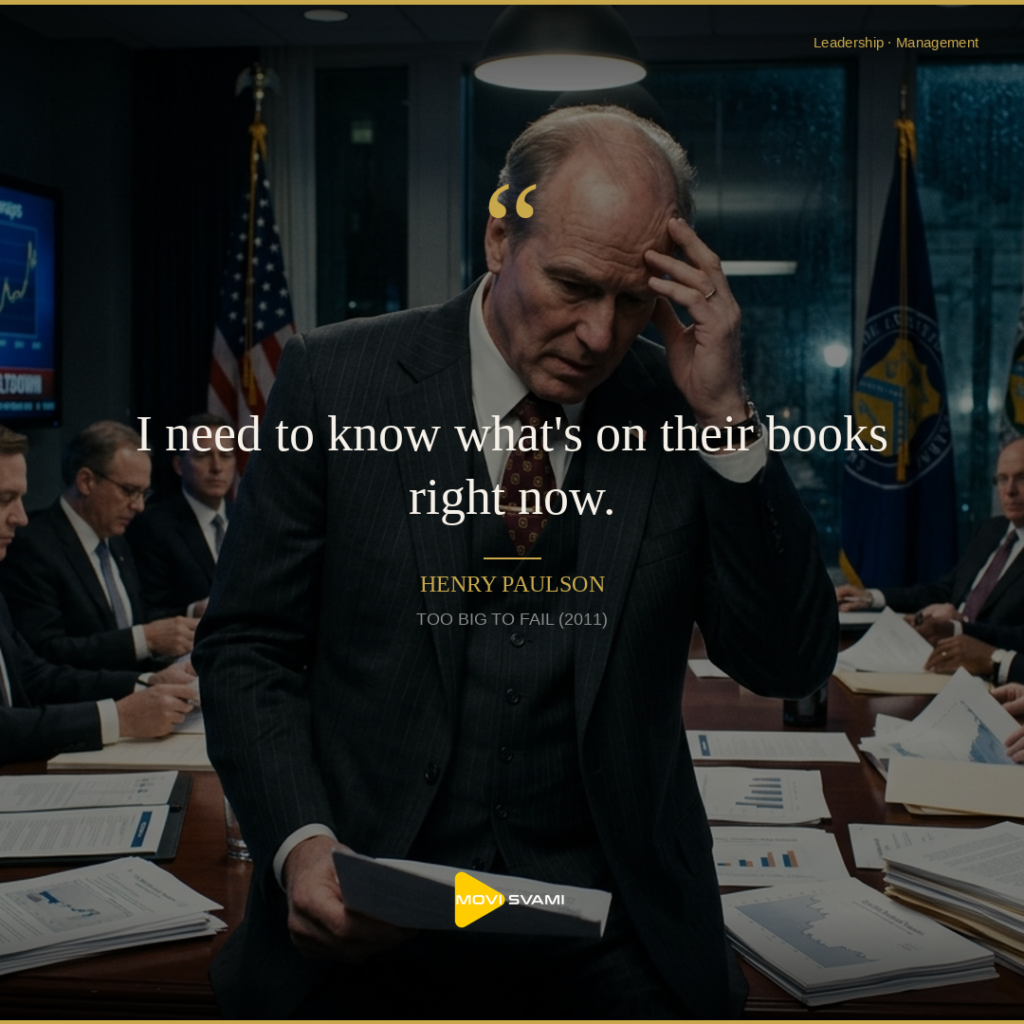
September 2008. The conference room at the Federal Reserve Bank of New York has become a war room. Treasury Secretary Henry Paulson stands at the head of the table, surrounded by the CEOs of America’s largest financial institutions. Lehman Brothers has just filed for bankruptcy. Merrill Lynch is hours from insolvency. AIG is next. The room smells of fear and stale coffee. On the screens behind Paulson, red numbers cascade like a stock ticker documenting the end of the world. He needs to know which banks can survive the weekend and which cannot. But when he asks for balance sheets, for exposure reports, for anything resembling real-time financial intelligence, he encounters delays, hedges, and opacity. In desperation, Paulson slams his hand on the table: “I need to know what’s on their books right now.”
That moment—captured in HBO’s *Too Big to Fail*—represents the operational failure that transformed a liquidity crisis into a global catastrophe. Paulson’s demand was not rhetorical. He genuinely could not determine which institutions held toxic mortgage-backed securities, how much counterparty exposure existed across the system, or whether a single bank failure would trigger a chain reaction that would collapse the entire financial architecture. The information existed somewhere—buried in complex derivatives portfolios, structured investment vehicles, and off-balance-sheet entities—but it was not accessible in the time frame required for decision-making. By the time accountants could aggregate and reconcile the data, markets would have already rendered the analysis obsolete. The gap between what executives claimed to know about their exposures and what actually sat on their balance sheets was not merely embarrassing; it was existential.
For modern CFOs, this scene distills a brutal truth: financial transparency is not a compliance exercise but a survival mechanism. In stable times, organizations can afford the luxury of monthly closes, quarterly reconciliations, and annual audits. But when credit markets freeze, when counterparties demand immediate collateral, when regulators threaten intervention, the inability to produce real-time visibility into liabilities becomes a death sentence. The principle extends beyond banks. Any enterprise with complex financial instruments—derivatives hedges, vendor financing arrangements, contingent liabilities embedded in customer contracts—faces the same vulnerability. If you cannot instantly parse your exposures under pressure, you cannot make the decisions required to survive volatility.
The operational imperative is straightforward: CFOs must architect financial reporting systems that eliminate the latency between transaction execution and executive visibility. This is not about faster monthly closes. It is about real-time dashboards that aggregate exposure across entities, instruments, and counterparties, providing decision-makers with the intelligence to act before markets force their hand. The organizations that survived 2008 were not necessarily those with the cleanest balance sheets; they were the ones that could answer Paulson’s question within hours rather than weeks.
Consider three scenarios where this principle determines outcomes.
First, examine counterparty credit risk in a multinational supply chain. A CFO at a manufacturing conglomerate wakes to news that a critical Tier-1 supplier has missed a debt payment. The supplier represents 30% of component volume for the flagship product line. Within hours, the CFO must determine: What is our exposure? Do we have outstanding payables? Are there prepayments or vendor financing arrangements that create concentration risk? Can we source alternatives before production halts? In a traditional financial architecture, answering these questions requires manual data pulls from procurement systems, reconciliation against accounts payable, and phone calls to divisional finance teams. By the time the analysis is complete, the supplier has filed for bankruptcy protection, and the conglomerate faces a production shutdown because no one knew the full scope of dependency. The CFO with real-time exposure dashboards, however, can pull a report within minutes, quantify the risk, activate contingency suppliers, and communicate a mitigation plan to the board before markets open. The difference is not intelligence but latency.
Second, assess derivative portfolio management in a commodity-dependent business. An energy company hedges diesel fuel costs using futures contracts managed by the treasury team. A geopolitical shock sends oil prices spiking 40% in a single trading session, and the company’s hedges move deep into the money. Suddenly, the treasury desk faces margin calls from brokers demanding immediate collateral. The CFO needs to know: What is our mark-to-mark exposure? Do we have sufficient cash or credit lines to meet margin requirements? Should we close positions to reduce exposure, or hold and let the hedges offset future fuel purchases? Without real-time visibility, the CFO is guessing. With it, she can model scenarios, quantify liquidity needs, authorize collateral transfers, and communicate the hedging strategy to investors—all within the trading day. The absence of this capability does not merely create embarrassment; it forces liquidation of profitable hedges at exactly the wrong time, destroying value that the hedges were designed to protect.
Finally, consider regulatory stress testing for a financial services firm. A regulatory agency announces a surprise liquidity stress test, requiring the firm to demonstrate that it can survive a 30-day credit freeze without accessing capital markets. The firm must submit a detailed report within 72 hours showing cash positions, unencumbered assets, contingent draws on credit facilities, and liquidity buffers across all legal entities. A CFO relying on monthly consolidation cycles cannot meet this deadline without heroic manual effort—spreadsheets, emails, reconciliation chaos. The result is either a delayed submission that invites regulatory scrutiny, or a hastily assembled report riddled with errors that trigger enforcement action. The CFO with real-time treasury dashboards, however, generates the report with a few database queries, demonstrating not only compliance but operational sophistication that earns regulatory confidence. The difference in outcomes is not trivial; it determines whether the firm remains a going concern or enters receivership.
The lesson of Paulson’s desperation is not that financial transparency prevents crises—it does not. The lesson is that opacity accelerates them. When executives cannot answer fundamental questions about their own balance sheets under pressure, they lose the ability to manage outcomes. Markets interpret delay as weakness, counterparties demand punitive terms, and regulators impose intervention. The CFO who can instantly illuminate exposures retains strategic optionality; the CFO who cannot has already ceded control to external forces. As you review your own financial architecture, ask yourself: If your largest counterparty failed tomorrow, could you quantify your exposure within the hour? If not, you are not prepared for the crisis that is already on its way.