
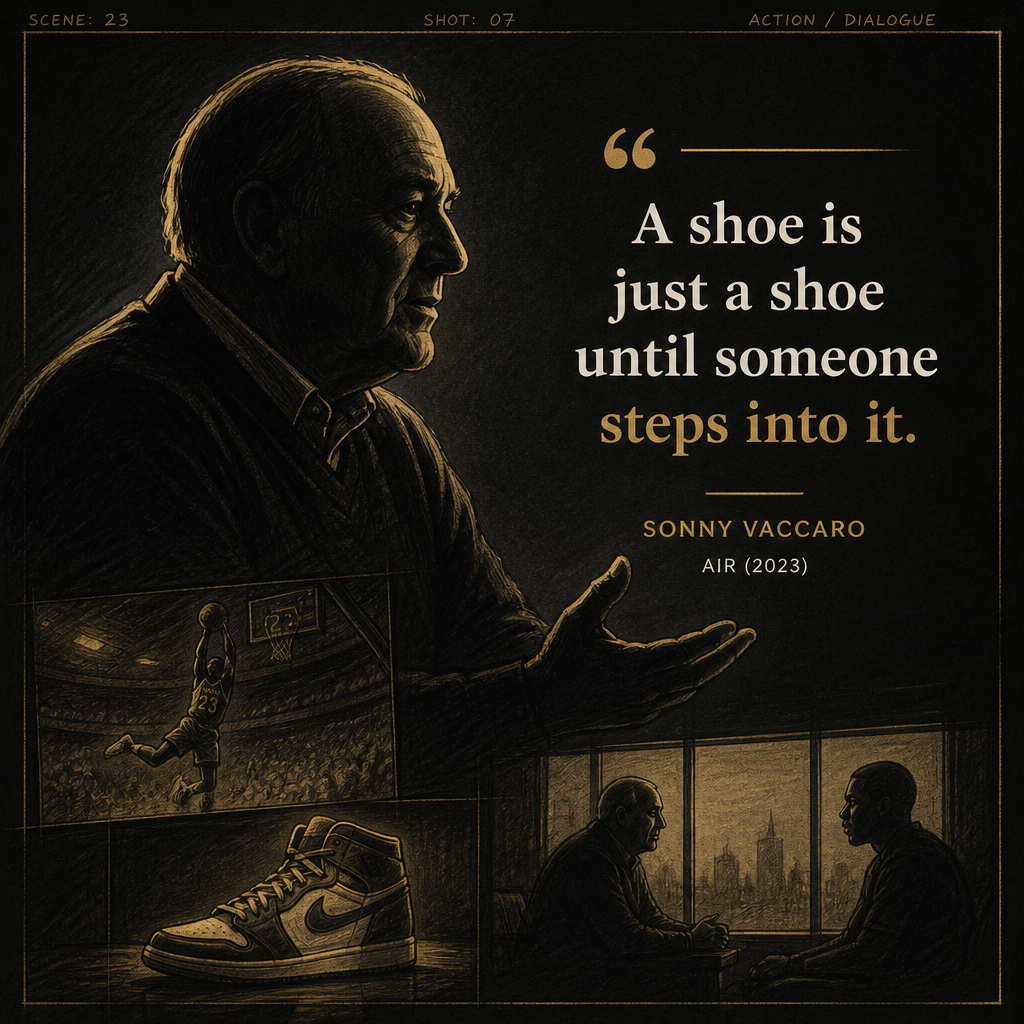
In the fast-paced and often unforgiving realm of business, traditional metrics like revenue growth, market share, and product innovation are seen as key indicators of success. Yet in the film *Air* (2023), a compelling narrative unfolds that suggests a different path to enduring success — one that goes beyond the product to tap into human emotions and cultural consciousness. At the heart of this narrative is Sonny Vaccaro, a visionary whose approach to the Nike strategy in securing a then-aspiring Michael Jordan defies conventional wisdom. The intensity of the Nike boardroom setting sets the tension, showcasing not just a pitch for athletic apparel, but a gamble for greatness by coalescing sport, identity, and brand ethos into a single proposition.
Embedded in the core of Vaccaro’s pitch is a striking realization: “A shoe is just a shoe until someone steps into it.” This powerful insight encapsulates a profound truth — that products achieve their real potential only when they are personified, when they merge with the narrative of those who use them. Vaccaro, an astute talent scout and marketing strategist, delivered this line knowing fully well that the stakes were monumental. Nike was not merely on a quest to sign an athlete; it was attempting to revolutionize its branding strategy against industry titans like Adidas and Converse. This statement became the crux of a negotiation that balanced between risk and vision, urging Nike to focus on the narrative of Michael Jordan rather than on the simple dynamics of sneaker technology or market analytics.
The leadership principle that emerges from this moment is unambiguous: a product on its own is an empty vessel; it gains life and significance through the stories and meaning attached to it. What Vaccaro insists upon isn’t market competitiveness — it’s brand transcendence. This core idea forces a reevaluation of what brand-building actually means, underscoring that meaning-making is essential for businesses aiming for long-term resonance with audiences. It is less about functional superiority and more about ideological alignment, where consumers do not just buy a product but also an idea, an aspiration, a reflection of cultural ethos. The pitch room becomes a philosophy seminar, and Vaccaro is its most unlikely professor.
For founders, this represents a structural challenge. The instinct in early-stage companies is to build, iterate, and optimize around product features — a rational response to the pressure of product-market fit. Yet the companies that graduate from product-led to brand-led growth do so precisely because they learn to tell a story that is larger than the feature set. They find the human at the center of the transaction and ask what that human is trying to become, not merely what problem they need solved. Nike did not solve a problem for Michael Jordan. It amplified a mythology that was already in formation, and in doing so it created a cultural artifact that outlived Jordan’s playing career by decades.
Brand positioning is the arena where this principle reveals its full strategic weight. A founder immersed in product attributes can easily neglect how identity shapes consumer perception. By cultivating narratives that amplify individual or collective aspirations, brands can position themselves not just as market participants but as cultural reference points. Vaccaro’s approach suggests founders should build narratives in which consumers see themselves reflected — not as buyers completing a transaction, but as participants in a story that matters. The product becomes a prop in a larger performance, and the customer is the lead.
In crisis rebranding, the scenario demands acute attention to narrative reclamation. Consider a technology company facing a data breach — a potential betrayal of trust at the most fundamental level. Vaccaro’s insight reframes the response strategy: the problem is not primarily technical, it is narrative. The company must shift the dialogue from product failure toward renewed commitments, shared futures, and the values that originally connected it to its audience. Fixing the system is necessary, but insufficient. What consumers need to hear is a story about who the company is — and who it intends to remain. That is meaning-making under pressure, and it is a leadership skill as demanding as any operational response.
For commodity differentiation, Vaccaro’s stratagem provides a template for competing on a dimension that pricing wars cannot touch. Commodities are, by definition, interchangeable on feature and price. The only escape from commodity logic is a story that transforms the transaction. A specialty coffee brand can differentiate itself not by flavor alone but by embedding each purchase in a narrative about the farmer’s livelihood, the ecological stewardship of the growing region, or the craft philosophy of the roaster. The customer is no longer buying caffeine. They are stepping into a story about how they engage with the world. The shoe analogy holds: the commodity is just an object until someone’s values and identity step into it and give it meaning.
Founders should approach Vaccaro’s insight not as a marketing tactic but as a business philosophy. The question is not “what should we say about our product?” but “what story does the customer live inside when they choose us?” That question changes the conversation inside the company before it changes anything in the market. It demands that founders understand their customers as people navigating ambitions and identities, not just as users seeking functional solutions. It demands that the product roadmap be informed by human narrative as much as by technical capability. And it demands that the leadership team holds a consistent answer to the question: what does stepping into this brand allow someone to become?
Sonny Vaccaro won the pitch not because he had superior data or a larger budget, but because he understood something the room had not yet articulated: the athlete was the story, and the product was the entry point. As you assess your own brand, the worth considering question is this — are you merely selling a product, or are you inviting your customers into a story that resonates with their deepest values and ambitions, one that they will return to and advocate for long after the transaction is complete?