
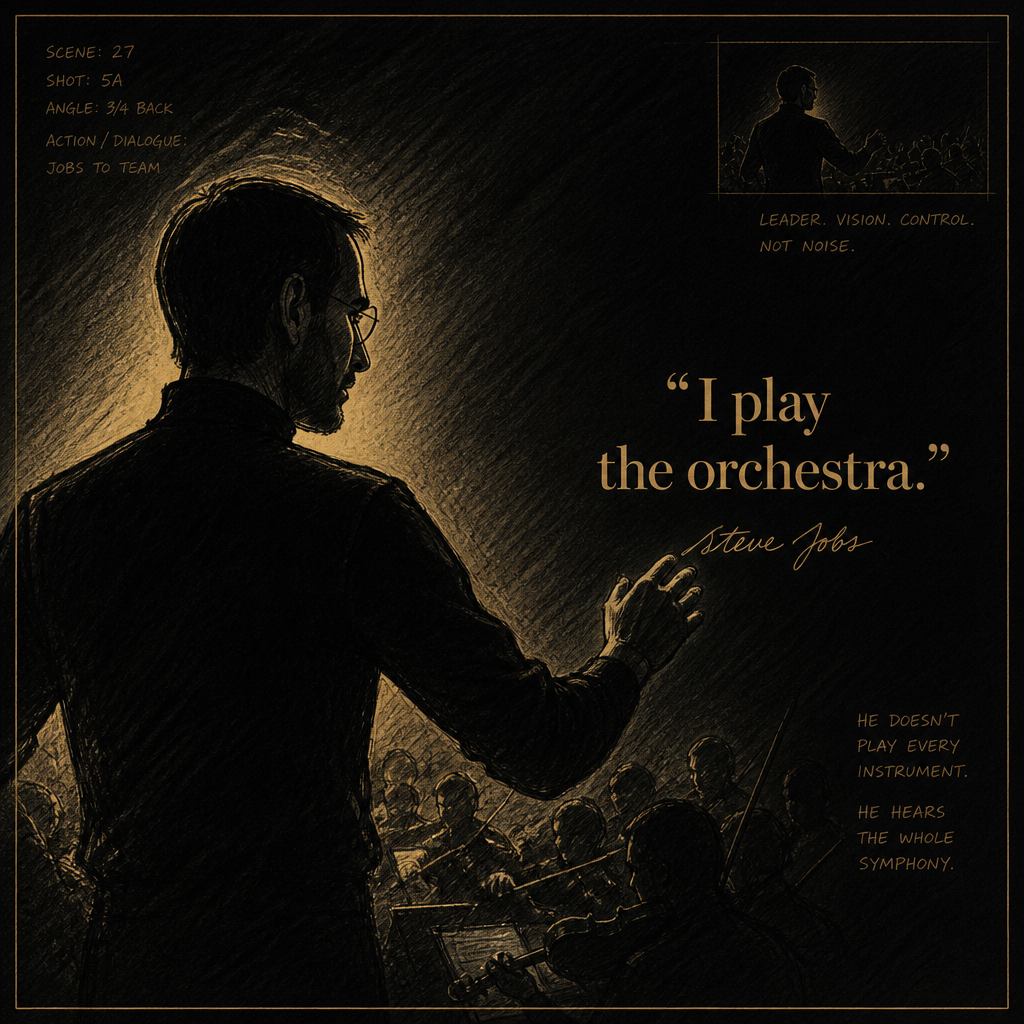
There is a dangerous romance in startup culture around the founder who can do everything. The engineer who designs. The designer who codes. The operator who closes every sale while refactoring the database and rewriting the brand narrative before dinner. It looks like competence. It often sounds like leadership, especially to investors hungry for proof of operator density. But in the final accounting, it is usually a trap — one that scales the individual while suffocating the organization. The most enduring companies are rarely built by virtuosos playing every instrument with manic speed. They are built by conductors who have the discipline to stand still, listen, and decide what the music actually means.
In Danny Boyle’s *Steve Jobs* (2015), this tension finds its most cinematic and uncomfortable expression. Steve Wozniak, the engineering conscience of Apple, confronts Jobs in the narrowing corridor backstage before a launch. He lists the contributions of the nameless engineers, designers, and coders who built the Macintosh. He accuses Jobs of being none of those things — not an engineer, not a designer, not a true coder. The charge is personal, historical, and precise: you are not one of us, and you are taking credit for our labor.
Jobs does not flinch. He stands perfectly still, his voice dropping to a measured, almost whispered intensity. “I play the orchestra.” The line lands not merely as arrogance, though it contains plenty of that. It lands as an articulation of authorship through direction. He claims the product not because he soldered a board or kerned a font, but because he held the entire map of creation in his head and forced every specialized talent to conform to a single, uncompromising vision. The scene is painful because it violates our instinct toward collaborative justice. But it is also true. Founders who build transformative products rarely do so by out-performing their specialists. They do so by out-composing them.
This distinction between performance and orchestration is not semantic. It is structural, and it determines how far an organization can evolve before it collapses under the weight of its own founder. When a founder insists on playing every instrument, they introduce a hard ceiling to the company’s complexity. The organization can only grow as wide as the founder’s personal bandwidth, technical range, and daily stamina. Worse, they signal to every specialist that their contribution is provisional — that mastery is always subject to the founder’s override, that no zone of expertise is truly sovereign. Over time, this erodes the very craftsmanship the company needs to survive adolescence. The best engineers stop building boldly. The best designers stop pushing boundaries because they anticipate revision. The room goes quiet not because the orchestra lacks talent, but because the conductor has convinced every player that their part will eventually be rewritten.
True founder leadership operates in the opposite register. It accepts the humbling, often bruising reality that others possess deeper technical craftsmanship in domains the founder will never fully master. It then adds value not by matching that craftsmanship detail for detail, but by imposing coherence upon it. The conductor does not need to outplay the cellist. The conductor needs to know precisely when the cello enters, how loudly it should speak, and what emotional texture it must carry so that the horns do not overwhelm it three bars later. That is the work: interpretation, pacing, the architecture of tension and release, and the relentless subtraction of anything that dilutes the whole. It requires stillness. It requires listening to frequencies others ignore. And it requires the nerve to stop an entire orchestra when one section is drifting out of tune, even if that section is playing something beautiful on its own.
In early-stage companies, the founder often serves as the de facto head of product, engineering, and design. The transition from builder to conductor usually happens somewhere around the ten- to fifteen-person mark, and a surprising number of founders miss it entirely. They continue to review every pull request, redraw every wireframe, and rewrite every headline in real time. The result is a product that bears the founder’s fingerprints but lacks the architectural depth that comes from distributed ownership and genuine debate. The founder who learns to play the orchestra does something radically different. They define the sensory standard — the feel of the interface, the latency threshold, the narrative arc of the onboarding flow, the emotional temperature of the error state — and then they step back. They hire people who can execute those standards with a virtuosity they do not personally possess, and they protect those people from the entropy of competing priorities, shifting requirements, and the founder’s own impatience. The product becomes better precisely because the founder’s hands are no longer on every instrument, and because the specialists have been given the security to play their parts with confidence.
The most volatile moments in a company’s life are rarely technical. They are human, political, and symbolic. When a key executive departs without warning, when a funding round crumbles at the term-sheet stage, when a market shifts overnight and renders the quarterly plan obsolete, the instinctive founder lunges for operational control. They begin playing instruments again — drafting investor updates themselves, re-inserting into sales cycles, second-guessing the CTO’s architecture at two in the morning, holding design reviews they had previously delegated. This reversion almost always broadcasts panic disguised as diligence. The orchestra sees the conductor abandon the podium and start tuning a violin while the rest of the ensemble loses the beat. The appropriate maneuver in crisis is to tighten the interpretive frame, not to replace the players. State the standard more clearly. Reduce the variables. Put your most trusted specialists in positions where their judgment can operate without your friction, and defend their authority publicly. Your job in crisis is to protect the tempo, to preserve morale through clarity, and to absorb the anxiety that would otherwise fracture the section. It is not to prove you still know the fingering.
Founders who confuse individual capability with organizational authority often misallocate their scarcest resource: their own attention. They spend afternoons debugging code that a mid-level engineer could resolve in an hour. They re-edit marketing collateral because they have taste, not because the revision moves the business forward in any measurable way. They attend meetings where their presence stalls decision velocity rather than accelerating it. Conductors do not spend rehearsals proving they can read music. They spend rehearsals shaping the moment when thirty disparate musicians, each with decades of private practice, become one voice that fills a hall. In strategic terms, this means the founder’s calendar is the score. Where you place your time determines which sections of the orchestra receive emphasis, which initiatives gain interpretive weight, and which departments learn that their work matters most to the person who sets the tempo. If you are not actively making those choices, you are not conducting. You are merely playing louder than everyone else, and eventually the audience stops listening.
The myth of the solitary genius dies hard because it flatters the ego and simplifies the narrative. It suggests that leadership is simply a widening of personal competence until it covers every function of the enterprise. The truth is more austere and ultimately more powerful. Leadership is the conscious choice to stop playing — to stand still in the noise of creation, to hear what others cannot yet hear, and to insist on a harmony that no single performer, however gifted, could achieve alone. The next time you walk into a room full of specialists who know vastly more than you do about their instruments, remember the posture Jobs took in that corridor. Stand still. Listen. Then ask yourself: am I adding another part to an already crowded stage, or am I shaping the whole?