
The prison yard at Shawshank is gray, concrete, and finite. Andy Dufresne sits with Red, polishing a chess piece carved from stone, and speaks of the Pacific Ocean. He describes water the color of forget-me-nots, a boat, and a life rebuilt under Mexican sun. Red warns him to abandon such thoughts. Hope, Red insists, is a dangerous thing that can drive a man insane. Andy listens, but his hands keep moving, shaping rock into possibility. He understands what Red has forgotten: that without a coherent image of the future, the present becomes unbearable. The tension between them is not merely philosophical; it is strategic. One man sees survival as the absence of death, while the other sees it as the presence of a destination.
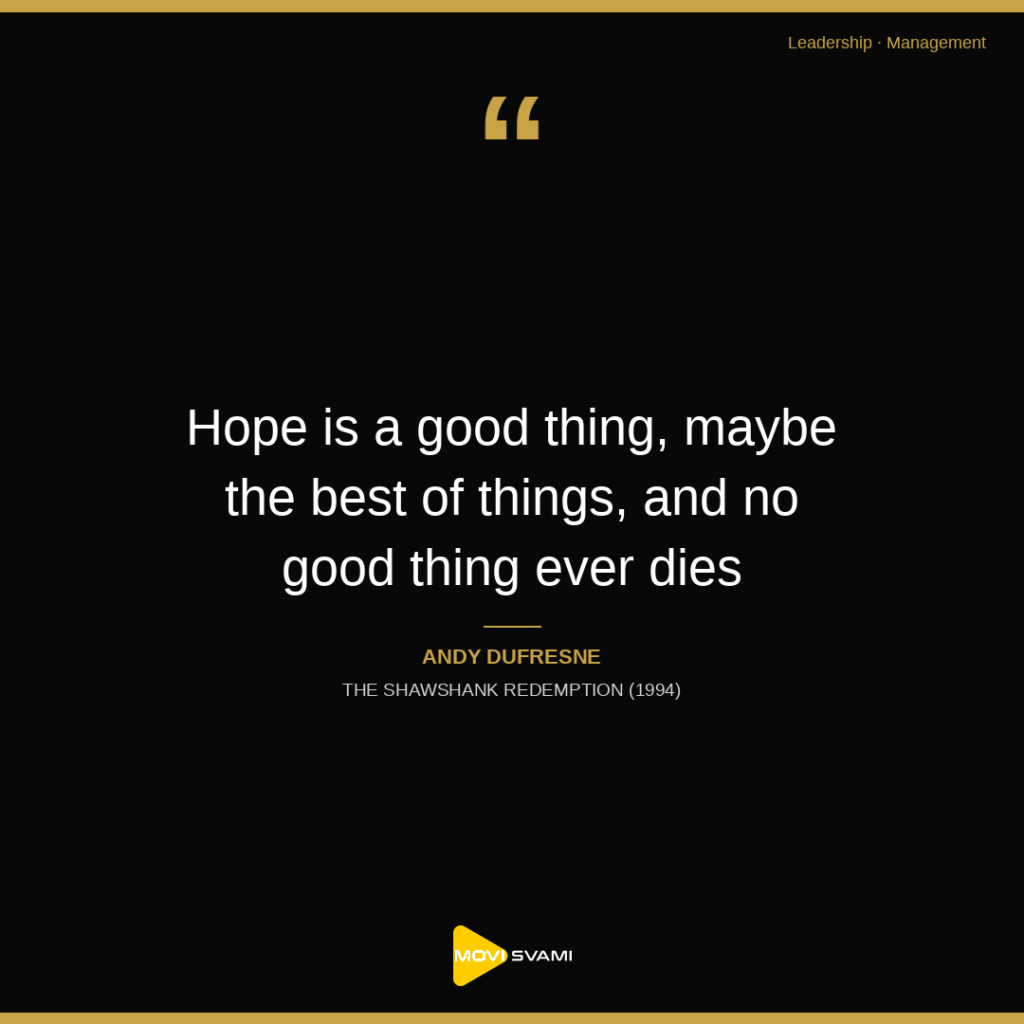
The quote arrives later, scratched onto paper and smuggled to Red in a halfway house after Andy has crawled through five hundred yards of sewage to freedom. “Hope is a good thing, maybe the best of things, and no good thing ever dies.” By this point, Red has been granted parole but is paralyzed by institutionalization, terrified of a world that moves too fast. Andy’s letter serves as proof of concept. The hope Andy cultivated was not naive optimism or delusional escape from reality; it was a disciplined operational framework that predicted the physics of liberation. For nineteen years, Andy chipped away at concrete with a rock hammer not because he wished the wall away, but because he calculated the rate of erosion against his biological timeline. The stakes were absolute: either maintain a credible vision of the future or surrender to the slow corrosion of the prison’s organizational culture.
This distinction reveals a critical leadership principle often conflated with mere motivation. Visionary leaders do not traffic in inspiration; they architect infrastructure. Hope, in an organizational context, is not an affective state distributed through town halls and slide decks. It is a structural condition built through resource allocation, temporal bridging, and symbolic consistency. Andy did not simply imagine Zihuatanejo; he built the prison library, filed tax returns for guards, and educated Tommy—creating value within the system even as he tunneled beneath it. He demonstrated that hope requires mechanics: a concrete destination, a daily practice that compounds, and evidence that the future is already leaking into the present. Leaders who treat hope as a communication campaign rather than an operational discipline discover that morale evaporates when quarterly targets disappoint. Those who build hope as infrastructure enable their organizations to endure the “long middle”—the tunnel period between crisis onset and transformation realization—without losing coherence.
Consider the executive steering a post-merger integration. The initial announcement creates a burst of energy, but the subsequent eighteen months involve grinding systems consolidation, redundant role eliminations, and cultural friction. Without a Zihuatanejo—a tangible, specific vision of the combined entity’s capabilities—survivors adopt Red’s institutionalized survival mode. They protect their silos, hoard information, and wait for the next reorganization. A leader operating on hope-as-strategy invests in “possibility architecture” during the chaos: cross-functional pilot programs that demonstrate the merged culture’s potential, retention of key talent through transitional roles that bridge old and new operating models, and transparent milestones that mark progress through the sewage pipe. The suffering becomes transactional rather than existential because the organization can touch the future it is buying with present pain.
In turnaround scenarios, the application becomes even more stark. When a company enters Chapter 11, leadership typically focuses on liquidity and cost rationalization. While necessary, cuts without narrative coherence create what psychologists call “learned helplessness”—the Red trap. Employees conclude that survival is merely the absence of bankruptcy, not the presence of vitality. The visionary leader instead frames austerity as tunneling. A manufacturing firm shuttering legacy plants might simultaneously fund intensive retraining in advanced automation for retained workers, making explicit that the current contraction is purchasing future market position. The leader maintains the physics of hope: showing that the rock hammer is striking true north, even when the noise of demolition drowns out other signals.
Finally, examine innovation pipelines during extended droughts. Research teams facing years of failed trials experience the erosion of belief that Andy fought in solitary confinement. Leadership must resist the temptation to pivot prematurely or inject toxic positivity. Instead, they build infrastructure that sustains strategic patience: celebrating null results as data that eliminate wrong paths, maintaining funding for “skunkworks” projects that preserve institutional memory of breakthrough potential, and rotating talent through exploratory roles to prevent cynicism from calcifying. Like Andy’s weekly letters to the state senate requesting library funds—ignored for six years until they suddenly weren’t—organizational hope requires redundant systems that outlast individual moments of discouragement.
What are you tunneling toward, and what concrete mechanisms are you leaving behind to ensure your team keeps digging when you are no longer there to hold the rock hammer?