
The courtroom grows still as Atticus Finch gathers his papers. He has just finished his closing argument defending Tom Robinson, a Black man falsely accused of rape in 1930s Alabama. The verdict is a foregone conclusion. The all-white jury will convict. The townspeople know it, the judge knows it, and Atticus knows it. Yet he spent hours dismantling the prosecution’s case with meticulous care, exposing the physical impossibility of the alleged crime, appealing to the jury’s dormant sense of justice. When he speaks to his daughter Scout later, he does not frame this as futility. He frames it as the only choice a person with character could make. This scene from *To Kill a Mockingbird* (1962) captures something leadership literature too often ignores: the most important battles are frequently the ones you cannot win.
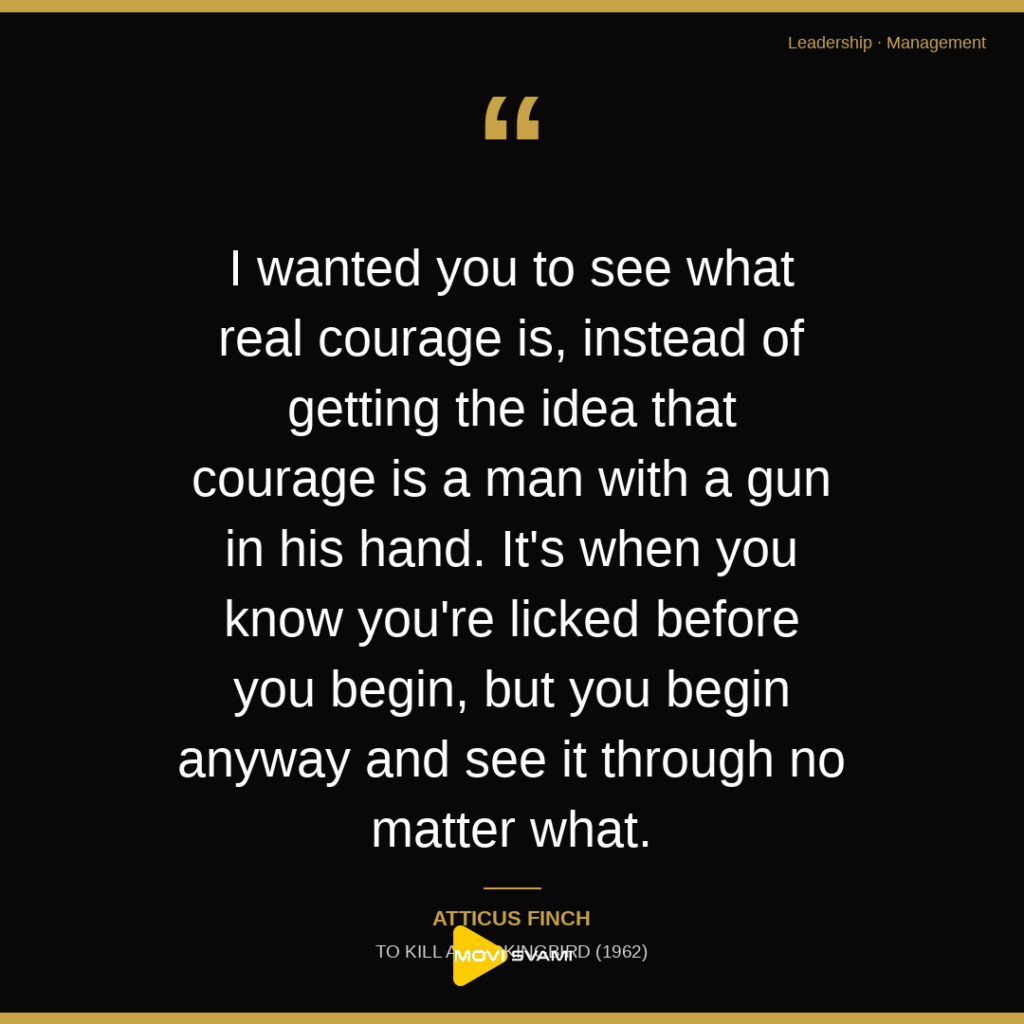
Atticus delivers his definition of courage to Scout after she has witnessed Mrs. Dubose, their cantankerous neighbor, wrestle with morphine addiction in her final days. “I wanted you to see what real courage is,” he tells her, “instead of getting the idea that courage is a man with a gun in his hand. It’s when you know you’re licked before you begin, but you begin anyway and see it through no matter what.” The line carries extra weight because we have watched Atticus live it. He stood between a lynch mob and his client. He sat outside the jail through the night. He accepted the case when others whispered he should refuse it, knowing it would expose his children to danger and his reputation to ruin. What was at stake was not merely Tom Robinson’s freedom but the moral coherence of a community and the example Atticus would set for his children. He understood that certain defeat in a worthy cause often accomplishes more than victory in an unworthy one.
This reveals something uncomfortable about management theory: we have constructed entire disciplines around winning. Strategy promises competitive advantage. Execution frameworks guarantee results. Even “fail fast” rhetoric ultimately serves the goal of eventual success. Yet Atticus’s courage points to a different competency entirely—the capacity to pursue right action when success is impossible by conventional measures. Ethical leadership frequently operates in this zone. The manager who discovers accounting irregularities committed by a high-performing superior. The executive who must communicate layoffs with dignity when shareholder interests demand speed. The team leader who defends a junior employee’s unpopular but correct recommendation. In each case, the “win” is not external validation. It is the preservation of integrity that others can observe, remember, and eventually emulate. This form of leadership produces no metrics, no quarterly bonuses, no conference keynotes. Its returns accrue slowly and invisibly, building the trust architecture that organizations require to function during their inevitable crises.
Consider three scenarios where this courage manifests in contemporary management. First, the dissenting voice in strategic consensus. A leadership team has aligned around an acquisition that will destroy value and harm employees, but momentum has built, egos have attached, and disagreement feels professionally dangerous. The Atticus-minded manager speaks anyway—preparing data, acknowledging uncertainty, accepting the isolation that follows. The acquisition proceeds. The damage unfolds exactly as predicted. But months later, when the next strategic question arises, colleagues remember who saw clearly. Trust, that scarce organizational resource, concentrates around those who demonstrated judgment without the insulation of guaranteed outcomes.
Second, the protection of process when shortcuts beckon. A product launch deadline approaches. Testing reveals safety concerns that could be minimized, documentation that could be delayed, warnings that could be softened. The business case for proceeding is overwhelming: market timing, competitive pressure, careers accumulated around this moment. The courageous leader insists on rigor, knowing the delay may cost personal advancement, knowing the product might fail regardless, knowing that “following process” often reads as obstructionism. Here courage means accepting that your professionalism may never be recognized, that you may be blamed for outcomes others caused, that your reward is simply the ability to live with your own decisions.
Third, the maintenance of dignity during organizational decline. Companies fail. Industries transform. Roles become obsolete. The leader who guides teams through this reality—with transparency about uncertainty, with investment in transition support, with refusal to extract personal advantage from collective hardship—practices a form of courage Atticus would recognize. There is no winning in managing layoffs well. There is only the refusal to compound harm with cowardice, the determination that how things end matters as much as how they began.
These applications share a common structure: the leader acts without expectation of personal benefit, sometimes with expectation of personal cost, because the alternative—silent complicity in wrong—represents a deeper failure than any professional setback. This is not martyrdom. Atticus does not seek suffering; he seeks consistency between his values and his conduct. The distinction matters. Organizational cultures that romanticize sacrifice produce burnout and cynicism. Cultures that recognize principled action despite uncertain outcomes produce something more valuable: colleagues who trust each other enough to take collective risks.
What circumstance in your current leadership role involves certain or probable defeat? Not the manageable challenge where effort might turn the tide, but the situation where the structural forces arrayed against you exceed any individual capacity to overcome them. How are you conducting yourself in that space? The answer defines more than your effectiveness. It defines whether you are building something that outlasts your tenure—whether, when your colleagues remember how you behaved when it mattered most, they will have reason to follow where you lead.