
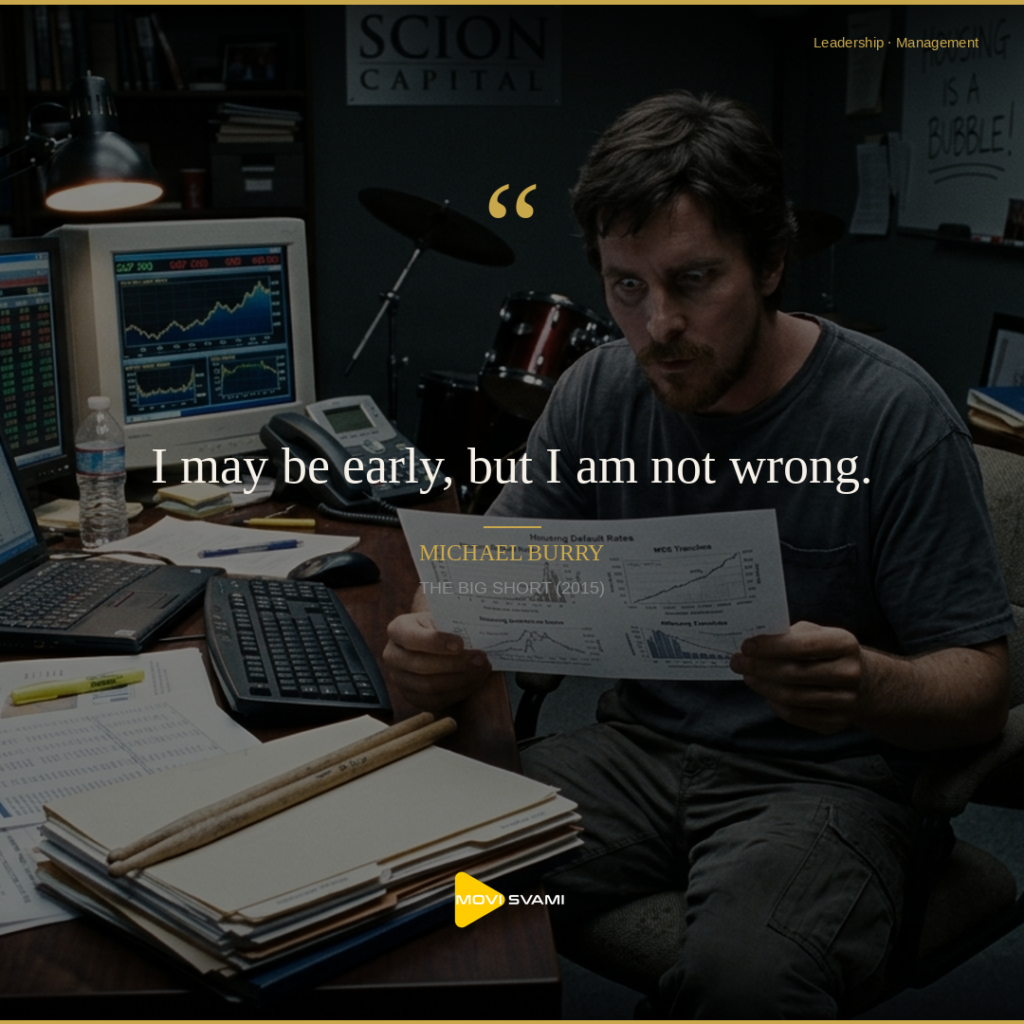
In the mid-2000s, while Wall Street celebrated the seemingly infinite liquidity of the housing boom, Dr. Michael Burry sat alone in his office at Scion Capital, surrounded by stacks of mortgage bond prospectuses that no one else had bothered to read. The music on the trading floors was loud, the leverage was higher, and the consensus was universal: real estate was invincible. But Burry, with his glass eye and his Asperger’s-driven focus on pattern recognition, was painstakingly tracing the default rates of individual subprime loans, building spreadsheets that told a different story. While institutional capital piled into mortgage-backed securities rated AAA, Burry was identifying the structural rot beneath the veneer of stability. He was not merely contrarian; he was isolated, swimming against a current so powerful that questioning it appeared irrational, if not career-ending.
The moment Burry utters his now-famous defense—*”I may be early, but I am not wrong”*—arrives at the apex of professional torment. He has bet billions against the housing market through credit default swaps, and the market has refused to cooperate. His investors, wealthy individuals who initially sought his idiosyncratic genius, are now screaming for redemption. The fund is down, margin calls are mounting, and the very instruments he purchased to short the market appear to be bleeding capital with no end in sight. The quote is not bravado; it is a diagnostic statement. Burry recognizes that markets can remain irrational longer than individuals can remain solvent, but his models indicate that the mathematics of mortgage resets will inevitably trigger systemic collapse. The pressure to unwind his position is immense—legal threats, personal vilification, and the potential destruction of his firm hang in the balance. Yet the data has not changed; only the timeline has shifted.
This scene reveals a fundamental principle of conviction-based leadership: the discipline to trust empirical analysis over social consensus. Visionary leaders do not derive confidence from the validation of their peers; they derive it from the robustness of their methodology. Burry’s leadership was not evidenced by his charm or his ability to build coalitions, but by his willingness to be professionally isolated while adhering to first-principles reasoning. In an era defined by information cascades and groupthink, his leadership demonstrates that asymmetric insight—seeing what others cannot because you are willing to examine primary data—requires not just intellectual rigor but emotional fortitude. The distinction between stubbornness and conviction lies in the falsifiability of the thesis; Burry had specific triggers (adjustable-rate mortgage resets) that would validate or invalidate his position, making his stand calculated rather than dogmatic.
**When to Trust Your Analysis**
For executives navigating strategic inflection points, the question is not whether to be contrarian, but when to trust independent analysis over institutional wisdom. Burry’s approach suggests that conviction is warranted when your information advantage is structural rather than speculative—when you have examined primary data that aggregators have dismissed or misunderstood. In business, this translates to building proprietary datasets, questioning industry-standard metrics that no longer correlate with reality, and maintaining the cognitive hygiene to update your timelines without abandoning your thesis. The key is distinguishing between being early and being wrong: early implies temporal displacement, while wrong implies logical error. If your unit economics, market dynamics, or competitive moats remain intact despite short-term price dislocation, maintaining position requires structural safeguards against forced liquidation, whether financial or political.
**How to Communicate Contrarian Positions**
Burry’s letters to his investors serve as a masterclass in transparently managing stakeholder expectations while defending non-consensus positions. The lesson for modern leaders is that contrarian strategy requires linguistic precision and vulnerability about uncertainty. Rather than projecting false confidence, Burry explained the specific conditions under which his thesis would play out, the duration he anticipated, and the maximum pain tolerance required. For executives, this translates to creating “pre-mortems” with boards and investors—establishing in advance the metrics that validate divergence from market trends. It involves separating the signal (fundamental business reality) from the noise (quarterly price movements), and educating stakeholders on the difference between volatility and risk. When you ask capital to endure discomfort, you must provide a narrative that explains *why* the discomfort is temporary and *what* evidence would force you to concede error.
**Managing the Cost of Being Early**
The most brutal lesson of *The Big Short* is that in markets and organizations, being early is analytically indistinguishable from being wrong until the moment of vindication. Burry survived because he structured his positions to withstand the “bleed”—the carrying cost of being premature. Similarly, leaders pursuing transformational change must engineer organizational liquidity, whether financial, political, or temporal. This means securing committed capital that cannot be withdrawn at the first sign of turbulence, isolating experimental units from core P&L pressures during transition periods, and building psychological resilience against the “innovator’s penalty”—the social and professional costs incurred before validation arrives. The ability to sustain a position through the gap between recognition and reality defines whether a leader captures asymmetric returns or becomes a cautionary tale.
As you review your current strategic roadmap, consider: What fundamental truths about your industry, customer base, or competitive landscape do you see clearly that the market currently dismisses? And more importantly, have you structured your organization—and your relationships with stakeholders—to survive the uncomfortable interval between when you prove right and when the world acknowledges it? The margin between visionary leadership and professional ruin is often measured not in analytical accuracy, but in the stamina to remain intellectually faithful while standing alone.