
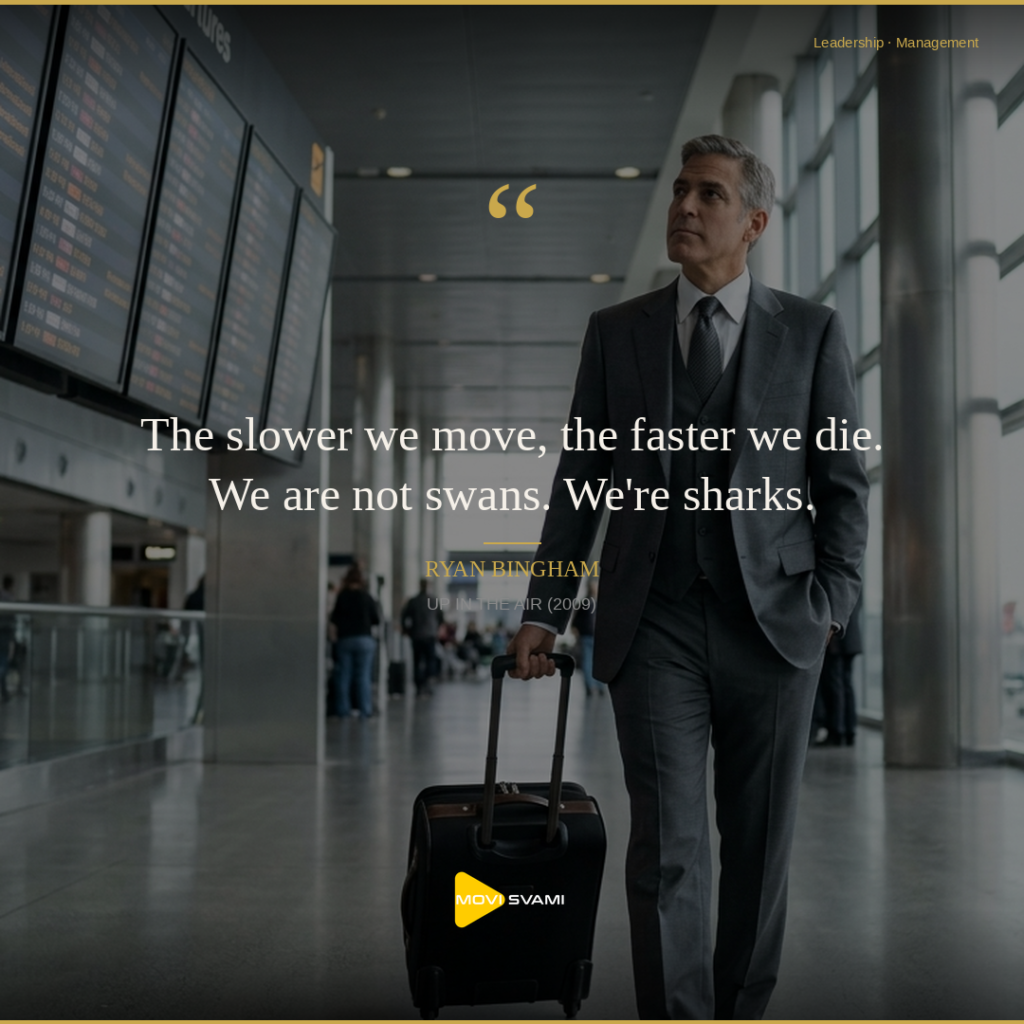
The hotel ballroom smells of institutional coffee and reheated anxiety. Ryan Bingham stands at the podium in a Detroit Marriott, adjusting his Tom Ford cufflinks while a projector displays his cumulative air miles—statistics that qualify as biography. The audience, mostly middle managers facing their own obsolescence, shifts in ergonomic banquet chairs. He delivers the line with practiced charm—a motivational crescendo meant to justify a life spent in transit: “The slower we move, the faster we die. We are not swans. We’re sharks.” The applause is polite, but the metaphor hangs in the recycled air, predatory and desperate. We sense, even before the narrative confirms it, that Bingham is not selling wisdom; he is defending a prison of his own construction.
Bingham, played with laconic precision by George Clooney, occupies a peculiar niche in the corporate ecosystem: he fires people for a living. As a “career transition counselor”—a euphemism as sterile as the hotel rooms he inhabits—he travels 322 days a year severing employment ties so that company executives need not stain their own hands. The shark philosophy emerges during a motivational speaking circuit where he packages his trauma as empowerment. Swans, he implies, are sedentary, attached, vulnerable; sharks are pure velocity, biological necessity made metaphor. What is at stake in this speech is not merely his audience’s inspiration but his own survival strategy. If he stops moving—if he accepts an apartment lease, a committed relationship, or the vulnerability of emotional rootedness—he will suffocate. The tragedy, of course, is that he is already suffocating; he has merely mistaken breathlessness for vitality.
This tension articulates a dominant pathology in contemporary leadership: the conflation of motion with strategy. In an era defined by strategic inflection points and algorithmic pace, Bingham’s shark logic has become management doctrine. Velocity is the ultimate virtue; stillness is interpreted as organizational death. Yet *Up in the Air* interrogates this calculus, revealing its fatal flaw. Bingham’s tragedy is not that he travels too much, but that he moves without mass. He accumulates ten million frequent flyer miles but lacks a single relationship capable of surviving his absence. For the modern executive, the paradox is identical: sustainable agility requires ballast. Organizations are not predators hunting prey; they are ecosystems requiring coral—institutional memory, trust density, and relational infrastructure that accrues only during moments of deliberate pause. A leader who swims constantly may oxygenate the moment, but they leave no reef for their organization to inhabit.
Consider the executive leading a post-merger integration. The default impulse is Bingham’s shark: accelerate layoffs, consolidate reporting lines, and maintain a blistering cadence of town halls that announce change without absorbing grief. The logic of constant motion suggests that hesitation breeds resistance, that empathy is a form of drag. Yet the mergers that succeed—those that actually achieve cultural synergies rather than mere cost savings—invariably violate this doctrine. They establish “legacy tissues,” periods of intentional organizational stillness where acquired talent is not immediately reassigned but listened to. Effective leaders here recognize that executional velocity must be inversely matched by dialogic depth; the speed of the decision requires a counterbalancing slowness in the conversation.
Or examine the geography of modern remote leadership, where the Ryan Bingham lifestyle has been democratized across Zoom backgrounds and airport lounges. The contemporary executive often treats their calendar like Bingham’s flight itinerary: a densely packed proof of relevance. Back-to-back video calls, asynchronous Slack threads at midnight, and quarterly business reviews conducted from hotel lobbies create a simulacrum of productivity that masks a deficit of presence. The application here is architectural rather than temporal. Wise leaders construct “executive lounges”— structured immobility within the velocity—weekly blocks where cameras are off and the agenda is non-transactional. These are not inefficiencies to be optimized away but necessary ballast, preventing the team from becoming as interchangeable as Bingham’s hotel keycards.
Finally, observe the succession crisis looming in firms where the founder or CEO has spent a decade embodying Bingham’s self-sufficiency, carrying institutional knowledge in a mental backpack, moving too fast to document, delegate, or develop. When Ryan faces the threat of obsolescence via Natalie Keener’s video-conferencing technology, he has no protean network to defend him, only miles. Leaders who confuse indispensability with importance create fragile organizations. The countermeasure is a disciplined “swan season”—quarterly intervals where strategic motion is deliberately arrested to facilitate mentorship, knowledge transfer, and the cultivation of replaceability. It is the acknowledgment that leadership legacy is measured not by the distance traveled but by the depth of the wake left behind.
Before you close this tab and return to your inbox’s gravitational pull, audit the physics of your own leadership. Is your movement carrying the organization forward, or is it merely preventing your own psychic suffocation? Ask yourself: *This week, where did I choose depth over distance—and what died in the silence I refused to hold?*