
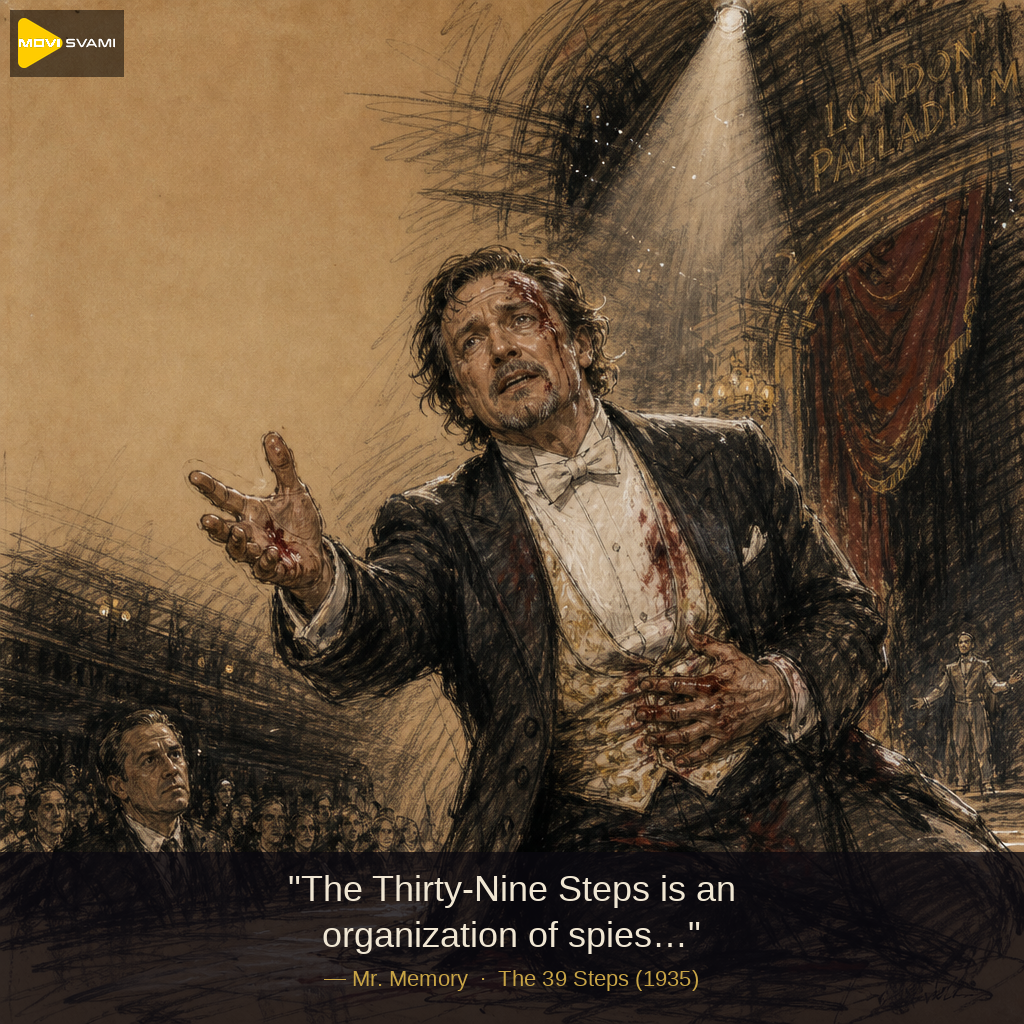
In the climactic sequence of Alfred Hitchcock’s ‘The 39 Steps’ (1935), the audience gathers in a London music hall to watch Mr. Memory, a performer whose defining gift is total recall. He absorbs facts, figures, and secrets with mechanical precision, then dispenses them on demand as popular entertainment. But in his final moments, under gunfire and dying on the same stage where he entertained thousands, he reveals the truth that eluded detectives, spies, and the entire British security apparatus: ‘The Thirty-Nine Steps is an organization of spies…’ The secret, which could have altered the course of the nation’s security, existed in exactly one location—the mind of a music-hall act. It was never written down. Never shared. Never institutionalized. And it nearly died with him in front of a crowd that thought they were watching vaudeville.
This is arguably the most concise and brutal case study in knowledge management ever filmed.
Organizations cultivate ‘indispensable’ people with remarkable consistency across industries and eras. They are the senior engineers who alone understand the legacy codebase that processes forty percent of revenue. They are the sales directors who alone hold the relational history with the three largest accounts. They are the operations leads who alone know which regulatory filing requires which handwritten workaround, and in what precise sequence. Leadership treats them with a mixture of reverence and anxiety—reverence for their capability, anxiety about their leverage, and quiet dread about their vacation schedule. But the anxiety is usually misdirected. The danger is not that the indispensable person will demand an exorbitant raise or a bigger title. The danger is that the organization has mistaken a catastrophic single point of failure for a durable competitive advantage.
Mr. Memory is not a villain. He is, in many ways, the ideal employee: loyal, discrete, capable of holding extraordinary complexity without complaint or visibility. His employer—the spy ring that planted him—treated his memory as a perfect vault, secure precisely because it was invisible and inscrutable. This logic is seductive and perennial. Documentation takes time. Knowledge transfer creates redundancy, which can feel like inefficiency or even disloyalty. Why duplicate what one brilliant mind can contain without friction? The answer arrives on a theater stage, accompanied by gunshots and public chaos. When knowledge is not institutionalized, the organization does not own its own intelligence. It rents it, day by day, from an individual whose health, loyalty, availability, and survival are not contractual guarantees.
The modern corporate equivalent of Mr. Memory’s dying confession is the exit interview that desperately mines years of undocumented expertise in forty-five minutes of hurried conversation. It is the emergency phone call to the retired employee who alone knows how the factory line was originally calibrated. It is the technology startup that discovers, only after its chief architect resigns, that its entire infrastructure exists as mental models never rendered into shared documentation or cross-trained understanding. These are not accidents or surprises. They are the predictable, almost inevitable outcomes of leadership failing to treat institutional memory as infrastructure rather than ornament.
Institutionalizing knowledge is not merely about creating wiki pages or process manuals, though these are necessary foundations. It is about designing systems where critical understanding flows through structures rather than personalities, where the organization’s capability is separable from any single individual’s presence. When a secret as vital as the nature of an international spy ring lives only in a performer’s act, the problem is not the performer’s brilliance. The problem is the architecture of secrecy itself, which mistook obscurity for security. Leaders must repeatedly ask the question that organizations hate because it feels disloyal: if this person were hit by a bus tomorrow—if they were poached by a competitor, if they were incapacitated, if they simply chose to stop answering emails—would the organization still know what it needs to know to function? If the answer provokes discomfort, the organization has not hired an expert. It has taken a hostage, and the ransom is operational risk.
There is a political dimension to this failure that leaders often ignore. Knowledge hoarding is frequently reinforced by power dynamics that benefit both the keeper and the keeper’s immediate manager. The person who alone knows the secret becomes immune to challenge, audit, or replacement. They control access, translation, and application, creating a dependency that translates into influence. The organization, in turn, becomes dependent not only on their memory but on their interpretation of what that memory means. In ‘The 39 Steps,’ the spy ring presumably allowed this concentration because it felt secure and insulated from penetration. In reality, it created catastrophic fragility. The leader who tolerates similar concentration because ‘we can’t afford to slow them down with documentation’ or ‘they prefer to work alone’ is making the same bargain, with the same vulnerability, dressed in business casual.
The remedy requires conscious, visible executive intervention. It requires treating knowledge extraction and transfer as seriously as product development or sales execution. It requires rewarding not only those who know, but those who make what they know transferable, teachable, and resilient. It requires accepting the short-term friction of documentation, mentoring, cross-training, and paired execution as the non-negotiable price of long-term operational resilience. Mr. Memory’s final words should have been unnecessary. A healthy organization would have already known the secret and acted upon it. The fact that an audience of hundreds hears the truth only as its keeper collapses is not a testament to the keeper’s irreplaceable value. It is an indictment of the leaders who never asked where the knowledge lived until it was too late.