
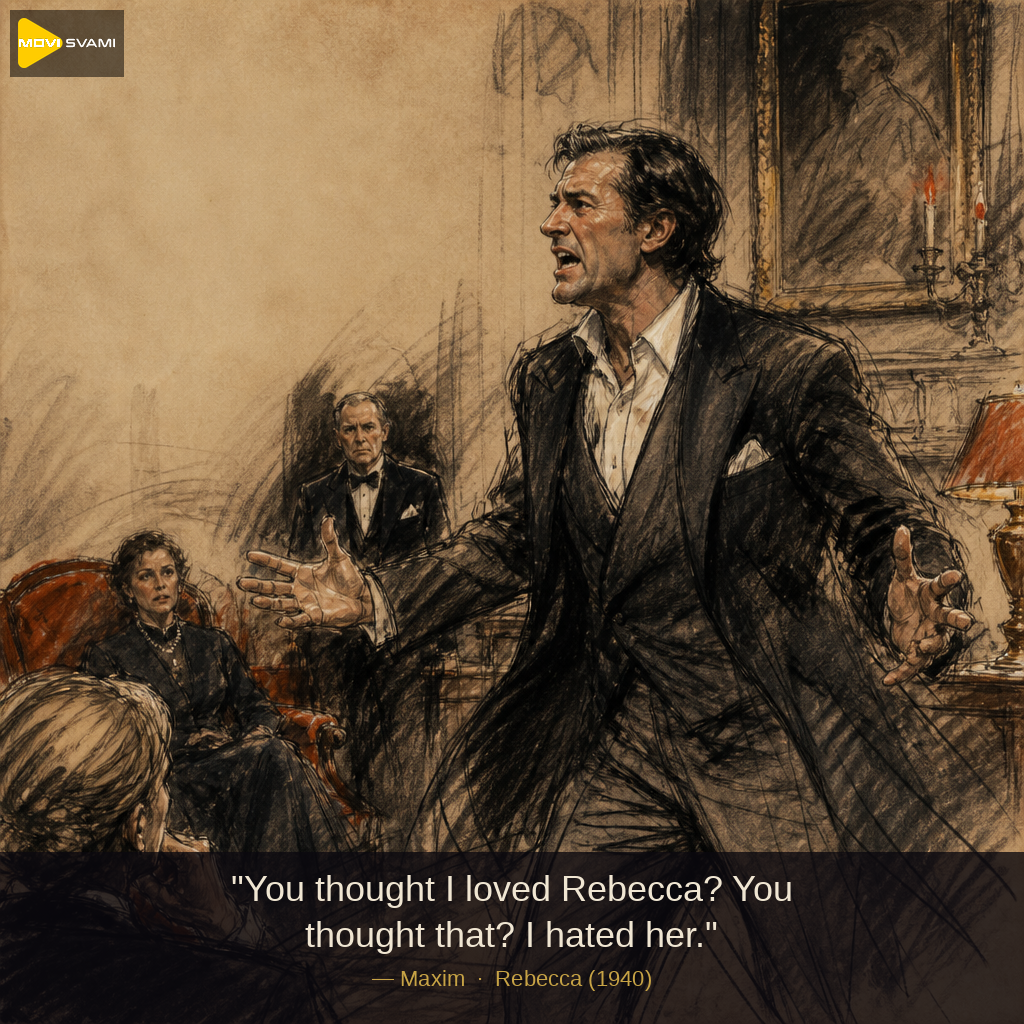
In the great hall of Manderley, the second Mrs. de Winter lives in the suffocating shadow of a woman she has never met. Rebecca—the first wife, the perfect hostess, the luminous beauty whose taste defined every room, whose standards haunt every servant, whose legend is whispered like scripture—commands the estate more powerfully in death than she ever could have in life. The household operates according to her preferences. The social world measures every new action against her precedent. Even Maxim de Winter seems paralyzed by the memory of perfection, unable to redecorate, unable to explain, unable to offer his new wife anything but the echo of a predecessor who cannot be challenged. Then comes the confession that dismantles the cathedral: ‘You thought I loved Rebecca? You thought that? I hated her.’ With these words, Maxim reveals that the institutional memory of Manderley is a fiction, a consensus hallucination maintained by reverence and fear rather than by evidence or experience.
Every organization has its Rebecca.
The mythology may center on a founder whose early decisions were more a function of timing and luck than of genius, but are now treated as immutable principles carved into stone. It may fixate on a golden era of growth that occurred under market conditions that no longer exist, yet remains the benchmark against which current results are judged and found wanting. It may venerate a management philosophy—a commitment to ‘founder’s hustle,’ to ‘relationship-based selling,’ to ‘engineering-first culture’—that has calcified into dogma and now prevents adaptation. What these mythologies share is the quality Maxim’s household exhibits: they are harder to question than the evidence arrayed against them. The story becomes self-protecting. To challenge it is to reveal oneself as ignorant, disloyal, or insufficiently devoted to the heritage of the place.
This dynamic is lethal to strategic adaptation. In ‘Rebecca,’ the new Mrs. de Winter nearly destroys herself trying to live up to a standard that was, unbeknownst to her, despised by its own architect. Employees in mythology-bound organizations do the same. They pursue strategies they privately believe are obsolete because the strategy is associated with the revered past and its guardians. They ignore market signals that contradict the founder’s original vision because that vision has been encoded as identity rather than hypothesis. They treat historical success as predictive formula rather than contingent outcome. The myth functions as an organizational immune system, rejecting any data, any outsider, any alternative that would require its revision. The result is a company that honors its past by strangling its future.
Maxim’s confession is shocking not merely for its content but for its heresy. It breaks a sacred taboo. The household—and by extension the audience—has invested so heavily in the perfection of Rebecca that the truth feels almost obscene, a violation of communal trust. Leaders must recognize that organizations generate this same taboo around their own sacred histories. The founder did not merely build the company; the founder *is* the company, or so the narrative insists. The early playbook did not merely work; it is *who we are.* These formulations are not historical observations. They are theological commitments. And like all theology, they resist empirical refutation because they were never designed to be tested. They were designed to be believed.
The leadership task, then, is to create structural permission for heresy without collapsing into cynicism. This does not mean disparaging the past or mocking the sacrifices that built the enterprise. It means distinguishing precisely between honoring a legacy and being imprisoned by it. Effective leaders install mechanisms—rigorous strategy reviews, red-team exercises, new-employee listening tours, outsider board membership, post-mortems that question core assumptions—that treat the official narrative as one input among many rather than as the immutable framework within which all inputs must fit. They ask explicitly: if we were starting today, with no history and no legacy obligations, would we still organize ourselves this way? If the answer is no, then the mythology is operating as constraint, not compass, and the organization is competing with a map of territory that no longer exists.
There is also a personal and psychological dimension that leaders ignore at their peril. Maxim maintained the myth of Rebecca partly because exposing the truth would expose his own complicity in a darker story. Organizations often cling to mythology because the alternative implicates current leadership in sustained error. If the founder’s strategy was flawed, then the executives who perpetuated it for a decade were not careful stewards but sleepwalkers. If the golden era was an anomaly produced by cheap capital or a temporary monopoly, then current stagnation is not a betrayal of the past but a return to normal. Mythologies persist because they absolve. They allow leaders to blame current conditions on a failure to honor what came before, rather than on the inadequacy of what came before for present realities. The myth becomes alibi.
‘Rebecca’ ends with Manderley in flames, the physical manifestation of a past too toxic to inhabit and too powerful to escape. Organizations that cannot question their own mythology meet similar fates—not in fire, but in obsolescence, as markets move past what culture forbids them from seeing. The leader’s obligation is to let evidence eclipse story, to treat the past as prologue rather than as policy. The moment the official narrative becomes harder to challenge than the data contradicting it, the organization has ceased to be a business and has become a haunted house. And haunted houses, however beautifully preserved, are not built for the living.