
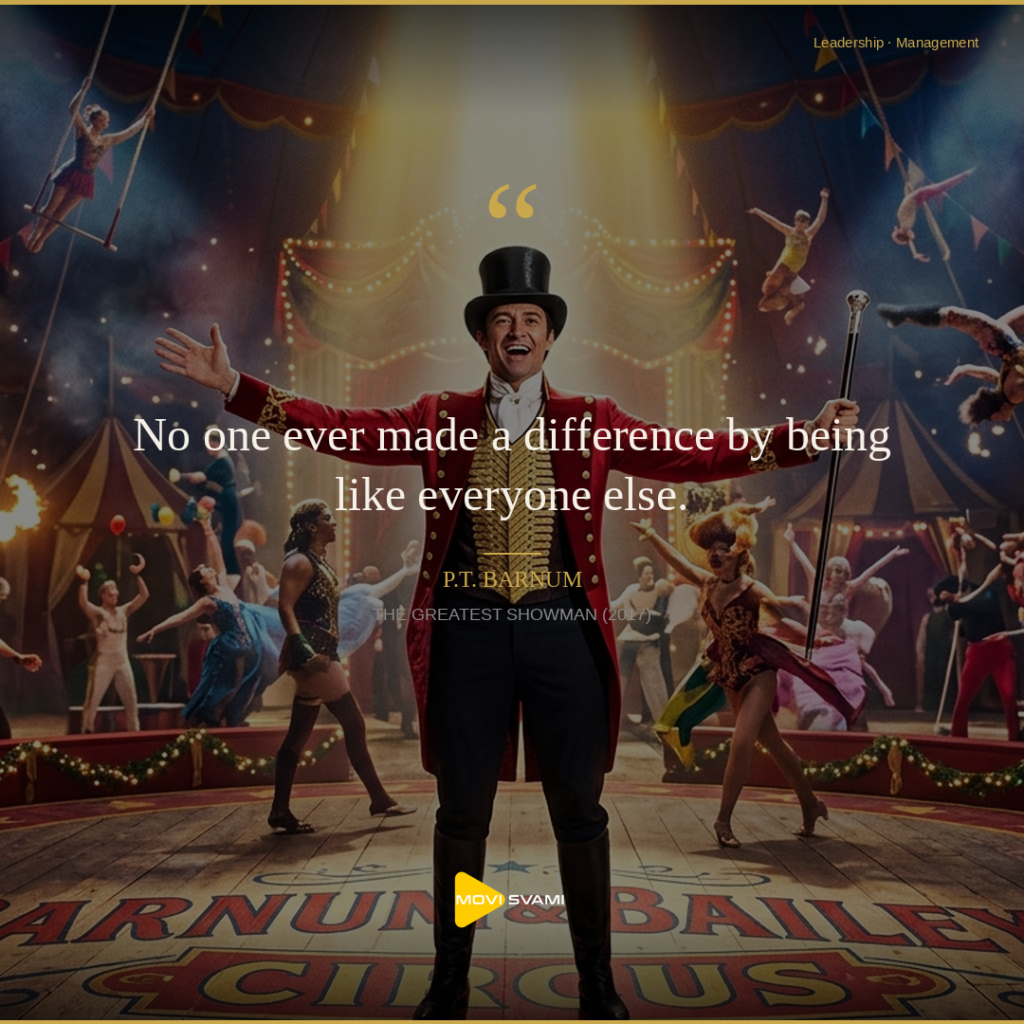
The ledger was empty, the collateral was nonexistent, and the banker’s expression suggested he was entertaining a madman. Yet P.T. Barnum stood in that dusty, cavernous building on Broadway, arms outstretched, describing gaslight, velvet, and thunderous applause to an audience of one who saw only rotting floorboards and financial ruin. He was not requesting funds for a proven enterprise; he was asking a creditor to purchase shares in a hallucination. This is the precise moment where management ends and leadership begins—not in the optimization of existing assets, but in the audacious act of selling a reality that has not yet materialized.
“No one ever made a difference by being like everyone else.” Barnum delivers this line not as a platitude, but as a battle cry to Lettie Lutz, the bearded lady, and his cadre of “oddities” who have spent lifetimes hiding in shadows. The stakes could not be higher. For his performers, acceptance means risking public humiliation and confirming society’s verdict that they are mere curiosities. For Barnum, it means wagering his family’s security and his own solvency on a counterintuitive thesis: that what the market rejects—difference, anomaly, the grotesque—contains asymmetric value if repositioned as art rather than aberration. The quote crystallizes the film’s central transaction: Barnum does not ask his troupe to conform to the world; he convinces the world to expand its definition of beauty to include them. He sells the dream before the tent is raised, securing organizational legitimacy through narrative capital rather than historical proof.
This dynamic reveals a fundamental distinction between stewardship and visionary leadership. Managers excel within established paradigms, optimizing workflows against known benchmarks. Leaders, conversely, operate in the realm of market creation, where traditional metrics are useless because the category does not yet exist. Barnum’s genius lies not in logistics—his early museum fails precisely because he attempts to curate within conventional bounds—but in his ability to manufacture consent for the unprecedented. He understands that before capital flows or talent commits, there must be a shared hallucination of success robust enough to withstand current evidence of impossibility. This is the heavy burden of the contrarian: the leader must possess the cognitive fortitude to hold a vision of the future while navigating the institutional inertia of the present, often without external validation for months or years.
The practical implications of this philosophy manifest in three distinct domains of executive decision-making.
**First, in resource allocation.** Consider the senior leader pitching a disruptive initiative to a board conditioned to incremental returns. Like Barnum approaching the bank with only deeds to a derelict property and a fevered description of “the greatest show on earth,” the modern innovator must secure funding for initiatives where ROI calculations are speculative. The temptation is to wait for perfect data, to demand market validation before commitment. But category creators—those who establish new industries rather than competing in existing ones—must sell the dream while the warehouse is still empty. This requires translating intuition into narrative, convincing stakeholders to underwrite possibility rather than probability. The skill is not financial modeling but rhetorical architecture: building a structure of logic and emotion sturdy enough to support investment in the unproven.
**Second, in talent strategy.** Barnum does not “fix” his performers; he monetizes their distinction. In corporate contexts, this challenges the prevailing orthodoxy of “culture fit,” which often functions as a euphemism for homogeneity. The equivalent modern scenario involves the hiring manager evaluating candidates with non-linear careers, neurodivergent cognitive styles, or expertise from adjacent industries that seem irrelevant to current operations. The visionary leader recognizes that asymmetric returns often reside in the very attributes that screening algorithms reject. Like Barnum seeing theatrical royalty in a woman society labeled a freak, the astute executive identifies in the unconventional candidate a perspective capable of breaking zero-sum competitive dynamics. This is not diversity for optics, but strategic arbitrage: acquiring undervalued human capital by seeing talent through a different valuation model than the market standard.
**Third, in strategic inflection points.** There arrives a moment in every organization’s lifecycle when the “museum” is failing—when core products face commoditization and incremental innovation yields diminishing returns. Barnum’s pivot from a static museum of wax figures to a kinetic circus of living wonders mirrors the corporate existential crisis: the data suggests contraction, but intuition suggests metamorphosis. Leading through this transition requires selling a future identity to employees, investors, and customers who are anchored to the company’s historical self-conception. The leader must maintain operational continuity while simultaneously dismantling the very foundations upon which that continuity rests, convincing all stakeholders that the terrifying ambiguity of transformation is preferable to the certain death of stasis.
The greatest show was never the acrobatics or the songs; it was the shared delusion Barnum constructed until reality caught up to his imagination. As you review your current strategic portfolio, ask yourself: What “oddities” are you currently filtering out—whether unconventional talent, counterintuitive market opportunities, or disruptive internal initiatives—because they fail to fit yesterday’s success criteria? What dream are you failing to sell with sufficient conviction simply because the tent has not yet been raised?