
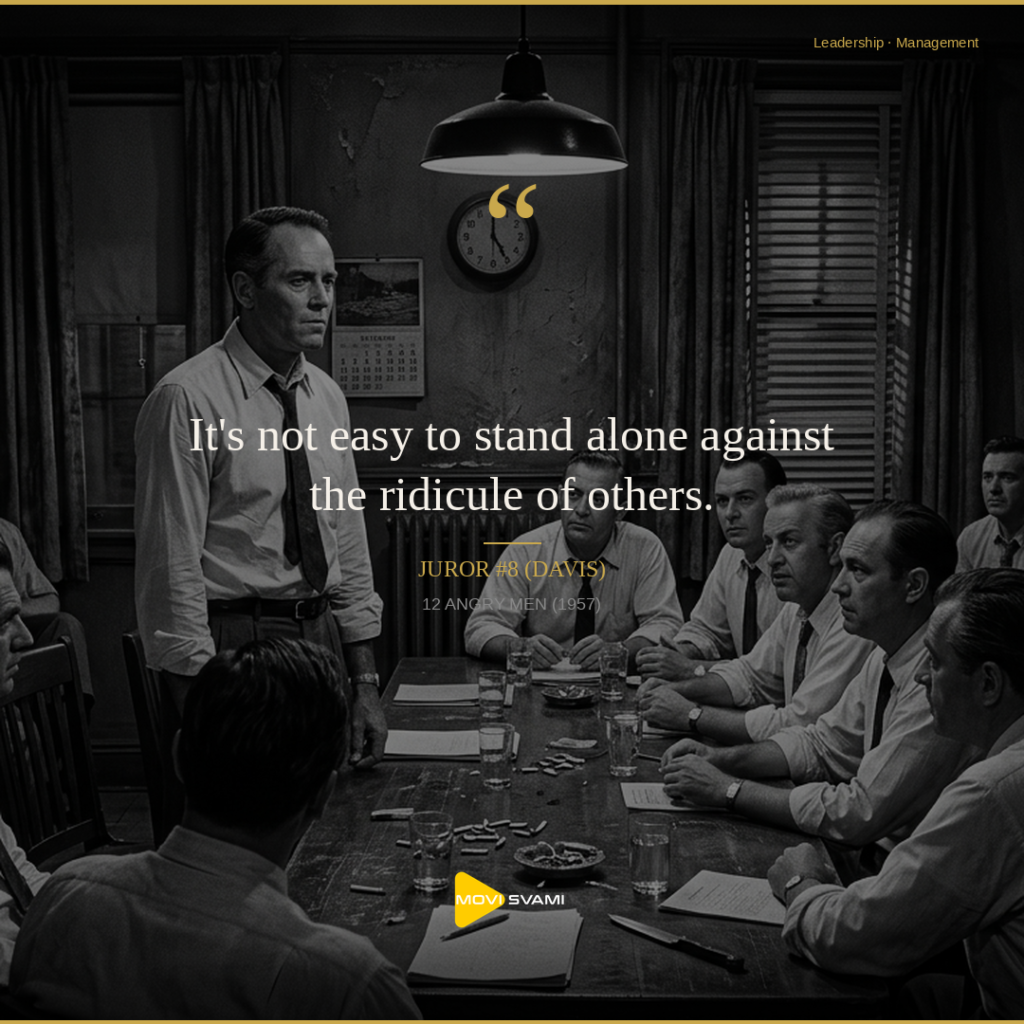
The air in the jury room is thick—not just with the summer heat that has trapped twelve men in a confined space, but with the weight of certainty. Eleven jurors are ready to leave. The evidence seems clear. The defendant’s alibi has collapsed, the eyewitness testimony appears solid, and the murder weapon—a unique switchblade—was found in the boy’s pocket. The foreman calls for a vote, expecting unanimous consent for a guilty verdict that will send a teenager to the electric chair. Then, Juror #8 (Davis) raises his hand. Not because he knows the boy is innocent, but because he refuses to let the machinery of justice—or the comfort of consensus—override his doubt. The room’s hostility is immediate. The other jurors sigh, roll their eyes, and begin to pressure him to conform. They want to go home. He wants to be certain.
It is in this crucible of scorn that Davis delivers the line that defines the film’s moral architecture: “It’s not easy to stand alone against the ridicule of others.” He says this not as a complaint, but as a quiet acknowledgment of the psychological tax of dissent. He is not a grandstanding contrarian; he is an architect questioning the structural integrity of a building that everyone else has already moved into. What is at stake is not merely the fate of one defendant, but the integrity of the deliberative process itself. Davis understands that organizations—whether juries or corporations—are vulnerable to what social psychologist Irving Janis later termed “groupthink”: the tendency for cohesive groups to prioritize unanimity and morale over critical evaluation of alternatives. By refusing to capitulate to the social pressure of his peers, Davis forces the group to examine assumptions they had collectively agreed to ignore: the reliability of eyewitness testimony under stress, the physical limitations of an elderly witness, and the probability that a switchknife could be common rather than unique. His dissent is not a destination; it is a methodology.
What Davis demonstrates is that leadership is not the art of aggregating agreement, but the discipline of safeguarding doubt. In executive suites, we often conflate decisiveness with unanimity, treating consensus as a proxy for correctness. Yet the history of corporate failure is littered with boardrooms where everyone agreed—until catastrophe proved them wrong. True leadership, as Davis illustrates, requires epistemic humility: the willingness to admit that the group may be collectively wrong, and the courage to bear the social costs of saying so. This is distinct from devil’s advocacy, which is often performative and temporary. Davis’s dissent is substantive and persistent. He brings evidence (the identical switchblade he purchased at a pawn shop), he asks questions that reveal cognitive bias, and he models the patience to let complexity emerge from initial certainty. He leads not by commanding, but by insisting on the rigor of the process when the temptation is to rush to judgment.
Consider three scenarios where this principle applies in modern management. First, in mergers and acquisitions due diligence, when deal fever has infected the C-suite and the investment bank is pushing to close. The momentum is intoxicating: synergies are projected, stock prices are anticipated, and the social pressure to complete the deal becomes overwhelming. Here, the Davis figure is the executive who interrupts the celebratory consensus to ask whether the cultural integration has been stress-tested, or whether the due diligence has adequately accounted for contingent liabilities that the target company has artfully obscured. This is not obstructionism; it is fiduciary courage. The leader who delays the vote to ensure the evidence holds up under scrutiny may save the organization from a value-destroying acquisition that looked inevitable to everyone else in the room.
Second, consider product strategy during a pivot. A team has spent eighteen months developing a feature set based on initial market research. The sunk costs are enormous, and team identity has become wrapped around the current roadmap. Then, new data suggests a fundamental shift in user behavior that renders the product obsolete before it even launches. In this moment, groupthink manifests as collective rationalization: “We can’t change course now,” “The market will come back to us,” “We’ve already promised this to the board.” The Davis leader is the product manager or CEO who halts the sprint to ask whether they are building the right solution for a market that no longer exists. They create space for the dissenting data point, even when it threatens the project’s timeline and the team’s morale. They understand that shipping on time means nothing if you are shipping the wrong product.
Third, in ethical compliance and risk management, where the stakes replicate the life-and-death gravity of the jury room. When operational pressure mounts—deadlines looming, quarterly earnings at risk, competitors gaining ground—there is immense pressure to normalize deviance. Safety protocols become “guidelines,” quality assurance becomes “bureaucratic overhead,” and red flags are reinterpreted as “noise in the system.” Here, the Davis figure is the quality engineer, the compliance officer, or the line manager who refuses to sign off on the shipment despite the entire leadership team’s implicit consensus that “good enough” is sufficient. They stand against ridicule not because they enjoy conflict, but because they understand that organizational integrity, once compromised, cannot be recovered in the closing minutes of deliberation.
As you lead your next strategic review or sit in your next board meeting, consider this: When was the last time you were the lone voice in a unanimous room, and what did it cost you to speak? More importantly, have you created an organizational culture where Davis would feel safe enough to raise his hand, or have you built a jury room where dissent is treated as disloyalty? The most dangerous decisions are not those made in anger, but those made in unexamined agreement.